




Products obtained when cold $HI$ reacts with isopropyl methyl ether at $273K$ are:
(A) Isopropyl iodine and methyl alcohol
(B) Isopropyl alcohol and methyl iodine
(C) Isopropyl iodine and water
(D) Methyl iodine and water
Answer
 Verified
585.9k+ views
Hint: $HI$ reacts with isopropyl methyl ether by undergoing substitution reaction. Substitution reaction is a reaction in which one functional group of the compound gets substituted with another group. Substitution reaction is of two types i.e. nucleophilic substitution reaction and electrophilic substitution reaction.
Complete step by step answer:
When isopropyl methyl ether reacts with cold $HI$ , it undergoes $S{N_2}$ reaction. In $S{N_2}$ reaction, the elimination of the leaving group and attack of the nucleophile occurs simultaneously.
In the reaction, isopropyl methyl ether (mixed ether) or reacting with cold $HI$ yields methyl iodine (lower alkyl halide) and isopropyl alcohol (higher alcohol), as show in the reaction below:
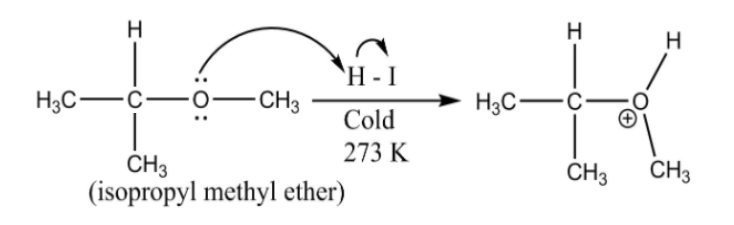
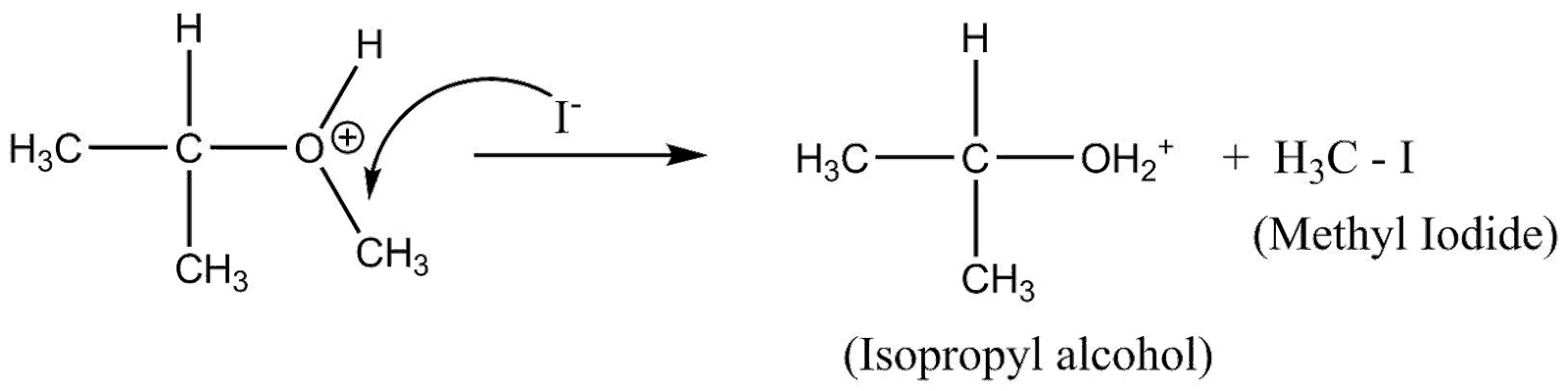
The ${(C{H_3})_2} - CH - O - $ is formed and $H$ from $H - I$ attaches to it. Whereas, the $I$ from $H - I$ attaches to $ - C{H_3}$ (leaving group)
Additional Information:
When isopropyl methyl ether is reacted with hot $HI$ instead of cold $HI$ , following reaction takes place at $373K$
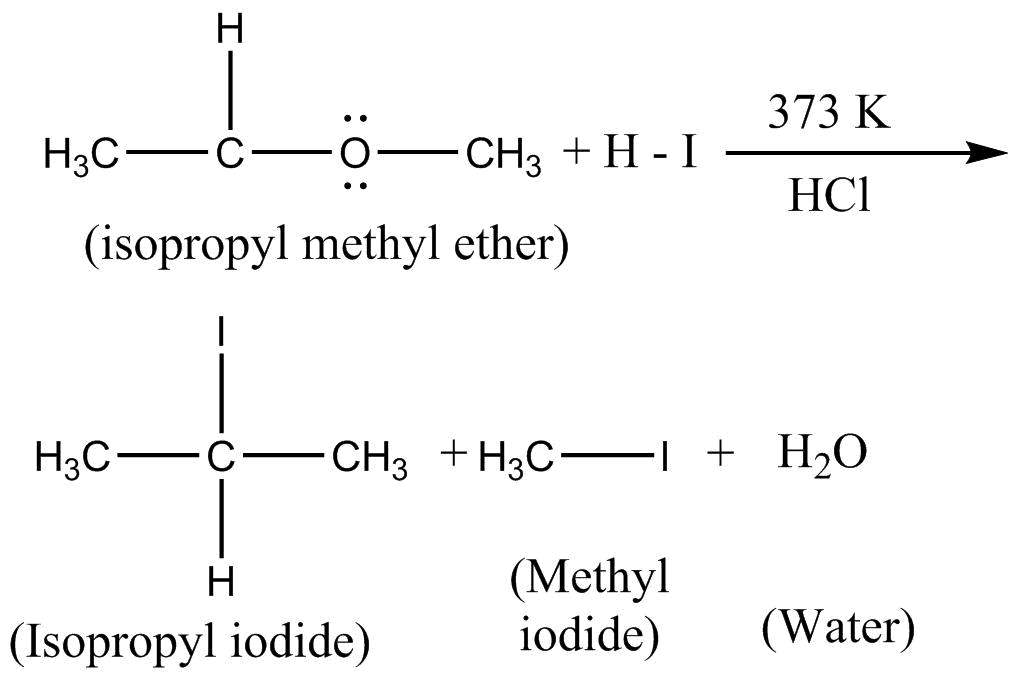
Hence, isopropyl iodine, methyl iodine and water are obtained upon the reaction of isopropyl methyl ether with hot conc $HI$ .
So, the correct answer is Option B.
Note: $S{N_2}$ reaction is a common reaction in organic chemistry. In this reaction one bond is broken and another bond is formed simultaneously. In this reaction, the nucleophile attacks from the back side of the substrate, to break the carbon-leaving group bond. It then forms a new carbon-nucleophile bond. For observing the maximum rate of $S{N_2}$ reaction, the substrate must be least hindered. Therefore, the primary and methyl substrate show maximum rate of $S{N_2}$ reaction, the secondary substrates have a lower rate of reaction and the tertiary substrate do not participate at all in the $S{N_2}$ reaction because of large amount of steric hindrance in them.
Complete step by step answer:
When isopropyl methyl ether reacts with cold $HI$ , it undergoes $S{N_2}$ reaction. In $S{N_2}$ reaction, the elimination of the leaving group and attack of the nucleophile occurs simultaneously.
In the reaction, isopropyl methyl ether (mixed ether) or reacting with cold $HI$ yields methyl iodine (lower alkyl halide) and isopropyl alcohol (higher alcohol), as show in the reaction below:
The ${(C{H_3})_2} - CH - O - $ is formed and $H$ from $H - I$ attaches to it. Whereas, the $I$ from $H - I$ attaches to $ - C{H_3}$ (leaving group)
Additional Information:
When isopropyl methyl ether is reacted with hot $HI$ instead of cold $HI$ , following reaction takes place at $373K$
Hence, isopropyl iodine, methyl iodine and water are obtained upon the reaction of isopropyl methyl ether with hot conc $HI$ .
So, the correct answer is Option B.
Note: $S{N_2}$ reaction is a common reaction in organic chemistry. In this reaction one bond is broken and another bond is formed simultaneously. In this reaction, the nucleophile attacks from the back side of the substrate, to break the carbon-leaving group bond. It then forms a new carbon-nucleophile bond. For observing the maximum rate of $S{N_2}$ reaction, the substrate must be least hindered. Therefore, the primary and methyl substrate show maximum rate of $S{N_2}$ reaction, the secondary substrates have a lower rate of reaction and the tertiary substrate do not participate at all in the $S{N_2}$ reaction because of large amount of steric hindrance in them.
Recently Updated Pages
Master Class 12 Business Studies: Engaging Questions & Answers for Success

Master Class 12 Chemistry: Engaging Questions & Answers for Success
Master Class 12 Biology: Engaging Questions & Answers for Success
Class 12 Question and Answer - Your Ultimate Solutions Guide
Master Class 11 English: Engaging Questions & Answers for Success
Master Class 11 Social Science: Engaging Questions & Answers for Success
Trending doubts
Which are the Top 10 Largest Countries of the World?
Draw a labelled sketch of the human eye class 12 physics CBSE
Differentiate between homogeneous and heterogeneous class 12 chemistry CBSE
Differentiate between Pyramid of energy and pyramid class 12 biology CBSE
Why is the cell called the structural and functional class 12 biology CBSE
Draw the diagram of the pyramid of energy Explain In class 12 biology CBSE