




What is the product of the reaction of \[1,3 - butadiene\] with \[B{r_2}\] ?
A. \[1,4 - dibromobut - 2 - ene\]
B. \[1,2 - dibromobutene\]
C. \[3,4 - dibromobutene\]
D. \[2,3 - dibromo - 2 - butene\]
Answer
 Verified
560.7k+ views
Hint: Bromine shows a simple addition reaction with unsaturated organic compounds like alkenes and alkynes (due to their electron rich nature) where a double or triple gets broken and new carbon-bromine bonds are formed. But dienes are selective in nature and the bromine atoms attack at specific positions only.
Complete answer:
\[1,3 - butadiene\] is a conjugated diene i.e. its double bonds are alternatively placed and can therefore show resonance that adds to the stability of the compound but at the same time affects its reactivity.
Bromine is a monatomic molecule yet shows polarity. One of the double bonds of the conjugated diene gets attacked by electrophilic bromine atoms with partial positive charge so that the adjacent carbon becomes a stable conjugated carbocation.
The reaction proceeds in the direction in which a stable product is formed and not a stable intermediate. Though the formation of a secondary carbocation is more stable than a primary one, the nucleophilic bromine atom attacks the primary carbocation position as it results in a more stable alkene. (Based on Saytzeff’s rule that more substituted alkenes are more stable in nature).
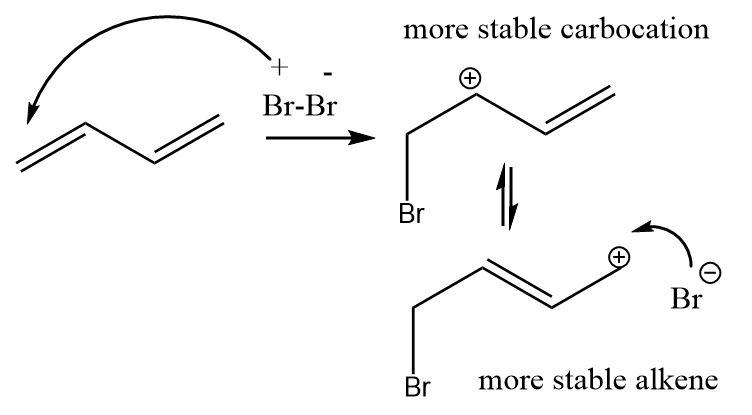
Thus, a \[1,4 - addition\] product called the thermodynamic product (in which a stable alkene is formed) is preferred over a \[1,2 - addition\] product called the kinetic product (in which a stable carbocation is formed).
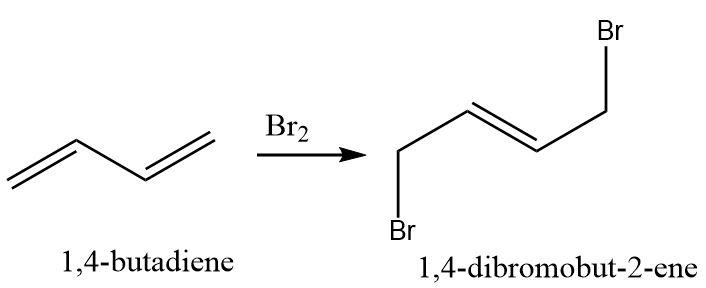
Hence, the correct option is (A)
Note:
The major product formed in the reaction is the thermodynamic product but on changing the reaction conditions a different product is obtained. If the same reaction is carried on at lower temperatures and in the presence of a polar solvent then the product obtained will be a \[1,2 - addition\] product i.e. \[3,4 - dibromobutene\].
Complete answer:
\[1,3 - butadiene\] is a conjugated diene i.e. its double bonds are alternatively placed and can therefore show resonance that adds to the stability of the compound but at the same time affects its reactivity.
Bromine is a monatomic molecule yet shows polarity. One of the double bonds of the conjugated diene gets attacked by electrophilic bromine atoms with partial positive charge so that the adjacent carbon becomes a stable conjugated carbocation.
The reaction proceeds in the direction in which a stable product is formed and not a stable intermediate. Though the formation of a secondary carbocation is more stable than a primary one, the nucleophilic bromine atom attacks the primary carbocation position as it results in a more stable alkene. (Based on Saytzeff’s rule that more substituted alkenes are more stable in nature).
Thus, a \[1,4 - addition\] product called the thermodynamic product (in which a stable alkene is formed) is preferred over a \[1,2 - addition\] product called the kinetic product (in which a stable carbocation is formed).
Hence, the correct option is (A)
Note:
The major product formed in the reaction is the thermodynamic product but on changing the reaction conditions a different product is obtained. If the same reaction is carried on at lower temperatures and in the presence of a polar solvent then the product obtained will be a \[1,2 - addition\] product i.e. \[3,4 - dibromobutene\].
Recently Updated Pages
If x a + bt + ct2 where x is in meters and t is in class 11 physics CBSE

A car covers the first half distance between two places class 11 physics CBSE
The resultant of two vectors overrightarrow P and overrightarrow class 11 physics CBSE
Find the value of cos 135 class 11 maths CBSE
A mass M is held in place by an applied force F and class 11 physics CBSE
A solution of glucose in water is labelled as 10 dfracwv class 11 chemistry CBSE
Trending doubts
One Metric ton is equal to kg A 10000 B 1000 C 100 class 11 physics CBSE
Find the value of the expression given below sin 30circ class 11 maths CBSE
Draw a diagram of nephron and explain its structur class 11 biology CBSE
10 examples of friction in our daily life
Proton was discovered by A Thomson B Rutherford C Chadwick class 11 chemistry CBSE
Bond order ofO2 O2+ O2 and O22 is in order A O2 langle class 11 chemistry CBSE