




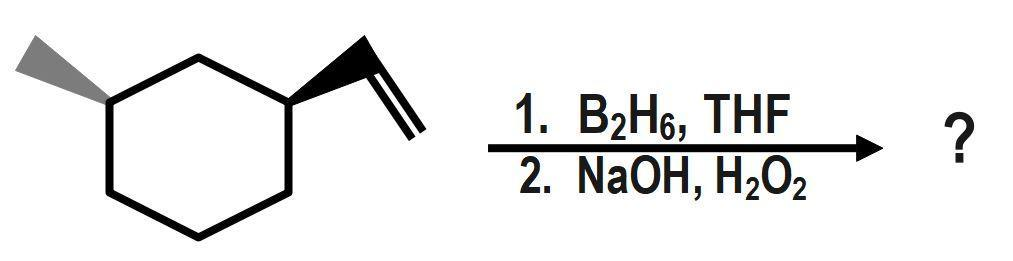
What is the product of the following reactions?
(A)
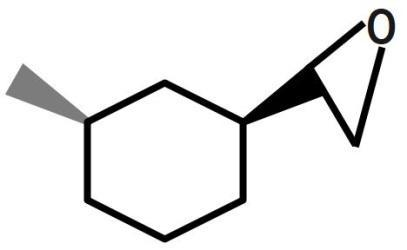
(B)
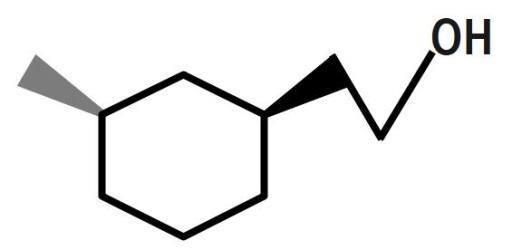
(C)
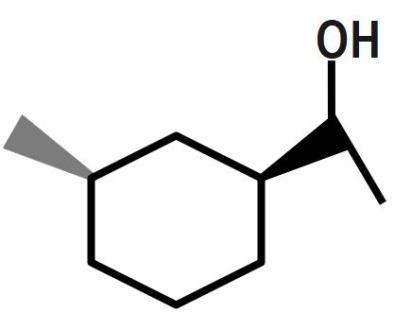
(D)
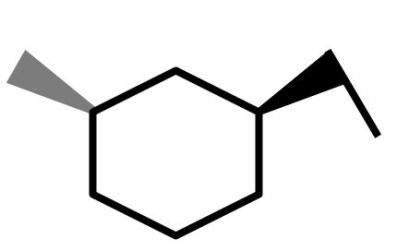
Answer
 Verified
545.7k+ views
Hint :We know that the hydroboration oxidation is an anti-markovnikov addition of water across alkene. Also, it is a two-step organic reaction. Hydroboration oxidation reaction is another important chemical reaction of organic chemistry which converts alkene into an alcohol. This reaction gives a more stereo specific and regiochemical alternative to other hydration reactions such as acid-catalyzed addition and oxymercuration reduction reactions.
Complete Step By Step Answer:
Hydroboration oxidation reaction is a two-step reaction in which alkene reacts with $ B{{H}_{3}}, $ THF (tetrahydrofuran) and hydrogen peroxide in a basic medium to give alcohol. It is also known as $ HBO $ reaction. Hydroboration oxidation of symmetrical alkene and unsymmetrical alkene works differently. As the reaction proceeds with unsymmetrical alkene follows Anti-Markovnikov rule. Although as a product we always get alcohol from both alkenes.
It is known to you that hydroboration oxidation is a two-step organic reaction. It is an organic reaction that converts an alkene into an alcohol by the net addition of water across the double bond. THF (Tetrahydrofuran) is used as a solvent. The hydrogen $ \left( H \right) $ and hydroxyl group $ \left( OH \right) $ are added in a syn (addition of addendum on the same side of the alkene or alkyne) addition leading to cis stereochemistry. Hydroboration-oxidation is an anti-Markovnikov’s addition of water across an alkene. The $ -OH $ group is added to the less substituted position and the -H is in the more substituted position. If there is more than one chiral center in the product, then the product will produce a pair of enantiomers that results from syn addition.
Here, we can see that first, is added to the carbon-carbon double bond in a way that $ H- $ atoms get bonded to a carbon that has less number of hydrogen atoms(means in an anti-markovnikov manner). Then, in presence of hydrogen peroxide-an oxidizing agent, the organo-borane compound decomposes and gives an alcohol as shown in the reaction. One molecule can oxidise three molecules of alkene because one $ B-H $ bond is responsible for the oxidation of one molecule of alkene.

Therefore, the correct answer is option B.
Note :
Remember that it's necessary to understand the chemistry of $ B{{H}_{3}} $ before understanding the mechanism of hydroboration oxidation reaction. As boron has one p-orbital empty so $ B{{H}_{3}} $ acts as Lewis acid. It exists as a dimer of $ B{{H}_{3}}, $ it means it exists in the form of $ {{B}_{2}}{{H}_{6}}2B{{H}_{3}}\to {{B}_{2}}{{H}_{6}} $ .
Complete Step By Step Answer:
Hydroboration oxidation reaction is a two-step reaction in which alkene reacts with $ B{{H}_{3}}, $ THF (tetrahydrofuran) and hydrogen peroxide in a basic medium to give alcohol. It is also known as $ HBO $ reaction. Hydroboration oxidation of symmetrical alkene and unsymmetrical alkene works differently. As the reaction proceeds with unsymmetrical alkene follows Anti-Markovnikov rule. Although as a product we always get alcohol from both alkenes.
It is known to you that hydroboration oxidation is a two-step organic reaction. It is an organic reaction that converts an alkene into an alcohol by the net addition of water across the double bond. THF (Tetrahydrofuran) is used as a solvent. The hydrogen $ \left( H \right) $ and hydroxyl group $ \left( OH \right) $ are added in a syn (addition of addendum on the same side of the alkene or alkyne) addition leading to cis stereochemistry. Hydroboration-oxidation is an anti-Markovnikov’s addition of water across an alkene. The $ -OH $ group is added to the less substituted position and the -H is in the more substituted position. If there is more than one chiral center in the product, then the product will produce a pair of enantiomers that results from syn addition.
Here, we can see that first, is added to the carbon-carbon double bond in a way that $ H- $ atoms get bonded to a carbon that has less number of hydrogen atoms(means in an anti-markovnikov manner). Then, in presence of hydrogen peroxide-an oxidizing agent, the organo-borane compound decomposes and gives an alcohol as shown in the reaction. One molecule can oxidise three molecules of alkene because one $ B-H $ bond is responsible for the oxidation of one molecule of alkene.
Therefore, the correct answer is option B.
Note :
Remember that it's necessary to understand the chemistry of $ B{{H}_{3}} $ before understanding the mechanism of hydroboration oxidation reaction. As boron has one p-orbital empty so $ B{{H}_{3}} $ acts as Lewis acid. It exists as a dimer of $ B{{H}_{3}}, $ it means it exists in the form of $ {{B}_{2}}{{H}_{6}}2B{{H}_{3}}\to {{B}_{2}}{{H}_{6}} $ .
Recently Updated Pages
Master Class 12 Economics: Engaging Questions & Answers for Success

Master Class 12 English: Engaging Questions & Answers for Success
Master Class 12 Social Science: Engaging Questions & Answers for Success
Master Class 12 Maths: Engaging Questions & Answers for Success
Master Class 12 Physics: Engaging Questions & Answers for Success
Master Class 11 Social Science: Engaging Questions & Answers for Success
Trending doubts
One Metric ton is equal to kg A 10000 B 1000 C 100 class 11 physics CBSE
Difference Between Prokaryotic Cells and Eukaryotic Cells
Find the value of the expression given below sin 30circ class 11 maths CBSE
Two of the body parts which do not appear in MRI are class 11 biology CBSE
Draw a diagram of nephron and explain its structur class 11 biology CBSE
10 examples of friction in our daily life