




Process of release of an ovum from an ovary is known as …………
Answer
 Verified
626.4k+ views
Hint: Ovaries are part of the female reproductive system, and two ovaries one on each side of the uterus. Release of the ovum from an ovary is an important process after the process of maturation of primary follicle into a secondary follicle which develops into tertiary and then finally into graafian follicle.
Complete answer:
In females, the process of gametogenesis is known as oogenesis which is a process of formation of female gametes or ova and the produced female gamete is known as an ovum. Oogenesis occurs in the outermost layer of the ovaries. Oogonia is an immature reproductive cell that gives rise to primary oocytes by undergoing mitotic division in fetal life. The primary oocyte after the first meiotic division gives rise to the secondary oocyte during the period of birth, childhood, and puberty. During this time, it remains in the secondary oocyte and first polar body formation occurs. During the adult reproductive life formation of the ovum and second polar body occurs. Primary oocytes are covered by granulosa cells known as a primary follicle, whereas secondary oocytes are covered with granulosa cells known as a secondary follicle. These secondary follicles then mature into the tertiary follicle and finally into the mature follicle or graafian follicle.
Hence, the graafian follicle ruptures and releases the ovum from the ovary, and this process of release of an ovum from the ovary is known as ovulation. This process occurs on day 14 of the 28-day menstrual cycle. This process of ovulation is controlled by the hormonal changes in the female body. During 6 to 14 days of the menstrual cycle, FSH (Follicle Stimulating Hormone) helps in the maturation of the ovum.
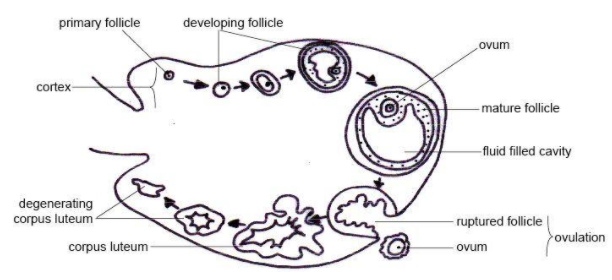
Note: Hormonal triggering causes ovulation and release of the ovum from the ovary. During the process of the graafian follicle, various changes occur and the oocyte undergoes many differentiations.
Complete answer:
In females, the process of gametogenesis is known as oogenesis which is a process of formation of female gametes or ova and the produced female gamete is known as an ovum. Oogenesis occurs in the outermost layer of the ovaries. Oogonia is an immature reproductive cell that gives rise to primary oocytes by undergoing mitotic division in fetal life. The primary oocyte after the first meiotic division gives rise to the secondary oocyte during the period of birth, childhood, and puberty. During this time, it remains in the secondary oocyte and first polar body formation occurs. During the adult reproductive life formation of the ovum and second polar body occurs. Primary oocytes are covered by granulosa cells known as a primary follicle, whereas secondary oocytes are covered with granulosa cells known as a secondary follicle. These secondary follicles then mature into the tertiary follicle and finally into the mature follicle or graafian follicle.
Hence, the graafian follicle ruptures and releases the ovum from the ovary, and this process of release of an ovum from the ovary is known as ovulation. This process occurs on day 14 of the 28-day menstrual cycle. This process of ovulation is controlled by the hormonal changes in the female body. During 6 to 14 days of the menstrual cycle, FSH (Follicle Stimulating Hormone) helps in the maturation of the ovum.
Note: Hormonal triggering causes ovulation and release of the ovum from the ovary. During the process of the graafian follicle, various changes occur and the oocyte undergoes many differentiations.
Recently Updated Pages
Master Class 12 Economics: Engaging Questions & Answers for Success

Master Class 12 Social Science: Engaging Questions & Answers for Success
Master Class 12 English: Engaging Questions & Answers for Success
Master Class 12 Maths: Engaging Questions & Answers for Success
Master Class 12 Physics: Engaging Questions & Answers for Success
Master Class 12 Biology: Engaging Questions & Answers for Success
Trending doubts
Draw a labelled sketch of the human eye class 12 physics CBSE
Which are the Top 10 Largest Countries of the World?
Draw ray diagrams each showing i myopic eye and ii class 12 physics CBSE
Which is the correct genotypic ratio of mendel dihybrid class 12 biology CBSE
Differentiate between homogeneous and heterogeneous class 12 chemistry CBSE
Which animal never drinks water in its entire life class 12 biology CBSE