




Proboscis of elephant is formed of
A) Prolongation of nose
B) Enlargement of upper lip
C) Both A and B
D) Prolongation of lower lip
Answer
 Verified
613.2k+ views
Hint:Proboscis is an elongated appendage from the head of an animal.It is considered a nose or a snout of the vertebrae.
Complete answer:
The proboscis of an elephant is the extension of nose and the upper lip fused together.The proboscidea nerve is made up of the combined distal nerve fibers of the infraorbital branch of the maxillary nerve (CN V3) and zygomatic branch of the facial nerve (CN VII)..The proboscidea nerve then travels down the length of the proboscis transmitting small sensory and motor nerve fibers to all muscle fascicles and surrounding skin and tissue. Given this anatomy, fine‐tuned neuromuscular control and coordination of the individual nerve fibers are necessary to control the diverse movements that occur throughout the length of the proboscis. This specialized evolutionary adaptation helped shape a functionally innovative organ that grew, modified, and persisted throughout the course of proboscidean evolution.The elephant's trunk is an incredible part of the body, allowing it to smell, drink, reach food at unreachable heights by other animals, to move objects and obstacles and to maintain and consolidate social relations with the other members of the group.
Studying the skeleton of the elephant there is no trace of the proboscis, this important and very evident part of the animal does not have any bone inside and constitutes the fusion of the nose and the upper lip.
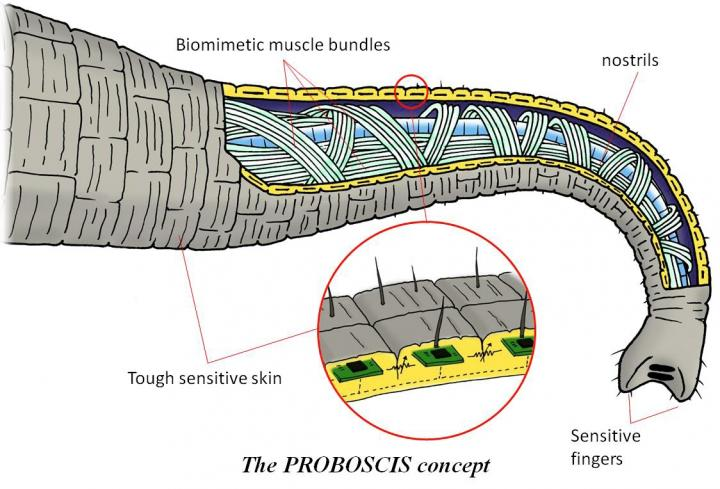
Note:The trunk of an elephant has 8 main muscles and they can use their trunk to bend and move in any direction they want.
Complete answer:
The proboscis of an elephant is the extension of nose and the upper lip fused together.The proboscidea nerve is made up of the combined distal nerve fibers of the infraorbital branch of the maxillary nerve (CN V3) and zygomatic branch of the facial nerve (CN VII)..The proboscidea nerve then travels down the length of the proboscis transmitting small sensory and motor nerve fibers to all muscle fascicles and surrounding skin and tissue. Given this anatomy, fine‐tuned neuromuscular control and coordination of the individual nerve fibers are necessary to control the diverse movements that occur throughout the length of the proboscis. This specialized evolutionary adaptation helped shape a functionally innovative organ that grew, modified, and persisted throughout the course of proboscidean evolution.The elephant's trunk is an incredible part of the body, allowing it to smell, drink, reach food at unreachable heights by other animals, to move objects and obstacles and to maintain and consolidate social relations with the other members of the group.
Studying the skeleton of the elephant there is no trace of the proboscis, this important and very evident part of the animal does not have any bone inside and constitutes the fusion of the nose and the upper lip.
Note:The trunk of an elephant has 8 main muscles and they can use their trunk to bend and move in any direction they want.
Recently Updated Pages
Master Class 11 Social Science: Engaging Questions & Answers for Success

Master Class 11 Chemistry: Engaging Questions & Answers for Success
Master Class 12 Business Studies: Engaging Questions & Answers for Success
Master Class 12 Chemistry: Engaging Questions & Answers for Success
Master Class 12 Biology: Engaging Questions & Answers for Success
Class 12 Question and Answer - Your Ultimate Solutions Guide
Trending doubts
One Metric ton is equal to kg A 10000 B 1000 C 100 class 11 physics CBSE
Difference Between Prokaryotic Cells and Eukaryotic Cells
How many of the following diseases can be studied with class 11 biology CBSE
Two of the body parts which do not appear in MRI are class 11 biology CBSE
Which of the following enzymes is used for carboxylation class 11 biology CBSE
Explain zero factorial class 11 maths CBSE