




How is the presence of Burmese pythons changing the Everglades?
Answer
 Verified
577.2k+ views
Hint: Burmese python in the class of Reptilia belongs to the family of Pythonidae is one of the largest species of snakes, and it is native to a large area of Southeast Asia.
Complete answer:
The Burmese python is a dark-colored snake with many brown blotches bordered in black down the back, and they can grow to an unmanageable size.
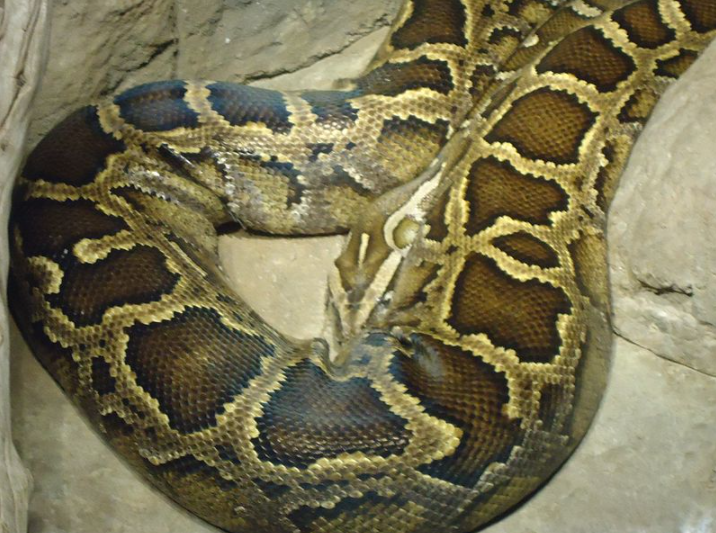
This species is native to the tropics in South and Southeast Asia, and these pythons are one of the invasive species. They are an excellent swimmer and require a permanent source of water. They live in grasslands, marshes, swamps, etc., and are good climbers with a prehensile tail. They are generally nocturnal rainforest dwellers.
The swamps of the South Florida Everglades (swampy grassland) have been over-run by one of the most damaging invasive species of the region i.e. Burmese Python. These massive snakes can grow up to twenty feet long or more with telephone-pole-sized girths, and have all but destroyed the region's small and medium-sized mammal population and caused widespread destruction of the area's ecosystem. These pythons have a tremendous impact on the Everglades. These top predators are known to consume much of the natural wildlife, including birds, mammals, and also known to compete with American alligators.
These Burmese pythons prey on the wildlife, affecting population abundance, and also compete with other animals, and population numbers differing far from the normal and this showing a chain reaction. For example, the Burmese python consumes a lot of marsh rabbits and around seventy percent of these rabbits are consumed by the Burmese python. So, any other animal who depends on marsh rabbits will feel this impact, and this impact extends beyond animals too, plants that rabbits eat may be affected if their main seed disperser declines rapidly.
Note: Female pythons can lay fifty to hundred eggs per year and this creature has no natural predator in the region and their threats continue to increase, and so considered as invasive species because of their impacts on native wildlife.
Complete answer:
The Burmese python is a dark-colored snake with many brown blotches bordered in black down the back, and they can grow to an unmanageable size.
This species is native to the tropics in South and Southeast Asia, and these pythons are one of the invasive species. They are an excellent swimmer and require a permanent source of water. They live in grasslands, marshes, swamps, etc., and are good climbers with a prehensile tail. They are generally nocturnal rainforest dwellers.
The swamps of the South Florida Everglades (swampy grassland) have been over-run by one of the most damaging invasive species of the region i.e. Burmese Python. These massive snakes can grow up to twenty feet long or more with telephone-pole-sized girths, and have all but destroyed the region's small and medium-sized mammal population and caused widespread destruction of the area's ecosystem. These pythons have a tremendous impact on the Everglades. These top predators are known to consume much of the natural wildlife, including birds, mammals, and also known to compete with American alligators.
These Burmese pythons prey on the wildlife, affecting population abundance, and also compete with other animals, and population numbers differing far from the normal and this showing a chain reaction. For example, the Burmese python consumes a lot of marsh rabbits and around seventy percent of these rabbits are consumed by the Burmese python. So, any other animal who depends on marsh rabbits will feel this impact, and this impact extends beyond animals too, plants that rabbits eat may be affected if their main seed disperser declines rapidly.
Note: Female pythons can lay fifty to hundred eggs per year and this creature has no natural predator in the region and their threats continue to increase, and so considered as invasive species because of their impacts on native wildlife.
Recently Updated Pages
Three beakers labelled as A B and C each containing 25 mL of water were taken A small amount of NaOH anhydrous CuSO4 and NaCl were added to the beakers A B and C respectively It was observed that there was an increase in the temperature of the solutions contained in beakers A and B whereas in case of beaker C the temperature of the solution falls Which one of the following statements isarecorrect i In beakers A and B exothermic process has occurred ii In beakers A and B endothermic process has occurred iii In beaker C exothermic process has occurred iv In beaker C endothermic process has occurred

Master Class 11 Social Science: Engaging Questions & Answers for Success
Master Class 11 Physics: Engaging Questions & Answers for Success
Master Class 11 Maths: Engaging Questions & Answers for Success
Master Class 11 Economics: Engaging Questions & Answers for Success
Master Class 11 Computer Science: Engaging Questions & Answers for Success
Three beakers labelled as A B and C each containing 25 mL of water were taken A small amount of NaOH anhydrous CuSO4 and NaCl were added to the beakers A B and C respectively It was observed that there was an increase in the temperature of the solutions contained in beakers A and B whereas in case of beaker C the temperature of the solution falls Which one of the following statements isarecorrect i In beakers A and B exothermic process has occurred ii In beakers A and B endothermic process has occurred iii In beaker C exothermic process has occurred iv In beaker C endothermic process has occurred
Master Class 11 Social Science: Engaging Questions & Answers for Success
Master Class 11 Physics: Engaging Questions & Answers for Success
Trending doubts
One Metric ton is equal to kg A 10000 B 1000 C 100 class 11 physics CBSE
There are 720 permutations of the digits 1 2 3 4 5 class 11 maths CBSE
State and prove Bernoullis theorem class 11 physics CBSE
Difference Between Prokaryotic Cells and Eukaryotic Cells
1 Quintal is equal to a 110 kg b 10 kg c 100kg d 1000 class 11 physics CBSE
Which among the following are examples of coming together class 11 social science CBSE