




Prepare 2-iodo-2-methylpropane from 2-chloro-2-methylpropane.
Answer
 Verified
595.2k+ views
Hint: The given reactants and forming product both are alkyl halides in nature and alkyl halides are those compounds in which halogen is present with alkyl groups where halogens are iodine, chlorine, bromine etc.
Complete step by step answer: The reaction can be done under the reaction named Finkelstein reaction which kept in the category of substitution nucleophilic reaction and substitution nuclear is of two types known as\[S{{N}^{1}}\] and \[S{{N}^{2}}\] reactions i.e. Substitution nucleophilic unimolecular reaction and substitution nucleophilic bimolecular reaction.
The Finkelstein reaction is kept under the category of \[S{{N}^{2}}\]reaction which generally involves the exchange of halogen atom and this reaction is named after the name of German scientist who discovered it i.e. Hans Finkelstein.
It is basically an organic reaction in which an alkyl halide exchange into another alkyl halide through a reaction wherein the metal halide salt i.e. sodium iodide is used and reaction takes place at an equilibrium process in the presence of acetone. Reaction between 2-iodo-2-methylpropane from 2-chloro-2-methyl propane can be shown as:
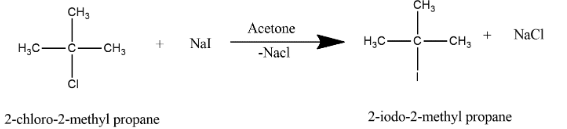
The mechanism of the Finkelstein reaction is single-step reaction with stereochemistry inversion and the reaction involves the process of an alkyl bromide or an alkyl chloride into an alkyl iodide which is treated with a sodium iodide solution in acetone.
Note: Only sodium iodide solution is used in this reaction the reason behind this is sodium iodide is soluble in the acetone while the other solutions like sodium bromide and sodium chloride are not soluble in the acetone.
Complete step by step answer: The reaction can be done under the reaction named Finkelstein reaction which kept in the category of substitution nucleophilic reaction and substitution nuclear is of two types known as\[S{{N}^{1}}\] and \[S{{N}^{2}}\] reactions i.e. Substitution nucleophilic unimolecular reaction and substitution nucleophilic bimolecular reaction.
The Finkelstein reaction is kept under the category of \[S{{N}^{2}}\]reaction which generally involves the exchange of halogen atom and this reaction is named after the name of German scientist who discovered it i.e. Hans Finkelstein.
It is basically an organic reaction in which an alkyl halide exchange into another alkyl halide through a reaction wherein the metal halide salt i.e. sodium iodide is used and reaction takes place at an equilibrium process in the presence of acetone. Reaction between 2-iodo-2-methylpropane from 2-chloro-2-methyl propane can be shown as:
The mechanism of the Finkelstein reaction is single-step reaction with stereochemistry inversion and the reaction involves the process of an alkyl bromide or an alkyl chloride into an alkyl iodide which is treated with a sodium iodide solution in acetone.
Note: Only sodium iodide solution is used in this reaction the reason behind this is sodium iodide is soluble in the acetone while the other solutions like sodium bromide and sodium chloride are not soluble in the acetone.
Recently Updated Pages
Explain the structure of megasporangium class 12 biology CBSE

Why is chloroform kept in dark coloured bottles class 12 chemistry CBSE
Derive the balancing condition of a Wheatstone bri class 12 physics CBSE
Draw VI characteristics of a pn junction diode Explain class 12 physics CBSE
Is it possible to carry pride in ones language too class 12 english CBSE
In a population at Hardy Weinberg equilibrium the allele class 12 biology CBSE
Trending doubts
Draw a labelled sketch of the human eye class 12 physics CBSE
Which are the Top 10 Largest Countries of the World?
Draw ray diagrams each showing i myopic eye and ii class 12 physics CBSE
Which is the correct genotypic ratio of mendel dihybrid class 12 biology CBSE
Differentiate between homogeneous and heterogeneous class 12 chemistry CBSE
Which animal never drinks water in its entire life class 12 biology CBSE