




PQR and XYZ are wires in a circuit. A galvanometer connects Q and Y as a null indicator. When the galvanometer reads zero, which statement is correct?
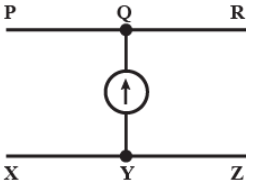
A. The potential difference between Q and Y is infinite
B. The potential difference between Q and Y is zero
C. The resistance between Q and Y is infinite
D. The resistance between Q and Y is zero
Answer
 Verified
594k+ views
Hint: The question is based on the concept of the balanced condition in a galvanometer. So, we will make use of the same concept to solve this problem. We know that the galvanometer shows deflection for an unbalanced system, similarly, for a balanced system, the galvanometer does not show any kind of deflection.
Complete step by step answer:
There are several conditions when the galvanometer shows deflection or not based on the parameters involved in the working of a galvanometer. They are as follows.
Consider the parameter current: The galvanometer shows deflection when the current passes through the symmetry of the system, that is, in this case, the path QY. The galvanometer does not show any kind of deflection when the current does not pass through the symmetry of the system, the path QY.
Consider the parameter resistor: The galvanometer shows deflection, when the resistors present on both sides of the system, the path QY have different values, that is, the unbalanced condition. The galvanometer does not show any kind of deflection when the resistors present on both sides of the system, the path QY have the same values, that is, the balanced condition.
Consider the parameter potential difference: The galvanometer shows deflection when there is some potential difference across the terminals of the system, that is, the path QY. The galvanometer does not show any kind of deflection, when there is zero potential difference across the terminals of the system, that is, the path QY.
The statement, “The potential difference between Q and Y is zero”, is right.
Thus, the option (B) is correct.
Note:
In this case, the question was based on the parameter potential difference. Even, they can ask for the same question based on the parameters, such as the flow of current and the resistors present on both the sides of the line of symmetry, that is, in our case, the path QY. The answers to these concepts are discussed in the above explanation section.
Complete step by step answer:
There are several conditions when the galvanometer shows deflection or not based on the parameters involved in the working of a galvanometer. They are as follows.
Consider the parameter current: The galvanometer shows deflection when the current passes through the symmetry of the system, that is, in this case, the path QY. The galvanometer does not show any kind of deflection when the current does not pass through the symmetry of the system, the path QY.
Consider the parameter resistor: The galvanometer shows deflection, when the resistors present on both sides of the system, the path QY have different values, that is, the unbalanced condition. The galvanometer does not show any kind of deflection when the resistors present on both sides of the system, the path QY have the same values, that is, the balanced condition.
Consider the parameter potential difference: The galvanometer shows deflection when there is some potential difference across the terminals of the system, that is, the path QY. The galvanometer does not show any kind of deflection, when there is zero potential difference across the terminals of the system, that is, the path QY.
The statement, “The potential difference between Q and Y is zero”, is right.
Thus, the option (B) is correct.
Note:
In this case, the question was based on the parameter potential difference. Even, they can ask for the same question based on the parameters, such as the flow of current and the resistors present on both the sides of the line of symmetry, that is, in our case, the path QY. The answers to these concepts are discussed in the above explanation section.
Recently Updated Pages
Basicity of sulphurous acid and sulphuric acid are

Master Class 11 Business Studies: Engaging Questions & Answers for Success
Master Class 11 Computer Science: Engaging Questions & Answers for Success
Master Class 11 Economics: Engaging Questions & Answers for Success
Master Class 11 Social Science: Engaging Questions & Answers for Success
Master Class 11 English: Engaging Questions & Answers for Success
Trending doubts
One Metric ton is equal to kg A 10000 B 1000 C 100 class 11 physics CBSE
The largest wind power cluster is located in the state class 11 social science CBSE
Explain zero factorial class 11 maths CBSE
State and prove Bernoullis theorem class 11 physics CBSE
Which among the following are examples of coming together class 11 social science CBSE
Draw a diagram of a plant cell and label at least eight class 11 biology CBSE