




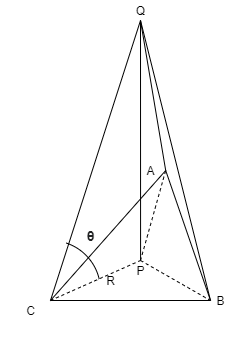
\[PQ\] is a vertical tower. P is the foot, Q is the top of the tower, A, B, C are three points in the horizontal plane through P. the angles of elevations of Q from A, B, C are equal and equal to \[\theta \] . The sides of \[\Delta ABC\] are a, b, c and the area of \[\Delta ABC\] is \[\Delta \] . The height of tower is
(a) \[\dfrac{\left( abc \right)\tan \theta }{4\Delta }\]
(b) \[\dfrac{\left( abc \right)\sin \theta }{4\Delta }\]
(c) \[\dfrac{\left( abc \right)\cot \theta }{4\Delta }\]
(d) None of these
Answer
 Verified
578.4k+ views
Hint: For solving this problem we use some properties of triangle that is \[\Delta =\dfrac{abc}{4R}\] where, a, b, c are the sides of the triangle, \[R\] is the circumradius and \[\Delta \] is the area of the triangle. From the figure we form a relation between the height of the tower, \[\theta \] and \[R\] to get the height of the tower.
Complete step by step answer:
We are given that the elevations of Q from the points A, B, C are equal.
So, we can write
\[\angle QAP=\angle QBP=\angle QCP=\theta \]
Here, as the elevations are all equal then we can say that the circumradius is given as
\[PA=PB=PC=R\]
Let us assume that the height of tower as
\[PQ=h\]
Let us consider the triangle \[\Delta QPC\] .
Here we can say that \[QP\bot CP\] .
So, for a right angled triangle
\[\tan \theta =\dfrac{\text{opposite side}}{\text{adjacent side}}\]
By applying this formula to \[\Delta QPC\] we get
\[\begin{align}
& \Rightarrow \tan \theta =\dfrac{PQ}{PC} \\
& \Rightarrow \tan \theta =\dfrac{h}{R} \\
& \Rightarrow h=R\tan \theta ......equation(i) \\
\end{align}\]
We know that from the properties of triangle we can take
\[\begin{align}
& \Rightarrow \Delta =\dfrac{abc}{4R} \\
& \Rightarrow R=\dfrac{abc}{4\Delta } \\
\end{align}\]
Now, by substituting the value of \['R'\] in equation (i) we get
\[\begin{align}
& \Rightarrow h=\left( \dfrac{abc}{4\Delta } \right)\tan \theta \\
& \Rightarrow h=\dfrac{\left( abc \right)\tan \theta }{4\Delta } \\
\end{align}\]
Therefore, the value of height of the tower is \[\dfrac{\left( abc \right)\tan \theta }{4\Delta }\] .
So, the correct answer is “Option a”.
Note: Students will make mistakes in understanding the diagram. Since it should be assumed in three dimensional students will get confused and take different values instead of some other.
Let us consider the triangle \[\Delta QPC\] .
\[\begin{align}
& \Rightarrow \tan \theta =\dfrac{PQ}{PC} \\
& \Rightarrow \tan \theta =\dfrac{h}{R} \\
& \Rightarrow h=R\tan \theta \\
\end{align}\]
Here, some students will make mistakes in taking \[\tan \theta \] because they may not consider \[QP\bot CP\] . For this they apply different properties of triangles to find \[\tan \theta \] which results in wrong answers. So, understanding the problem and figure is important in this question.
Complete step by step answer:
We are given that the elevations of Q from the points A, B, C are equal.
So, we can write
\[\angle QAP=\angle QBP=\angle QCP=\theta \]
Here, as the elevations are all equal then we can say that the circumradius is given as
\[PA=PB=PC=R\]
Let us assume that the height of tower as
\[PQ=h\]
Let us consider the triangle \[\Delta QPC\] .
Here we can say that \[QP\bot CP\] .
So, for a right angled triangle
\[\tan \theta =\dfrac{\text{opposite side}}{\text{adjacent side}}\]
By applying this formula to \[\Delta QPC\] we get
\[\begin{align}
& \Rightarrow \tan \theta =\dfrac{PQ}{PC} \\
& \Rightarrow \tan \theta =\dfrac{h}{R} \\
& \Rightarrow h=R\tan \theta ......equation(i) \\
\end{align}\]
We know that from the properties of triangle we can take
\[\begin{align}
& \Rightarrow \Delta =\dfrac{abc}{4R} \\
& \Rightarrow R=\dfrac{abc}{4\Delta } \\
\end{align}\]
Now, by substituting the value of \['R'\] in equation (i) we get
\[\begin{align}
& \Rightarrow h=\left( \dfrac{abc}{4\Delta } \right)\tan \theta \\
& \Rightarrow h=\dfrac{\left( abc \right)\tan \theta }{4\Delta } \\
\end{align}\]
Therefore, the value of height of the tower is \[\dfrac{\left( abc \right)\tan \theta }{4\Delta }\] .
So, the correct answer is “Option a”.
Note: Students will make mistakes in understanding the diagram. Since it should be assumed in three dimensional students will get confused and take different values instead of some other.
Let us consider the triangle \[\Delta QPC\] .
\[\begin{align}
& \Rightarrow \tan \theta =\dfrac{PQ}{PC} \\
& \Rightarrow \tan \theta =\dfrac{h}{R} \\
& \Rightarrow h=R\tan \theta \\
\end{align}\]
Here, some students will make mistakes in taking \[\tan \theta \] because they may not consider \[QP\bot CP\] . For this they apply different properties of triangles to find \[\tan \theta \] which results in wrong answers. So, understanding the problem and figure is important in this question.
Recently Updated Pages
Master Class 10 Computer Science: Engaging Questions & Answers for Success

Master Class 10 General Knowledge: Engaging Questions & Answers for Success
Master Class 10 English: Engaging Questions & Answers for Success
Master Class 10 Social Science: Engaging Questions & Answers for Success
Master Class 10 Maths: Engaging Questions & Answers for Success
Master Class 10 Science: Engaging Questions & Answers for Success
Trending doubts
What is the median of the first 10 natural numbers class 10 maths CBSE
Which women's tennis player has 24 Grand Slam singles titles?
Who is the Brand Ambassador of Incredible India?
Why is there a time difference of about 5 hours between class 10 social science CBSE
Write a letter to the principal requesting him to grant class 10 english CBSE
A moving boat is observed from the top of a 150 m high class 10 maths CBSE