




\[PQ\] is a double ordinate of hyperbola \[\dfrac{{{x^2}}}{{{a^2}}} - \dfrac{{{y^2}}}{{{b^2}}} = 1\] such that \[OPQ\] is an equilateral triangle, \[O\] being the centre of hyperbola, where eccentricity of hyperbola \[e\] satisfy \[\sqrt 3 e > k\], then the value of \[k\] is
Answer
 Verified
607.2k+ views
Hint: Here, we will draw a figure that will satisfy the given condition. Then, using the properties of double ordinate of hyperbola and an equilateral triangle, we will compare the two equations. Substituting the end product into the eccentricity of a hyperbola, we will get the required value of \[k\].
Complete step-by-step answer:
Let the coordinates of point \[P\] be \[\left( {h,k} \right)\].
We will draw a figure showing the given conditions such that \[OPQ\] is an equilateral triangle, \[O\] being the centre of hyperbola.
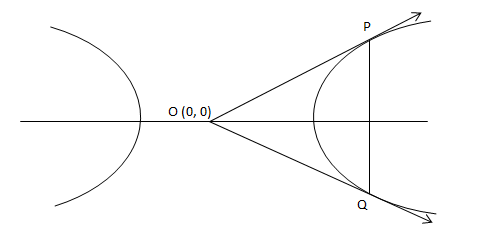
Since, \[PQ\] is a double ordinate of hyperbola, hence
\[l\left( {PQ} \right) = 2k\]
Also, \[l\left( {OP} \right) = \sqrt {{h^2} + {k^2}} \]
Now, according to the question, \[OPQ\] is an equilateral triangle. Hence,
\[2k = \sqrt {{h^2} + {k^2}} \]
Squaring both sides, we get
\[ \Rightarrow 4{k^2} = {h^2} + {k^2}\]
\[ \Rightarrow 3{k^2} = {h^2}\]…………………………….\[\left( 1 \right)\]
Now, point \[P\] lies on the hyperbola, so, it would satisfy \[\dfrac{{{h^2}}}{{{a^2}}} - \dfrac{{{k^2}}}{{{b^2}}} = 1\]………………….\[\left( 2 \right)\]
Substituting the value of equation \[\left( 1 \right)\] in equation \[\left( 2 \right)\], we get
\[\dfrac{{3{k^2}}}{{{a^2}}} - \dfrac{{{k^2}}}{{{b^2}}} = 1\]
\[ \Rightarrow {k^2}\left( {\dfrac{3}{{{a^2}}} - \dfrac{1}{{{b^2}}}} \right) = 1\]
Dividing both sides by \[{k^2}\], we get
\[ \Rightarrow \left( {\dfrac{3}{{{a^2}}} - \dfrac{1}{{{b^2}}}} \right) = \dfrac{1}{{{k^2}}} > 0\]
This is because \[{k^2}\] can neither be 1 nor be negative.
Hence, the above equation can be written as:
\[\dfrac{{{b^2}}}{{{a^2}}} > \dfrac{1}{3}\]
Now, we know that, \[{e^2} = 1 + \dfrac{{{b^2}}}{{{a^2}}} > 1 + \dfrac{1}{3} > \dfrac{4}{3}\], where \[e\] is the eccentricity.
Taking square root on both sides, we get
\[ \Rightarrow e > \dfrac{2}{{\sqrt 3 }}\]
Now, according to the question, the eccentricity of hyperbola \[e\] satisfies, \[\sqrt 3 e > k\]. So,
\[e > \dfrac{k}{{\sqrt 3 }}\]
Comparing \[e > \dfrac{k}{{\sqrt 3 }}\] and \[e > \dfrac{2}{{\sqrt 3 }}\], we can say that,
\[k = 2\]
Hence, this is the required answer.
Note: We can also solve this question using an alternate method:
Since, the points \[PQ\] lie on the hyperbola, so,
Coordinates of \[P = \left( {a\sec \theta ,b\tan \theta } \right)\]
Coordinates of \[Q = \left( {a\sec \theta , - b\tan \theta } \right)\]
Now, using distance formula, we get
\[PQ = \sqrt {{{\left( {{x_2} - {x_1}} \right)}^2} + {{\left( {{y_2} - {y_1}} \right)}^2}} \]
Substituting the values of coordinates, we get
\[ \Rightarrow PQ = \sqrt {{{\left( {a\sec \theta - a\sec \theta } \right)}^2} + {{\left( { - b\tan \theta - b\tan \theta } \right)}^2}} \]
Adding and subtracting the terms, we get
\[ \Rightarrow PQ = \sqrt {{{\left( { - 2b\tan \theta } \right)}^2}} = 2b\tan \theta \]
Similarly,
\[OQ = \sqrt {{{\left( {a\sec \theta - 0} \right)}^2} + {{\left( { - b\tan \theta - 0} \right)}^2}} \]
Adding the terms, we get
\[ \Rightarrow OQ = \sqrt {{a^2}{{\sec }^2}\theta + {b^2}{{\tan }^2}{\theta ^2}} \]
Since, \[OPQ\] is an equilateral triangle, hence,
\[PQ = OQ\]
\[ \Rightarrow 2b\tan \theta = \sqrt {{a^2}{{\sec }^2}\theta + {b^2}{{\tan }^2}{\theta ^2}} \]
Squaring both sides, we get
\[ \Rightarrow 4{b^2}{\tan ^2}\theta = {a^2}{\sec ^2}\theta + {b^2}{\tan ^2}{\theta ^2}\]
\[ \Rightarrow 3{b^2}{\tan ^2}\theta = {a^2}{\sec ^2}\theta \]……………………….\[\left( 3 \right)\]
Now, we know that in a hyperbola, \[{b^2} = {a^2}\left( {{e^2} - 1} \right)\].
Substituting \[{b^2} = {a^2}\left( {{e^2} - 1} \right)\] in equation \[\left( 3 \right)\], we get
\[ \Rightarrow 3{a^2}\left( {{e^2} - 1} \right){\tan ^2}\theta = {a^2}{\sec ^2}\theta \]
Substituting \[{\tan ^2}\theta = \dfrac{{{{\sin }^2}\theta }}{{{{\cos }^2}\theta }}\] and \[{\sec ^2}\theta = \dfrac{1}{{{{\cos }^2}\theta }}\], we get
\[ \Rightarrow 3\left( {{e^2} - 1} \right)\dfrac{{{{\sin }^2}\theta }}{{{{\cos }^2}\theta }} = \dfrac{1}{{{{\cos }^2}\theta }}\]
\[ \Rightarrow 3\left( {{e^2} - 1} \right){\sin ^2}\theta = 1\]
On cross multiplication, we get
\[ \Rightarrow {\sin ^2}\theta = \dfrac{1}{{3\left( {{e^2} - 1} \right)}}\]
The value of \[{\sin ^2}\theta \] is always less than 1, so
\[ \Rightarrow \dfrac{1}{{3\left( {{e^2} - 1} \right)}} < 1\]
Again on cross multiplication, we get
\[ \Rightarrow \dfrac{1}{{\left( {{e^2} - 1} \right)}} < 3\]
Taking reciprocal on both sides, and changing the inequality, we get
\[ \Rightarrow \left( {{e^2} - 1} \right) > \dfrac{1}{3}\]
Adding 1 on both sides, we get
\[ \Rightarrow {e^2} > \dfrac{1}{3} + 1 > \dfrac{4}{3}\]
Taking square root on both sides, we get
\[ \Rightarrow e > \dfrac{2}{{\sqrt 3 }}\]
Now, according to the question, the eccentricity of hyperbola \[e\] satisfies \[\sqrt 3 e > k\] or \[e > \dfrac{k}{{\sqrt 3 }}\].
Comparing \[e > \dfrac{k}{{\sqrt 3 }}\] and \[e > \dfrac{2}{{\sqrt 3 }}\], we can say that,
\[k = 2\]
Hence, this is the required answer.
Complete step-by-step answer:
Let the coordinates of point \[P\] be \[\left( {h,k} \right)\].
We will draw a figure showing the given conditions such that \[OPQ\] is an equilateral triangle, \[O\] being the centre of hyperbola.
Since, \[PQ\] is a double ordinate of hyperbola, hence
\[l\left( {PQ} \right) = 2k\]
Also, \[l\left( {OP} \right) = \sqrt {{h^2} + {k^2}} \]
Now, according to the question, \[OPQ\] is an equilateral triangle. Hence,
\[2k = \sqrt {{h^2} + {k^2}} \]
Squaring both sides, we get
\[ \Rightarrow 4{k^2} = {h^2} + {k^2}\]
\[ \Rightarrow 3{k^2} = {h^2}\]…………………………….\[\left( 1 \right)\]
Now, point \[P\] lies on the hyperbola, so, it would satisfy \[\dfrac{{{h^2}}}{{{a^2}}} - \dfrac{{{k^2}}}{{{b^2}}} = 1\]………………….\[\left( 2 \right)\]
Substituting the value of equation \[\left( 1 \right)\] in equation \[\left( 2 \right)\], we get
\[\dfrac{{3{k^2}}}{{{a^2}}} - \dfrac{{{k^2}}}{{{b^2}}} = 1\]
\[ \Rightarrow {k^2}\left( {\dfrac{3}{{{a^2}}} - \dfrac{1}{{{b^2}}}} \right) = 1\]
Dividing both sides by \[{k^2}\], we get
\[ \Rightarrow \left( {\dfrac{3}{{{a^2}}} - \dfrac{1}{{{b^2}}}} \right) = \dfrac{1}{{{k^2}}} > 0\]
This is because \[{k^2}\] can neither be 1 nor be negative.
Hence, the above equation can be written as:
\[\dfrac{{{b^2}}}{{{a^2}}} > \dfrac{1}{3}\]
Now, we know that, \[{e^2} = 1 + \dfrac{{{b^2}}}{{{a^2}}} > 1 + \dfrac{1}{3} > \dfrac{4}{3}\], where \[e\] is the eccentricity.
Taking square root on both sides, we get
\[ \Rightarrow e > \dfrac{2}{{\sqrt 3 }}\]
Now, according to the question, the eccentricity of hyperbola \[e\] satisfies, \[\sqrt 3 e > k\]. So,
\[e > \dfrac{k}{{\sqrt 3 }}\]
Comparing \[e > \dfrac{k}{{\sqrt 3 }}\] and \[e > \dfrac{2}{{\sqrt 3 }}\], we can say that,
\[k = 2\]
Hence, this is the required answer.
Note: We can also solve this question using an alternate method:
Since, the points \[PQ\] lie on the hyperbola, so,
Coordinates of \[P = \left( {a\sec \theta ,b\tan \theta } \right)\]
Coordinates of \[Q = \left( {a\sec \theta , - b\tan \theta } \right)\]
Now, using distance formula, we get
\[PQ = \sqrt {{{\left( {{x_2} - {x_1}} \right)}^2} + {{\left( {{y_2} - {y_1}} \right)}^2}} \]
Substituting the values of coordinates, we get
\[ \Rightarrow PQ = \sqrt {{{\left( {a\sec \theta - a\sec \theta } \right)}^2} + {{\left( { - b\tan \theta - b\tan \theta } \right)}^2}} \]
Adding and subtracting the terms, we get
\[ \Rightarrow PQ = \sqrt {{{\left( { - 2b\tan \theta } \right)}^2}} = 2b\tan \theta \]
Similarly,
\[OQ = \sqrt {{{\left( {a\sec \theta - 0} \right)}^2} + {{\left( { - b\tan \theta - 0} \right)}^2}} \]
Adding the terms, we get
\[ \Rightarrow OQ = \sqrt {{a^2}{{\sec }^2}\theta + {b^2}{{\tan }^2}{\theta ^2}} \]
Since, \[OPQ\] is an equilateral triangle, hence,
\[PQ = OQ\]
\[ \Rightarrow 2b\tan \theta = \sqrt {{a^2}{{\sec }^2}\theta + {b^2}{{\tan }^2}{\theta ^2}} \]
Squaring both sides, we get
\[ \Rightarrow 4{b^2}{\tan ^2}\theta = {a^2}{\sec ^2}\theta + {b^2}{\tan ^2}{\theta ^2}\]
\[ \Rightarrow 3{b^2}{\tan ^2}\theta = {a^2}{\sec ^2}\theta \]……………………….\[\left( 3 \right)\]
Now, we know that in a hyperbola, \[{b^2} = {a^2}\left( {{e^2} - 1} \right)\].
Substituting \[{b^2} = {a^2}\left( {{e^2} - 1} \right)\] in equation \[\left( 3 \right)\], we get
\[ \Rightarrow 3{a^2}\left( {{e^2} - 1} \right){\tan ^2}\theta = {a^2}{\sec ^2}\theta \]
Substituting \[{\tan ^2}\theta = \dfrac{{{{\sin }^2}\theta }}{{{{\cos }^2}\theta }}\] and \[{\sec ^2}\theta = \dfrac{1}{{{{\cos }^2}\theta }}\], we get
\[ \Rightarrow 3\left( {{e^2} - 1} \right)\dfrac{{{{\sin }^2}\theta }}{{{{\cos }^2}\theta }} = \dfrac{1}{{{{\cos }^2}\theta }}\]
\[ \Rightarrow 3\left( {{e^2} - 1} \right){\sin ^2}\theta = 1\]
On cross multiplication, we get
\[ \Rightarrow {\sin ^2}\theta = \dfrac{1}{{3\left( {{e^2} - 1} \right)}}\]
The value of \[{\sin ^2}\theta \] is always less than 1, so
\[ \Rightarrow \dfrac{1}{{3\left( {{e^2} - 1} \right)}} < 1\]
Again on cross multiplication, we get
\[ \Rightarrow \dfrac{1}{{\left( {{e^2} - 1} \right)}} < 3\]
Taking reciprocal on both sides, and changing the inequality, we get
\[ \Rightarrow \left( {{e^2} - 1} \right) > \dfrac{1}{3}\]
Adding 1 on both sides, we get
\[ \Rightarrow {e^2} > \dfrac{1}{3} + 1 > \dfrac{4}{3}\]
Taking square root on both sides, we get
\[ \Rightarrow e > \dfrac{2}{{\sqrt 3 }}\]
Now, according to the question, the eccentricity of hyperbola \[e\] satisfies \[\sqrt 3 e > k\] or \[e > \dfrac{k}{{\sqrt 3 }}\].
Comparing \[e > \dfrac{k}{{\sqrt 3 }}\] and \[e > \dfrac{2}{{\sqrt 3 }}\], we can say that,
\[k = 2\]
Hence, this is the required answer.
Recently Updated Pages
Master Class 11 English: Engaging Questions & Answers for Success

Master Class 11 Social Science: Engaging Questions & Answers for Success
Master Class 11 Maths: Engaging Questions & Answers for Success
Master Class 11 Biology: Engaging Questions & Answers for Success
Master Class 11 Physics: Engaging Questions & Answers for Success
Master Class 11 Chemistry: Engaging Questions & Answers for Success
Trending doubts
One Metric ton is equal to kg A 10000 B 1000 C 100 class 11 physics CBSE
Difference Between Prokaryotic Cells and Eukaryotic Cells
Find the value of the expression given below sin 30circ class 11 maths CBSE
Difference between physical and chemical change class 11 chemistry CBSE
Two of the body parts which do not appear in MRI are class 11 biology CBSE
Draw a diagram of a plant cell and label at least eight class 11 biology CBSE