




How potential difference $\left( V \right)$, current $\left( I \right)$ and resistance $\left( R \right)$ are related?
Answer
 Verified
479.1k+ views
Hint: The relationship between potential difference \[\left( V \right)\] and current $\left( I \right)$ for a given conductor is called Ohm’s law. It is given as $V = IR$. Where, $R$ is the resistance of the given conductor. The flow of electric charge through any given conductor in a unit time is known as the electric current. The potential difference is the difference in potential across the two points of a given conductor.
Complete step by step answer:
The relationship between potential difference $\left( V \right)$ and current $\left( I \right)$ through a conductor was first discovered by German scientist George Simon Ohm. This relationship is called Ohm’s law. The current $\left( I \right)$ flowing through a conductor is directly proportional to the potential difference $\left( V \right)$ across its ends provided the physical condition (temperature, strain, etc.) do not change.
$I \propto V$
$\therefore \dfrac{V}{I} = R$
Where $R$ is a constant of proportionality and is known as resistance of the conductor.
Hence,the relation between $\left( V \right)$, can also be written as $V = IR$.
Note: A conductor is said to have a resistance of one ohm if a potential difference of one volt across its ends causes a current of one ampere to flow through it.The plot between potential differences and electric current flowing through a conductor is given below.
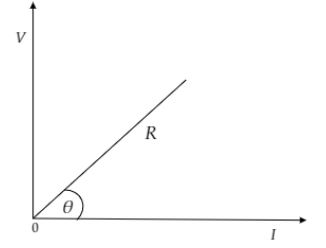
The above graph shows that the relation between potential difference and current flowing through a conductor is linear i.e., a straight line passing through the origin. The slope of the graph is the resistance of the conductor i.e, $\tan \theta = R$. Those conductors which follow the above graph are called ohmic conductors.
Complete step by step answer:
The relationship between potential difference $\left( V \right)$ and current $\left( I \right)$ through a conductor was first discovered by German scientist George Simon Ohm. This relationship is called Ohm’s law. The current $\left( I \right)$ flowing through a conductor is directly proportional to the potential difference $\left( V \right)$ across its ends provided the physical condition (temperature, strain, etc.) do not change.
$I \propto V$
$\therefore \dfrac{V}{I} = R$
Where $R$ is a constant of proportionality and is known as resistance of the conductor.
Hence,the relation between $\left( V \right)$, can also be written as $V = IR$.
Note: A conductor is said to have a resistance of one ohm if a potential difference of one volt across its ends causes a current of one ampere to flow through it.The plot between potential differences and electric current flowing through a conductor is given below.
The above graph shows that the relation between potential difference and current flowing through a conductor is linear i.e., a straight line passing through the origin. The slope of the graph is the resistance of the conductor i.e, $\tan \theta = R$. Those conductors which follow the above graph are called ohmic conductors.
Recently Updated Pages
Master Class 10 Computer Science: Engaging Questions & Answers for Success

Master Class 10 General Knowledge: Engaging Questions & Answers for Success
Master Class 10 English: Engaging Questions & Answers for Success
Master Class 10 Social Science: Engaging Questions & Answers for Success
Master Class 10 Maths: Engaging Questions & Answers for Success
Master Class 10 Science: Engaging Questions & Answers for Success
Trending doubts
What is the median of the first 10 natural numbers class 10 maths CBSE
Which women's tennis player has 24 Grand Slam singles titles?
Who is the Brand Ambassador of Incredible India?
Why is there a time difference of about 5 hours between class 10 social science CBSE
Write a letter to the principal requesting him to grant class 10 english CBSE
A moving boat is observed from the top of a 150 m high class 10 maths CBSE