




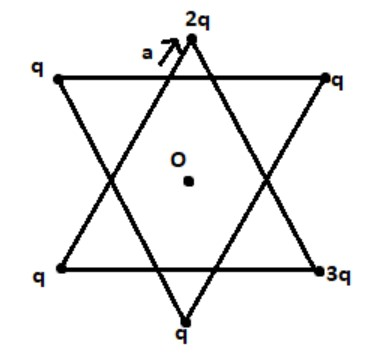
Positive point charges are placed at the vertices of a star shape as shown in the figure. Direction of the electrostatic force on a negative point charge at the centre O of the star is:
A. Neither along horizontal or vertical direction
B. Vertically up
C. Towards left
D. Vertically down
Answer
 Verified
629.1k+ views
Hint: We have to use the superposition principle to find the net electrostatic force on the charge kept at the center of the star structure.
Complete step by step solution:
Electrostatic force between two charges $q\text{ and }2q$ is the resultant of the force between the system of two combination of charge $\left( q,q \right)\text{ and }\left( q,q \right)$
Using symmetry of the structure,
If all the vertices have the same charge $q$ then the net force on the charge kept at the center is zero.
The remaining charge $\left( 2q-q=q \right)$on the top will apply force in vertically upward direction and the remaining charge $\left( 3q-q=2q \right)$will apply force along the vertices having charge $2q$.
As we know that the magnitude of force is given as $F=\dfrac{K{{Q}_{1}}{{Q}_{2}}}{{{r}^{2}}}$
Angle between force towards vertically up and the force towards $3q$vertex is $120{}^\circ $
Therefore, the resultant force will be in between the top and $3q$ vertex.
Hence, the direction of net force is neither horizontal nor the vertical.
Note: The principle of superposition states that every charge in space creates an electric field at point independent of the presence of other charges in that medium. The resultant electric field is a vector sum of the electric field due to individual charges.
Complete step by step solution:
Electrostatic force between two charges $q\text{ and }2q$ is the resultant of the force between the system of two combination of charge $\left( q,q \right)\text{ and }\left( q,q \right)$
Using symmetry of the structure,
If all the vertices have the same charge $q$ then the net force on the charge kept at the center is zero.
The remaining charge $\left( 2q-q=q \right)$on the top will apply force in vertically upward direction and the remaining charge $\left( 3q-q=2q \right)$will apply force along the vertices having charge $2q$.
As we know that the magnitude of force is given as $F=\dfrac{K{{Q}_{1}}{{Q}_{2}}}{{{r}^{2}}}$
Angle between force towards vertically up and the force towards $3q$vertex is $120{}^\circ $
Therefore, the resultant force will be in between the top and $3q$ vertex.
Hence, the direction of net force is neither horizontal nor the vertical.
Note: The principle of superposition states that every charge in space creates an electric field at point independent of the presence of other charges in that medium. The resultant electric field is a vector sum of the electric field due to individual charges.
Recently Updated Pages
Master Class 11 English: Engaging Questions & Answers for Success

Master Class 11 Social Science: Engaging Questions & Answers for Success
Master Class 11 Maths: Engaging Questions & Answers for Success
Master Class 11 Biology: Engaging Questions & Answers for Success
Master Class 11 Physics: Engaging Questions & Answers for Success
Master Class 11 Chemistry: Engaging Questions & Answers for Success
Trending doubts
One Metric ton is equal to kg A 10000 B 1000 C 100 class 11 physics CBSE
Difference Between Prokaryotic Cells and Eukaryotic Cells
Find the value of the expression given below sin 30circ class 11 maths CBSE
Difference between physical and chemical change class 11 chemistry CBSE
Two of the body parts which do not appear in MRI are class 11 biology CBSE
Draw a diagram of a plant cell and label at least eight class 11 biology CBSE