




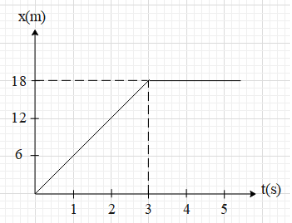
Position-time graph of a body of mass 5 kg is given in the diagram. The impulse on body at $t=3s$ is
A. $30\widehat{i}kgm{{s}^{-1}}$
B. $-30\widehat{i}kgm{{s}^{-1}}$
C. $6\widehat{i}kgm{{s}^{-1}}$
D. $-6\widehat{i}kgm{{s}^{-1}}$
Answer
 Verified
556.8k+ views
Hint: Analyse the given graph. Check what is happening to the motion of the body before time $t=3s$ and after time $t=3s$ and calculate the velocities before and after $t=3s$. Then use the formula for impulse and calculate the impulse on the body at $t=3s$.
Formula used:
$v=\dfrac{\Delta x}{\Delta t}$
where v is the constant velocity of a body with change in position of $\Delta x$ in a time interval of $\Delta t$.
$\Delta P=m\left( {{v}_{2}}-{{v}_{1}} \right)$
where $\Delta P$ is the impulse on a body of mass m when its velocity change from ${{v}_{2}}$ to ${{v}_{1}}$.
Complete step by step answer:
For the given figure, we can see that the graph of position – time graph of the body shows a straight line before time $t=3s$. This means that the position of the body is changing uniformly with respect to time. Therefore, the body is travelling with constant velocity before time $t=3s$.With this, the speed of the body before $t=3s$ is ${{v}_{1}}=\dfrac{\Delta x}{\Delta t}$ … (i)
From the graph, we get that $\Delta x=18m$ and $\Delta t=3s$.
Substitute these values in equation (i).
$\Rightarrow {{v}_{1}}=\dfrac{18}{3}=6m{{s}^{-1}}$
Now, in the graph we can see that just after time $t=3s$ the position of the body remains constant with respect to time. This means that the body comes to rest at time $t=3s$, and remains at rest. Since the body is at rest, its velocity is zero i.e. ${{v}_{2}}=0$.
This means that at time $t=3s$, the velocity of the body change from ${{v}_{1}}=6m{{s}^{-1}}$ to ${{v}_{2}}=0$.
Therefore, the impulse on the body at $t=3s$ is $\Delta P=m\left( {{v}_{2}}-{{v}_{1}} \right)=5\left( 0-6 \right)=-30kgm{{s}^{-1}}$.
Now, since the body’s position is increasing along the x-axis, we can write the impulse in vector form as $-30\widehat{i}kgm{{s}^{-1}}$.
Hence, the correct option is B.
Note: Some of the students may not know what is meant by impulse created on a body Impulse on a body is the change in momentum created in a body.Note that it is final momentum minus initial momentum. Some students may make a mistake by subtracting the initial momentum from the final momentum.
Formula used:
$v=\dfrac{\Delta x}{\Delta t}$
where v is the constant velocity of a body with change in position of $\Delta x$ in a time interval of $\Delta t$.
$\Delta P=m\left( {{v}_{2}}-{{v}_{1}} \right)$
where $\Delta P$ is the impulse on a body of mass m when its velocity change from ${{v}_{2}}$ to ${{v}_{1}}$.
Complete step by step answer:
For the given figure, we can see that the graph of position – time graph of the body shows a straight line before time $t=3s$. This means that the position of the body is changing uniformly with respect to time. Therefore, the body is travelling with constant velocity before time $t=3s$.With this, the speed of the body before $t=3s$ is ${{v}_{1}}=\dfrac{\Delta x}{\Delta t}$ … (i)
From the graph, we get that $\Delta x=18m$ and $\Delta t=3s$.
Substitute these values in equation (i).
$\Rightarrow {{v}_{1}}=\dfrac{18}{3}=6m{{s}^{-1}}$
Now, in the graph we can see that just after time $t=3s$ the position of the body remains constant with respect to time. This means that the body comes to rest at time $t=3s$, and remains at rest. Since the body is at rest, its velocity is zero i.e. ${{v}_{2}}=0$.
This means that at time $t=3s$, the velocity of the body change from ${{v}_{1}}=6m{{s}^{-1}}$ to ${{v}_{2}}=0$.
Therefore, the impulse on the body at $t=3s$ is $\Delta P=m\left( {{v}_{2}}-{{v}_{1}} \right)=5\left( 0-6 \right)=-30kgm{{s}^{-1}}$.
Now, since the body’s position is increasing along the x-axis, we can write the impulse in vector form as $-30\widehat{i}kgm{{s}^{-1}}$.
Hence, the correct option is B.
Note: Some of the students may not know what is meant by impulse created on a body Impulse on a body is the change in momentum created in a body.Note that it is final momentum minus initial momentum. Some students may make a mistake by subtracting the initial momentum from the final momentum.
Recently Updated Pages
Master Class 11 Computer Science: Engaging Questions & Answers for Success

Master Class 11 Business Studies: Engaging Questions & Answers for Success
Master Class 11 Economics: Engaging Questions & Answers for Success
Master Class 11 English: Engaging Questions & Answers for Success
Master Class 11 Maths: Engaging Questions & Answers for Success
Master Class 11 Biology: Engaging Questions & Answers for Success
Trending doubts
One Metric ton is equal to kg A 10000 B 1000 C 100 class 11 physics CBSE
There are 720 permutations of the digits 1 2 3 4 5 class 11 maths CBSE
Discuss the various forms of bacteria class 11 biology CBSE
Draw a diagram of a plant cell and label at least eight class 11 biology CBSE
State the laws of reflection of light
Explain zero factorial class 11 maths CBSE