




Porifera is triploblastic or diploblastic?
Answer
 Verified
529.8k+ views
Hint: Members of the phylum Porifera, sponges are multicellular organisms with holes and channels that allow water to flow through them. Their bodies are made up of jelly-like mesophyll placed in between the two thin layers of cells. Spongiology is the discipline of zoology that examines sponges.
Complete answer:
Sponge is the common name for poriferans. The phylum Porifera, which includes roughly 5,000 living sponge species, is divided into three groups : the Hexactinellida (glass sponges), Demospongia and Calcarea (calcareous sponges).
Porifera are mostly marine aquatic animals, with a few freshwater species thrown in for good measure. They have asymmetrical bodies.
Cylindrical, vase-like, spherical, or sac-like body shapes are all possible. They have two layers, the outer dermal layer and the inner gastro layer, and hence are diploblastic creatures.
Distinguished by a feeding strategy that is unique among animals, the poriferans don't have a mouth system; instead water is sucked through microscopic holes or pores found in their exterior walls. As the water is circulated through the body and out of the other larger apertures, cells in the sponge walls sift out the good stuff. Sponge cells execute a wide range of biological tasks and appear to be more self-contained than other animal cells.
Note:
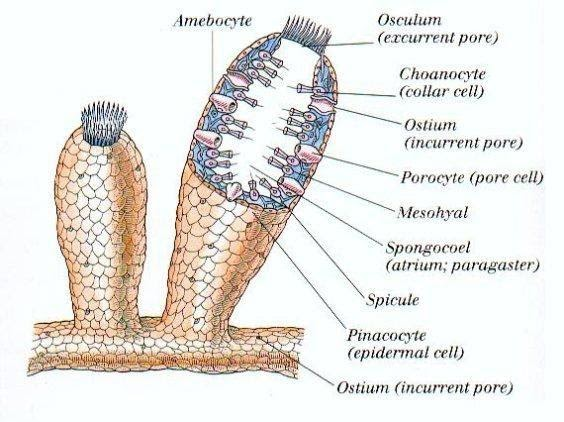
A blastula is a spherical, hollow, one cell thick structure seen at the initial stage of embryogenesis and is known as the 'pre-embryo'. Diploblastic and triploblastic refer to two different varieties of blastula stages. Diploblastic and triploblastic animals vary where the diploblastic animals develop two germ layers (excluding mesoderm), whereas triploblastic animals create all three germ layers. Image of a Phylum Porifera is as follows:
Complete answer:
Sponge is the common name for poriferans. The phylum Porifera, which includes roughly 5,000 living sponge species, is divided into three groups : the Hexactinellida (glass sponges), Demospongia and Calcarea (calcareous sponges).
Porifera are mostly marine aquatic animals, with a few freshwater species thrown in for good measure. They have asymmetrical bodies.
Cylindrical, vase-like, spherical, or sac-like body shapes are all possible. They have two layers, the outer dermal layer and the inner gastro layer, and hence are diploblastic creatures.
Distinguished by a feeding strategy that is unique among animals, the poriferans don't have a mouth system; instead water is sucked through microscopic holes or pores found in their exterior walls. As the water is circulated through the body and out of the other larger apertures, cells in the sponge walls sift out the good stuff. Sponge cells execute a wide range of biological tasks and appear to be more self-contained than other animal cells.
Note:
A blastula is a spherical, hollow, one cell thick structure seen at the initial stage of embryogenesis and is known as the 'pre-embryo'. Diploblastic and triploblastic refer to two different varieties of blastula stages. Diploblastic and triploblastic animals vary where the diploblastic animals develop two germ layers (excluding mesoderm), whereas triploblastic animals create all three germ layers. Image of a Phylum Porifera is as follows:
Recently Updated Pages
Master Class 11 English: Engaging Questions & Answers for Success

Master Class 11 Social Science: Engaging Questions & Answers for Success
Master Class 11 Maths: Engaging Questions & Answers for Success
Master Class 11 Biology: Engaging Questions & Answers for Success
Master Class 11 Physics: Engaging Questions & Answers for Success
Master Class 11 Chemistry: Engaging Questions & Answers for Success
Trending doubts
One Metric ton is equal to kg A 10000 B 1000 C 100 class 11 physics CBSE
Difference Between Prokaryotic Cells and Eukaryotic Cells
Find the value of the expression given below sin 30circ class 11 maths CBSE
Difference between physical and chemical change class 11 chemistry CBSE
Two of the body parts which do not appear in MRI are class 11 biology CBSE
Draw a diagram of a plant cell and label at least eight class 11 biology CBSE