




What is polygamous? Give an example.
Answer
 Verified
575.7k+ views
Hint: The condition in which both the unisexual flowers (having male parts or the female parts in the same or different flower) and the bisexual flowers (having both the male and the female parts in the same flower) are present on the same branch.
Complete answer
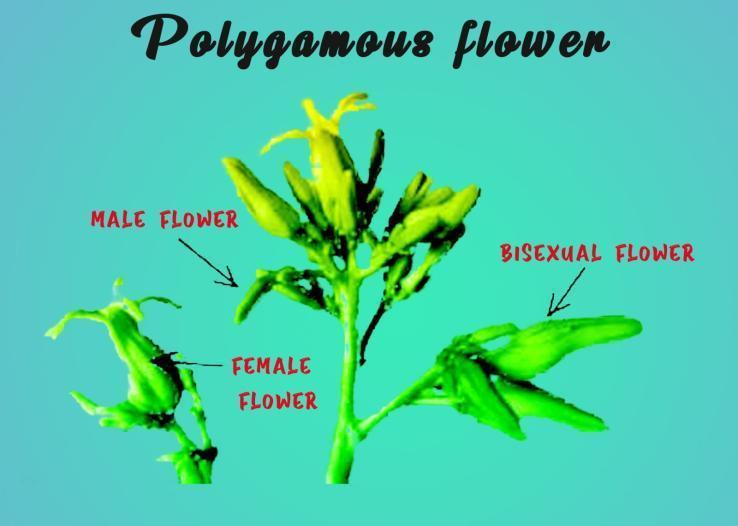
The plants consisting of the three types of flowers on the same branch that includes the pistillate flowers (flowers that consist of female parts), staminate flowers (flowers that consist of male parts), and the bisexual flowers are called the polygamous flowers. Examples of these flowers are Banana, Mango, Red maple, etc.
The name polygamous is derived from two words, ply means many and famous means reproductive organs. Overall it refers to the flowers having many reproductive organs in the same plant. It can also be said that the plants containing both the bisexual flowers along with the either male flower or the female flower are said to be polygamous in nature. In the case of the Mango plants, the male and the female flowers are present on the same tree. The flowers of the Mango are white and small that are arranged in the terminal panicle inflorescence. The petals of these flowers are five in number. In these flowers, the chances of cross-pollination are higher as the stamens and the carpels are present in the same flower. The transfer of pollen grains from the anther to the stigma of a different plant is a type of cross-pollination called xenogamy. During this type of pollination, the pollen that come to the stigma are genetically different.
Note:
The polygamous flowers are those flowers that are also called polygamomonoecious or trimonoecious. The flowers that are dioecious in nature and have few bisexual flowers or fee wither male or female plants in the same plant are termes as Polygamodioecious flowers while those flowers that are monoecious in nature and are partly polygamous are termed as Polyganomonoecious.
Complete answer
The plants consisting of the three types of flowers on the same branch that includes the pistillate flowers (flowers that consist of female parts), staminate flowers (flowers that consist of male parts), and the bisexual flowers are called the polygamous flowers. Examples of these flowers are Banana, Mango, Red maple, etc.
The name polygamous is derived from two words, ply means many and famous means reproductive organs. Overall it refers to the flowers having many reproductive organs in the same plant. It can also be said that the plants containing both the bisexual flowers along with the either male flower or the female flower are said to be polygamous in nature. In the case of the Mango plants, the male and the female flowers are present on the same tree. The flowers of the Mango are white and small that are arranged in the terminal panicle inflorescence. The petals of these flowers are five in number. In these flowers, the chances of cross-pollination are higher as the stamens and the carpels are present in the same flower. The transfer of pollen grains from the anther to the stigma of a different plant is a type of cross-pollination called xenogamy. During this type of pollination, the pollen that come to the stigma are genetically different.
Note:
The polygamous flowers are those flowers that are also called polygamomonoecious or trimonoecious. The flowers that are dioecious in nature and have few bisexual flowers or fee wither male or female plants in the same plant are termes as Polygamodioecious flowers while those flowers that are monoecious in nature and are partly polygamous are termed as Polyganomonoecious.
Recently Updated Pages
Difference Between Prokaryotic Cells and Eukaryotic Cells

If x a + bt + ct2 where x is in meters and t is in class 11 physics CBSE
A car covers the first half distance between two places class 11 physics CBSE
The resultant of two vectors overrightarrow P and overrightarrow class 11 physics CBSE
Find the value of cos 135 class 11 maths CBSE
A mass M is held in place by an applied force F and class 11 physics CBSE
Trending doubts
One Metric ton is equal to kg A 10000 B 1000 C 100 class 11 physics CBSE
Find the value of the expression given below sin 30circ class 11 maths CBSE
Draw a diagram of nephron and explain its structur class 11 biology CBSE
10 examples of friction in our daily life
Proton was discovered by A Thomson B Rutherford C Chadwick class 11 chemistry CBSE
Bond order ofO2 O2+ O2 and O22 is in order A O2 langle class 11 chemistry CBSE