




Pollinium is found in family
(a) Asclepiadaceae
(b) Rubiaceae
(c) Solanaceae
(d) Myrtaceae
Answer
 Verified
665.4k+ views
Hint: They are mainly erect herbs or woody climbers that are generally found in tropical regions of the world. This is often regularly seen in plants like orchids and lots of species of milkweeds.
Complete Answer:
Pollinum or the pollina are found in the Asclepiadaceae family which is a group of anthers that are held together. They are plants, herbs, shrubs, mostly twiners, and rare trees. Their leaves are opposite, simple, entire margins rarely alternate. The plants of this family contain the microsporangia or the pollen grains and ovaries and style are free, the only stigma fused to form discs that are required for the reproduction of the plant. Pollinium is a coherent mass of pollen grains during a plant that is the product of just one another but is transferred, during pollination, as a single unit.
Additional information:
- The Rubiaceae are a family of flowering plants, also known as the coffee and bedstraw family. It consists of terrestrial trees, shrubs, lianas, or herbs. - Solanaceae is a family characterized by flowers with five petals, sepals, stamens, and alternate leaves. Many of the species of this family have toxic alkaloids.
- Myrtaceae are a family of dicotyledonous plants placed within the order Myrtales. Myrtle, pohutukawa, bay rum tree, clove, guava, acca, and eucalyptus are some notable members of this group. All species are woody, contain essential oils, and have flower parts in multiples of four or five.
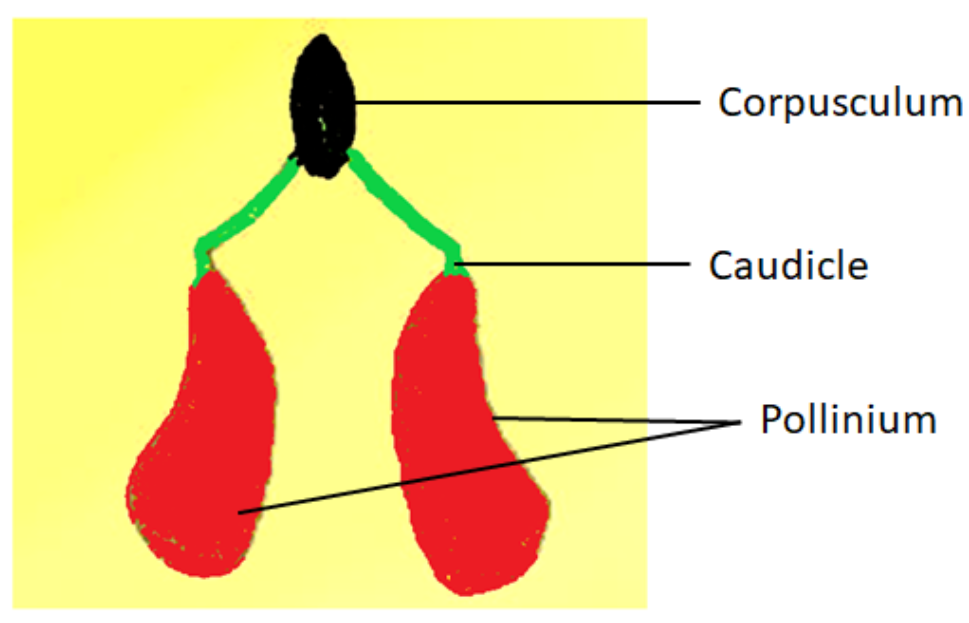
So, the correct answer is ‘Asclepiadaceae’.
Note: The Asclepiadaceae, commonly known as milkweed family. Many new hybrids have been formed due to the unique fertilization method of the flowers. The source of medicine in the family is latex from which alkaloids are extracted. They are also used as ornamentals. Cryptostegia Grandiflora( family-Asclepiadaceae) is a natural source of rubber in India.
Complete Answer:
Pollinum or the pollina are found in the Asclepiadaceae family which is a group of anthers that are held together. They are plants, herbs, shrubs, mostly twiners, and rare trees. Their leaves are opposite, simple, entire margins rarely alternate. The plants of this family contain the microsporangia or the pollen grains and ovaries and style are free, the only stigma fused to form discs that are required for the reproduction of the plant. Pollinium is a coherent mass of pollen grains during a plant that is the product of just one another but is transferred, during pollination, as a single unit.
Additional information:
- The Rubiaceae are a family of flowering plants, also known as the coffee and bedstraw family. It consists of terrestrial trees, shrubs, lianas, or herbs. - Solanaceae is a family characterized by flowers with five petals, sepals, stamens, and alternate leaves. Many of the species of this family have toxic alkaloids.
- Myrtaceae are a family of dicotyledonous plants placed within the order Myrtales. Myrtle, pohutukawa, bay rum tree, clove, guava, acca, and eucalyptus are some notable members of this group. All species are woody, contain essential oils, and have flower parts in multiples of four or five.
So, the correct answer is ‘Asclepiadaceae’.
Note: The Asclepiadaceae, commonly known as milkweed family. Many new hybrids have been formed due to the unique fertilization method of the flowers. The source of medicine in the family is latex from which alkaloids are extracted. They are also used as ornamentals. Cryptostegia Grandiflora( family-Asclepiadaceae) is a natural source of rubber in India.
Recently Updated Pages
Master Class 12 Physics: Engaging Questions & Answers for Success

Master Class 12 Social Science: Engaging Questions & Answers for Success
Master Class 12 English: Engaging Questions & Answers for Success
Master Class 12 Maths: Engaging Questions & Answers for Success
Master Class 12 Business Studies: Engaging Questions & Answers for Success
Master Class 12 Chemistry: Engaging Questions & Answers for Success
Trending doubts
Draw a labelled sketch of the human eye class 12 physics CBSE
Which are the Top 10 Largest Countries of the World?
Draw ray diagrams each showing i myopic eye and ii class 12 physics CBSE
One megawatt is equal to how many units of electri class 12 physics CBSE
Which is the correct genotypic ratio of mendel dihybrid class 12 biology CBSE
Give 10 examples of unisexual and bisexual flowers