




Pollination takes place by the agency of the bird is known as
Answer
 Verified
622.8k+ views
Hint: This type of pollination takes place by the birds with long beaks. It is the process of transfer of pollen grains from the male of a flower to the female stigma.
Complete step-by-step answer:
Pollination by the agency of birds is known as ornithophily. The flowers are usually large, colorful, and often tubular and have sweet nectar. Birds involved in ornithophily tend to be nectar lovers with brushy tongues and long bills which are either capable of hovering flight or light enough to perch on the flower structures, hummingbirds show this type of pollination.
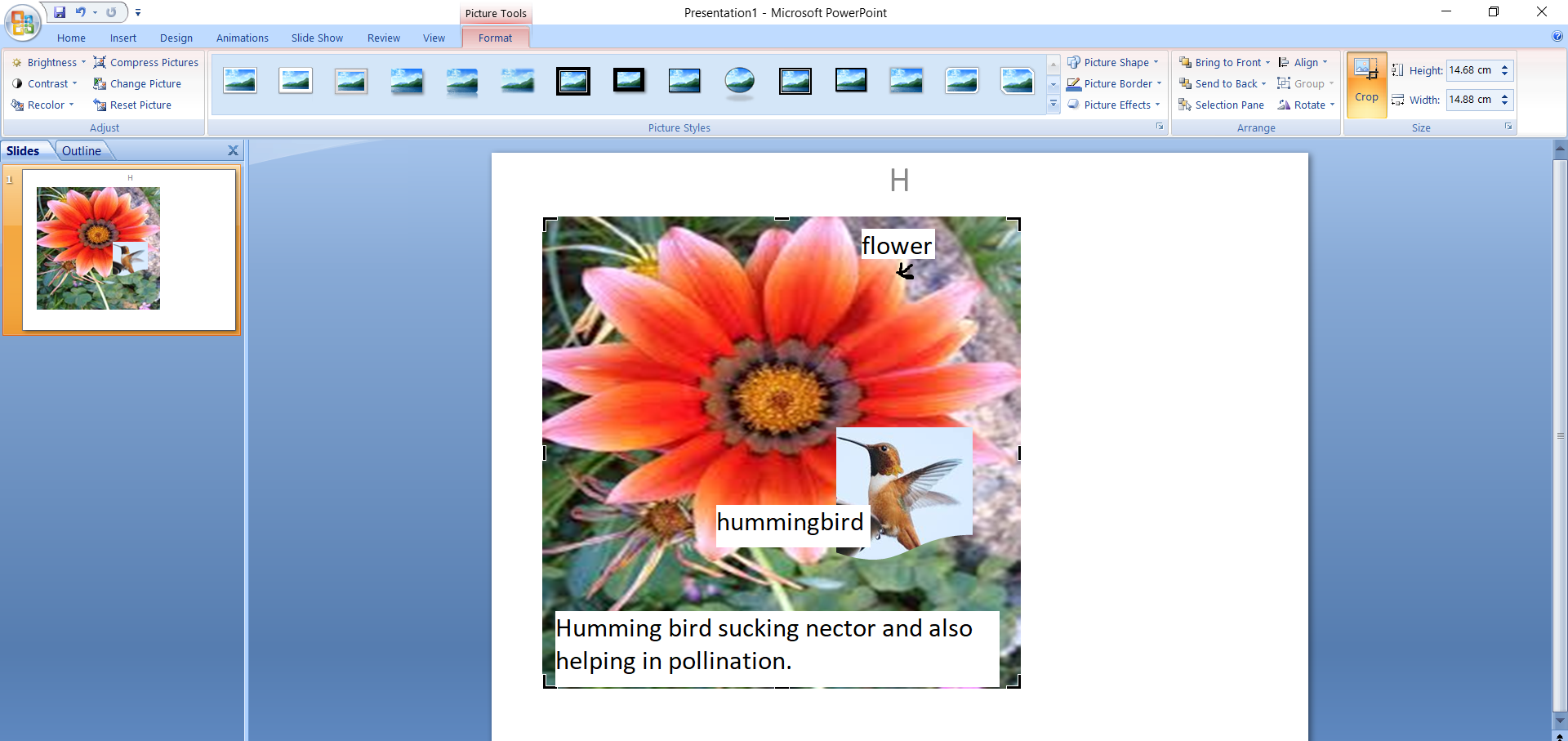
Additional Information: - Pollination is important because it leads to the production of fruits and seeds which in turn can create more plants.
- Pollinators receive nectar and/or pollen rewards from the flowers like sugary nectar provides pollinators with carbohydrates while pollen offers proteins, fats, vitamins, and necessary phytochemicals.
-The offspring produced is usually healthy, viable, and stronger.
- Undesirable characters of the plant can be eliminated, and the possibility to get new desirable characters.
- Two types of pollination- The transfer of pollen from another plant to the flower of another plant is known as cross-pollination. The pollination of a flower by pollen from the same flower or another flower on the same plant is known as self-pollination.
- In plants, after pollination, fertilization occurs when haploid gametes (pollen grain and egg) by certain agents meet to create a diploid zygote, leading to an embryo.
Note: There are other biotic agents like insects, bats and ants etc. that help in pollination. Pollination by the agency of ants is called myrmecophily, pollination by the agency of bats is called chiropterophily, and pollination by the agency of insects is called entomophily.
Complete step-by-step answer:
Pollination by the agency of birds is known as ornithophily. The flowers are usually large, colorful, and often tubular and have sweet nectar. Birds involved in ornithophily tend to be nectar lovers with brushy tongues and long bills which are either capable of hovering flight or light enough to perch on the flower structures, hummingbirds show this type of pollination.
Additional Information: - Pollination is important because it leads to the production of fruits and seeds which in turn can create more plants.
- Pollinators receive nectar and/or pollen rewards from the flowers like sugary nectar provides pollinators with carbohydrates while pollen offers proteins, fats, vitamins, and necessary phytochemicals.
-The offspring produced is usually healthy, viable, and stronger.
- Undesirable characters of the plant can be eliminated, and the possibility to get new desirable characters.
- Two types of pollination- The transfer of pollen from another plant to the flower of another plant is known as cross-pollination. The pollination of a flower by pollen from the same flower or another flower on the same plant is known as self-pollination.
- In plants, after pollination, fertilization occurs when haploid gametes (pollen grain and egg) by certain agents meet to create a diploid zygote, leading to an embryo.
Note: There are other biotic agents like insects, bats and ants etc. that help in pollination. Pollination by the agency of ants is called myrmecophily, pollination by the agency of bats is called chiropterophily, and pollination by the agency of insects is called entomophily.
Recently Updated Pages
Master Class 11 English: Engaging Questions & Answers for Success

Master Class 11 Social Science: Engaging Questions & Answers for Success
Master Class 11 Maths: Engaging Questions & Answers for Success
Master Class 11 Biology: Engaging Questions & Answers for Success
Master Class 11 Physics: Engaging Questions & Answers for Success
Master Class 11 Chemistry: Engaging Questions & Answers for Success
Trending doubts
One Metric ton is equal to kg A 10000 B 1000 C 100 class 11 physics CBSE
Difference Between Prokaryotic Cells and Eukaryotic Cells
Two of the body parts which do not appear in MRI are class 11 biology CBSE
Find the value of the expression given below sin 30circ class 11 maths CBSE
Draw a diagram of a plant cell and label at least eight class 11 biology CBSE
10 examples of friction in our daily life