




What is pollination? State its types.
Answer
 Verified
616.5k+ views
Hint: The anther and the stigma are the sexual reproductive parts of a flower. The result of their union is the fruits we eat. The end product of sexual reproduction in flowering plants is a seed.
Complete step by step answer: Pollination is a type of sexual reproduction that takes place in flower-bearing plants. The act of falling and sticking the pollen grains from anthers over the surface of the stigma of a mature flower is termed as the pollination process. The anthers or the pollen grains can be of the same or different flower.
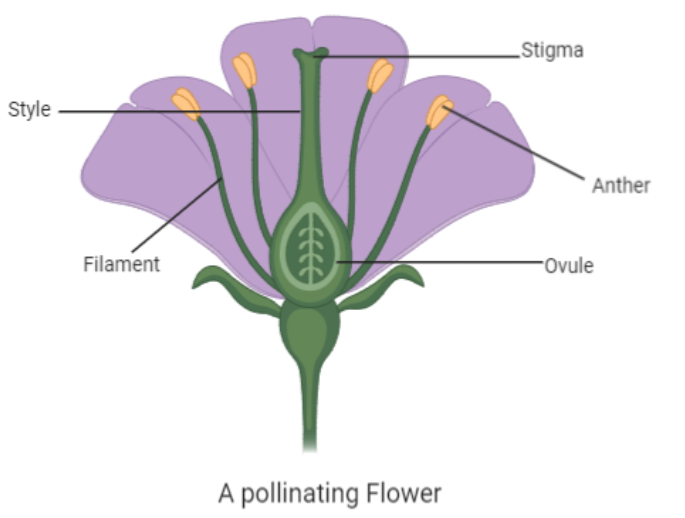
-The stigma and the ovule are the female parts of a flower and the anther and filament are the male parts of a flower. The process of pollination leads to the process of fertilization and then the production of seeds.
-Pollination is derived from various environmental factors. Animals and wind play a major role in pollination. The pollen grains in an anther are very light in weight and float easily in the air.
-In some flowers, the pollens have a sticky chemical substance over them that is used to stick over pollinating animal bodies such as bees, insects, and birds. These pollinating animals when the feed for nectar sticks some pollen grains over them and deposits them over stigmas of the flowers of the same or different plants.
-The stigma has a sticky surface over which the pollen sticks easily and forms a pollinating tube through which the male nucleus passes to the female nucleus in the ovule of the flower to begin fertilization. The process of pollination can happen in various ways.
-Based on this diversification there are various types of pollination in nature.
a. Self-pollination is when the anthers of a flower deposit their pollen over the stigma of the same flower.
b. Cross-pollination happens when the stigma which receives pollen from an anther of a flower is on the same plant but not the same flower.
-Based on the medium through which pollination takes place it is majorly of two types.
i. Anemophily- When the wind acts as the factor for depositing pollen over the stigma it is called wind pollination or Anemophily.
ii. Entomophily- When the insects are employed as factors transferring pollen from anther to stigma it is called insect pollination or Entomophily.
Note: There are various other factors that act as pollinators for flowers such as water. It should be noted that after pollination, fertilization proceeds only if the pollen grains are compatible with the genetic makeup of the ovule of the flower. The terms pollination and fertilization should not be confused. They both are different processes.
Complete step by step answer: Pollination is a type of sexual reproduction that takes place in flower-bearing plants. The act of falling and sticking the pollen grains from anthers over the surface of the stigma of a mature flower is termed as the pollination process. The anthers or the pollen grains can be of the same or different flower.
-The stigma and the ovule are the female parts of a flower and the anther and filament are the male parts of a flower. The process of pollination leads to the process of fertilization and then the production of seeds.
-Pollination is derived from various environmental factors. Animals and wind play a major role in pollination. The pollen grains in an anther are very light in weight and float easily in the air.
-In some flowers, the pollens have a sticky chemical substance over them that is used to stick over pollinating animal bodies such as bees, insects, and birds. These pollinating animals when the feed for nectar sticks some pollen grains over them and deposits them over stigmas of the flowers of the same or different plants.
-The stigma has a sticky surface over which the pollen sticks easily and forms a pollinating tube through which the male nucleus passes to the female nucleus in the ovule of the flower to begin fertilization. The process of pollination can happen in various ways.
-Based on this diversification there are various types of pollination in nature.
a. Self-pollination is when the anthers of a flower deposit their pollen over the stigma of the same flower.
b. Cross-pollination happens when the stigma which receives pollen from an anther of a flower is on the same plant but not the same flower.
-Based on the medium through which pollination takes place it is majorly of two types.
i. Anemophily- When the wind acts as the factor for depositing pollen over the stigma it is called wind pollination or Anemophily.
ii. Entomophily- When the insects are employed as factors transferring pollen from anther to stigma it is called insect pollination or Entomophily.
Note: There are various other factors that act as pollinators for flowers such as water. It should be noted that after pollination, fertilization proceeds only if the pollen grains are compatible with the genetic makeup of the ovule of the flower. The terms pollination and fertilization should not be confused. They both are different processes.
Recently Updated Pages
Master Class 12 Business Studies: Engaging Questions & Answers for Success

Master Class 12 Chemistry: Engaging Questions & Answers for Success
Master Class 12 Biology: Engaging Questions & Answers for Success
Class 12 Question and Answer - Your Ultimate Solutions Guide
Master Class 11 English: Engaging Questions & Answers for Success
Master Class 11 Social Science: Engaging Questions & Answers for Success
Trending doubts
Which are the Top 10 Largest Countries of the World?
Draw a labelled sketch of the human eye class 12 physics CBSE
The end of compass needle which points towards north class 12 physics CBSE
Differentiate between homogeneous and heterogeneous class 12 chemistry CBSE
Why is the cell called the structural and functional class 12 biology CBSE
When was the first election held in India a 194748 class 12 sst CBSE