




What is the polar form of the complex number \[{{\left( {{i}^{25}} \right)}^{3}}\]?
Answer
 Verified
585.6k+ views
Hint: Take the complex number as z. Split the power of \[\left( 25\times 3 \right)\]. The polar form is given as \[z=r\left( \cos \theta +i\sin \theta \right)\]. Find r which is \[\left| z \right|\] and \[\theta \] = argument (z) and substitute back to the polar form.
Complete step by step answer:
We have been given a complex number as \[{{\left( {{i}^{25}} \right)}^{3}}\]. Let us assume this complex number as z.
$\Rightarrow z={{\left( {{i}^{25}} \right)}^{3}}$ ---(1).
From law of exponents, we know that \[{{\left( {{a}^{x}} \right)}^{y}}={{a}^{xy}}\], where x and y are any real numbers. We use this result in equation (1).
So, we get $z={{i}^{25\times 3}}$.
$\Rightarrow z={{i}^{75}}$.
$\Rightarrow z={{i}^{\left( 72+3 \right)}}$ ---(2).
From law of exponents, we know that ${{a}^{m+n}}={{a}^{m}}.{{a}^{n}}$, where m and n are any real numbers. We use this result in equation (2).
So, we have $z=\left( {{i}^{72}} \right)\times \left( {{i}^{3}} \right)$.
$\Rightarrow z=\left( {{i}^{4\times 18}} \right)\times \left( {{i}^{3}} \right)$ ---(3).
From law of exponents, we know that \[{{a}^{xy}}={{\left( {{a}^{x}} \right)}^{y}}\], where x and y are any real numbers. We use this result in equation (3).
$\Rightarrow z={{\left( {{i}^{4}} \right)}^{18}}\times \left( {{i}^{3}} \right)$ ---(4).
We know that \[i=\sqrt{-1}\], \[{{i}^{2}}=-1\], \[{{i}^{3}}=-i\] and \[{{i}^{4}}=+1\]. We use these values in equation (4).
$\Rightarrow z={{\left( 1 \right)}^{18}}\times \left( -i \right)$.
$\Rightarrow z=\left( 1 \right)\times \left( -i \right)$.
$\Rightarrow z=-i$.
So, we got, \[z={{i}^{75}}=-i\].
We know that the polar form of a complex number, z as \[z=r\left( \cos \theta +i\sin \theta \right)\], where \[r=\left| z \right|\] and \[\theta =\arg \left( z \right)\].
We got \[z=-i\], which can be written in the form of, \[z=x+iy\Rightarrow z=0-i\], where real part x is zero and the imaginary part is (-i).
\[\begin{align}
& \therefore \left| z \right|=\sqrt{{{x}^{2}}+{{y}^{2}}}=\sqrt{0+{{\left( -1 \right)}^{2}}}=\sqrt{+1}=1 \\
& \therefore r=\left| z \right|=1 \\
\end{align}\]
Similarly, to get the value of \[\theta \],
\[\tan \alpha \] = |Imaginary part of z / real part of z|=\[\left| \dfrac{\operatorname{Im}\left( z \right)}{\operatorname{Re}\left( z \right)} \right|=\left| \dfrac{-1}{0} \right|=\infty \]
Thus, \[\alpha =\dfrac{\pi }{2}\].
And as x = 0 and y = -1, < 0. The coordinate (x, y) lies in the IV quadrant.
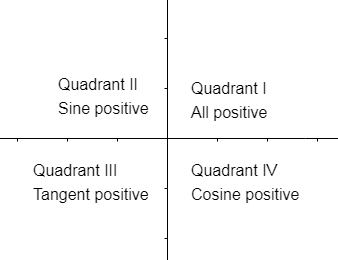
From the figure we can say that tangent function is quadrant IV is negative.
\[\therefore \alpha =-\dfrac{\pi }{2}\]
Hence we say that,
\[\arg \left( z \right)=\theta =\alpha =-\dfrac{\pi }{2}\]
Polar form of complex number,
\[\begin{align}
& z=r\left( \cos \theta +i\sin \theta \right) \\
& z=1\left[ \cos \left( \dfrac{-\pi }{2} \right)+i\sin \left( \dfrac{-\pi }{2} \right) \right] \\
& {{\left( {{i}^{25}} \right)}^{3}}=\cos \dfrac{\pi }{2}-i\sin \dfrac{\pi }{2} \\
\end{align}\]
So, we got the polar form of the given complex number \[{{\left( {{i}^{25}} \right)}^{3}}\].
Note: We should not directly take the value of \[\alpha =\dfrac{\pi }{2}\], without considering the quadrants which yields incorrect results. We should know about the concept of argument in each quadrant of complex numbers. We should not make calculation mistakes while using the law of exponents in this problem. Whenever we get this type of problem, we should try to convert them into the simpler form and then use the arguments to get the polar form.
Complete step by step answer:
We have been given a complex number as \[{{\left( {{i}^{25}} \right)}^{3}}\]. Let us assume this complex number as z.
$\Rightarrow z={{\left( {{i}^{25}} \right)}^{3}}$ ---(1).
From law of exponents, we know that \[{{\left( {{a}^{x}} \right)}^{y}}={{a}^{xy}}\], where x and y are any real numbers. We use this result in equation (1).
So, we get $z={{i}^{25\times 3}}$.
$\Rightarrow z={{i}^{75}}$.
$\Rightarrow z={{i}^{\left( 72+3 \right)}}$ ---(2).
From law of exponents, we know that ${{a}^{m+n}}={{a}^{m}}.{{a}^{n}}$, where m and n are any real numbers. We use this result in equation (2).
So, we have $z=\left( {{i}^{72}} \right)\times \left( {{i}^{3}} \right)$.
$\Rightarrow z=\left( {{i}^{4\times 18}} \right)\times \left( {{i}^{3}} \right)$ ---(3).
From law of exponents, we know that \[{{a}^{xy}}={{\left( {{a}^{x}} \right)}^{y}}\], where x and y are any real numbers. We use this result in equation (3).
$\Rightarrow z={{\left( {{i}^{4}} \right)}^{18}}\times \left( {{i}^{3}} \right)$ ---(4).
We know that \[i=\sqrt{-1}\], \[{{i}^{2}}=-1\], \[{{i}^{3}}=-i\] and \[{{i}^{4}}=+1\]. We use these values in equation (4).
$\Rightarrow z={{\left( 1 \right)}^{18}}\times \left( -i \right)$.
$\Rightarrow z=\left( 1 \right)\times \left( -i \right)$.
$\Rightarrow z=-i$.
So, we got, \[z={{i}^{75}}=-i\].
We know that the polar form of a complex number, z as \[z=r\left( \cos \theta +i\sin \theta \right)\], where \[r=\left| z \right|\] and \[\theta =\arg \left( z \right)\].
We got \[z=-i\], which can be written in the form of, \[z=x+iy\Rightarrow z=0-i\], where real part x is zero and the imaginary part is (-i).
\[\begin{align}
& \therefore \left| z \right|=\sqrt{{{x}^{2}}+{{y}^{2}}}=\sqrt{0+{{\left( -1 \right)}^{2}}}=\sqrt{+1}=1 \\
& \therefore r=\left| z \right|=1 \\
\end{align}\]
Similarly, to get the value of \[\theta \],
\[\tan \alpha \] = |Imaginary part of z / real part of z|=\[\left| \dfrac{\operatorname{Im}\left( z \right)}{\operatorname{Re}\left( z \right)} \right|=\left| \dfrac{-1}{0} \right|=\infty \]
Thus, \[\alpha =\dfrac{\pi }{2}\].
And as x = 0 and y = -1, < 0. The coordinate (x, y) lies in the IV quadrant.
From the figure we can say that tangent function is quadrant IV is negative.
\[\therefore \alpha =-\dfrac{\pi }{2}\]
Hence we say that,
\[\arg \left( z \right)=\theta =\alpha =-\dfrac{\pi }{2}\]
Polar form of complex number,
\[\begin{align}
& z=r\left( \cos \theta +i\sin \theta \right) \\
& z=1\left[ \cos \left( \dfrac{-\pi }{2} \right)+i\sin \left( \dfrac{-\pi }{2} \right) \right] \\
& {{\left( {{i}^{25}} \right)}^{3}}=\cos \dfrac{\pi }{2}-i\sin \dfrac{\pi }{2} \\
\end{align}\]
So, we got the polar form of the given complex number \[{{\left( {{i}^{25}} \right)}^{3}}\].
Note: We should not directly take the value of \[\alpha =\dfrac{\pi }{2}\], without considering the quadrants which yields incorrect results. We should know about the concept of argument in each quadrant of complex numbers. We should not make calculation mistakes while using the law of exponents in this problem. Whenever we get this type of problem, we should try to convert them into the simpler form and then use the arguments to get the polar form.
Recently Updated Pages
Master Class 11 Computer Science: Engaging Questions & Answers for Success

Master Class 11 Business Studies: Engaging Questions & Answers for Success
Master Class 11 Economics: Engaging Questions & Answers for Success
Master Class 11 English: Engaging Questions & Answers for Success
Master Class 11 Maths: Engaging Questions & Answers for Success
Master Class 11 Biology: Engaging Questions & Answers for Success
Trending doubts
One Metric ton is equal to kg A 10000 B 1000 C 100 class 11 physics CBSE
There are 720 permutations of the digits 1 2 3 4 5 class 11 maths CBSE
Discuss the various forms of bacteria class 11 biology CBSE
Draw a diagram of a plant cell and label at least eight class 11 biology CBSE
State the laws of reflection of light
Explain zero factorial class 11 maths CBSE