




Points $ A\left( {4,1} \right) $ lies on a line :
$ \left( A \right){\text{ }}x + 2y = 5 $
$ \left( B \right){\text{ }}x + 2y = 6 $
$ \left( C \right){\text{ }}x + 2y = 16 $
$ \left( D \right){\text{ }}x + 2y = - 6 $
Answer
 Verified
533.7k+ views
Hint: If a point $ \left( {x,y} \right) $ lies on a line, then the equation of the line must be satisfied by the given point $ \left( {x,y} \right), $ means by substituting the values of $ x{\text{ and }}y $ , the equation should hold true. Hence to solve this question we will put the given values of $ x{\text{ and }}y $ in all the given equations and the equation which will satisfy these values will be our answer. The equation of a line in slope intercept form is written as, $ y = mx + c $ ; where $ m $ is the slope or gradient of the line and $ c $ is called the intercept on the $ y - axis $ . The slope or gradient of a line is calculated by the formula , $ m = \dfrac{{{y_2} - {y_1}}}{{{x_2} - {x_1}}} $ where $ \left( {{x_1},{y_1}} \right){\text{ and }}\left( {{x_2},{y_2}} \right) $ are called the starting and end points of the line respectively.
Complete step-by-step answer:
The given point is : $ \left( {x,y} \right) = \left( {4,1} \right) $
The quadrant system is shown in the figure below:
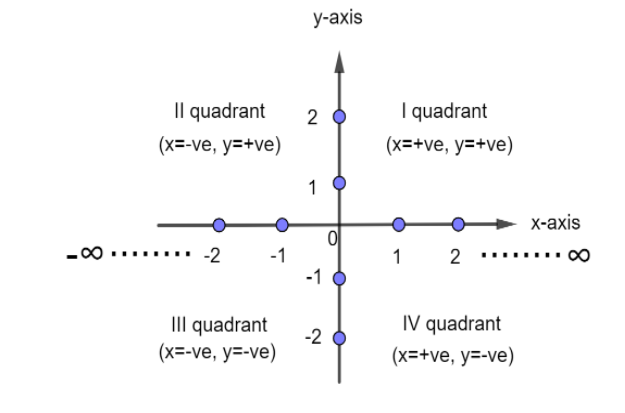
According to the quadrant system shown above, the given point $ A\left( {4,1} \right) $ lies in the first quadrant as both the values are positive.
Now, we will have to check for all the equations given in the question one by one:
$ \left( A \right){\text{ }}x + 2y = 5 $
$ \Rightarrow x = 4{\text{ and }}y = 1 $ (Given)
Put the values of $ x{\text{ and }}y $ in the given equation, we get;
$ {\text{L}}{\text{.H}}{\text{.S}}{\text{.}} \Rightarrow {\text{ 4}} + \left( {2 \times 1} \right) = 6 $
$ {\text{R}}{\text{.H}}{\text{.S}}{\text{. = 5}} $
$ \Rightarrow 6 \ne 5 $
Hence, $ {\text{L}}{\text{.H}}{\text{.S}}{\text{.}} \ne {\text{R}}{\text{.H}}{\text{.S}}{\text{.}} $
Therefore, option A can not be the correct answer.
$ \left( B \right){\text{ }}x + 2y = 6 $
$ \Rightarrow x = 4{\text{ and }}y = 1 $ (Given)
Put the values of $ x{\text{ and }}y $ in the given equation, we get;
$ {\text{L}}{\text{.H}}{\text{.S}}{\text{.}} \Rightarrow {\text{ 4}} + \left( {2 \times 1} \right) = 6 $
R.H.S. = 6
$ \Rightarrow 6 = 6 $
Hence, $ {\text{L}}{\text{.H}}{\text{.S}}{\text{. = R}}{\text{.H}}{\text{.S}}{\text{.}} $
Therefore, option B is the correct answer for this question.
$ \left( C \right){\text{ }}x + 2y = 16 $
$ \Rightarrow x = 4{\text{ and }}y = 1 $ (Given)
Put the values of $ x{\text{ and }}y $ in the given equation, we get;
$ {\text{L}}{\text{.H}}{\text{.S}}{\text{.}} \Rightarrow {\text{ 4}} + \left( {2 \times 1} \right) = 6 $
$ {\text{R}}{\text{.H}}{\text{.S}}{\text{. = 16}} $
$ \Rightarrow 6 \ne 16 $
Hence, $ {\text{L}}{\text{.H}}{\text{.S}}{\text{.}} \ne {\text{ R}}{\text{.H}}{\text{.S}}{\text{.}} $
Therefore, option C can not be the correct answer.
$ \left( D \right){\text{ }}x + 2y = - 6 $
$ \Rightarrow x = 4{\text{ and }}y = 1 $ (Given)
Put the values of $ x{\text{ and }}y $ in the given equation, we get;
$ {\text{L}}{\text{.H}}{\text{.S}}{\text{.}} \Rightarrow {\text{ 4}} + \left( {2 \times 1} \right) = 6 $
$ {\text{R}}{\text{.H}}{\text{.S}}{\text{. = }} - 6 $
$ \Rightarrow 6 \ne - 6 $
Hence, $ {\text{L}}{\text{.H}}{\text{.S}}{\text{.}} \ne {\text{R}}{\text{.H}}{\text{.S}}{\text{.}} $
Hence point $ A\left( {4,1} \right) $ lies on a line whose equation is given by: $ x + 2y = 6 $
So, the correct answer is “Option B”.
Note: We have seen the slope intercept form of a straight line with a gradient and intercept on the $ y - axis $ above. But in this question, we are given the equation of a straight line in a different form. For example: $ x + 2y = - 6 $ , then how can we represent this equation in the standard form. By rearranging the equation as $ 2y = - x - 6 $ or $ y = - \dfrac{1}{2}x - 3 $ . Now comparing this with the standard equation i.e. $ y = mx + c $ , we can say that $ m = - \dfrac{1}{2} $ and $ y - {\text{intercept or }}c = - 3 $
Complete step-by-step answer:
The given point is : $ \left( {x,y} \right) = \left( {4,1} \right) $
The quadrant system is shown in the figure below:
According to the quadrant system shown above, the given point $ A\left( {4,1} \right) $ lies in the first quadrant as both the values are positive.
Now, we will have to check for all the equations given in the question one by one:
$ \left( A \right){\text{ }}x + 2y = 5 $
$ \Rightarrow x = 4{\text{ and }}y = 1 $ (Given)
Put the values of $ x{\text{ and }}y $ in the given equation, we get;
$ {\text{L}}{\text{.H}}{\text{.S}}{\text{.}} \Rightarrow {\text{ 4}} + \left( {2 \times 1} \right) = 6 $
$ {\text{R}}{\text{.H}}{\text{.S}}{\text{. = 5}} $
$ \Rightarrow 6 \ne 5 $
Hence, $ {\text{L}}{\text{.H}}{\text{.S}}{\text{.}} \ne {\text{R}}{\text{.H}}{\text{.S}}{\text{.}} $
Therefore, option A can not be the correct answer.
$ \left( B \right){\text{ }}x + 2y = 6 $
$ \Rightarrow x = 4{\text{ and }}y = 1 $ (Given)
Put the values of $ x{\text{ and }}y $ in the given equation, we get;
$ {\text{L}}{\text{.H}}{\text{.S}}{\text{.}} \Rightarrow {\text{ 4}} + \left( {2 \times 1} \right) = 6 $
R.H.S. = 6
$ \Rightarrow 6 = 6 $
Hence, $ {\text{L}}{\text{.H}}{\text{.S}}{\text{. = R}}{\text{.H}}{\text{.S}}{\text{.}} $
Therefore, option B is the correct answer for this question.
$ \left( C \right){\text{ }}x + 2y = 16 $
$ \Rightarrow x = 4{\text{ and }}y = 1 $ (Given)
Put the values of $ x{\text{ and }}y $ in the given equation, we get;
$ {\text{L}}{\text{.H}}{\text{.S}}{\text{.}} \Rightarrow {\text{ 4}} + \left( {2 \times 1} \right) = 6 $
$ {\text{R}}{\text{.H}}{\text{.S}}{\text{. = 16}} $
$ \Rightarrow 6 \ne 16 $
Hence, $ {\text{L}}{\text{.H}}{\text{.S}}{\text{.}} \ne {\text{ R}}{\text{.H}}{\text{.S}}{\text{.}} $
Therefore, option C can not be the correct answer.
$ \left( D \right){\text{ }}x + 2y = - 6 $
$ \Rightarrow x = 4{\text{ and }}y = 1 $ (Given)
Put the values of $ x{\text{ and }}y $ in the given equation, we get;
$ {\text{L}}{\text{.H}}{\text{.S}}{\text{.}} \Rightarrow {\text{ 4}} + \left( {2 \times 1} \right) = 6 $
$ {\text{R}}{\text{.H}}{\text{.S}}{\text{. = }} - 6 $
$ \Rightarrow 6 \ne - 6 $
Hence, $ {\text{L}}{\text{.H}}{\text{.S}}{\text{.}} \ne {\text{R}}{\text{.H}}{\text{.S}}{\text{.}} $
Hence point $ A\left( {4,1} \right) $ lies on a line whose equation is given by: $ x + 2y = 6 $
So, the correct answer is “Option B”.
Note: We have seen the slope intercept form of a straight line with a gradient and intercept on the $ y - axis $ above. But in this question, we are given the equation of a straight line in a different form. For example: $ x + 2y = - 6 $ , then how can we represent this equation in the standard form. By rearranging the equation as $ 2y = - x - 6 $ or $ y = - \dfrac{1}{2}x - 3 $ . Now comparing this with the standard equation i.e. $ y = mx + c $ , we can say that $ m = - \dfrac{1}{2} $ and $ y - {\text{intercept or }}c = - 3 $
Recently Updated Pages
Master Class 11 English: Engaging Questions & Answers for Success

Master Class 11 Social Science: Engaging Questions & Answers for Success
Master Class 11 Maths: Engaging Questions & Answers for Success
Master Class 11 Biology: Engaging Questions & Answers for Success
Master Class 11 Physics: Engaging Questions & Answers for Success
Master Class 11 Chemistry: Engaging Questions & Answers for Success
Trending doubts
Find the value of the expression given below sin 30circ class 11 maths CBSE
Difference between physical and chemical change class 11 chemistry CBSE
How do I convert ms to kmh Give an example class 11 physics CBSE
What is the atomic mass of Sodium a 22 gmol b 23 gmol class 11 chemistry CBSE
In which country Lascaux cave is located A India B class 11 social science CBSE
1 ton equals to A 100 kg B 1000 kg C 10 kg D 10000 class 11 physics CBSE