




Point P(x, y) satisfying the equation ${{\sin }^{-1}}x+{{\cos }^{-1}}y+{{\cos }^{-1}}(2xy)=\pi /2$ lies on
1) The bisector of the first and third quadrant.
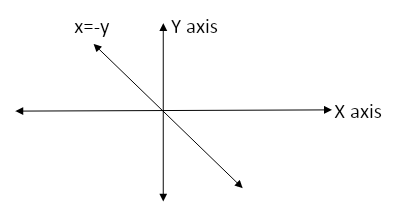
2) The bisector of the second and fourth quadrant.
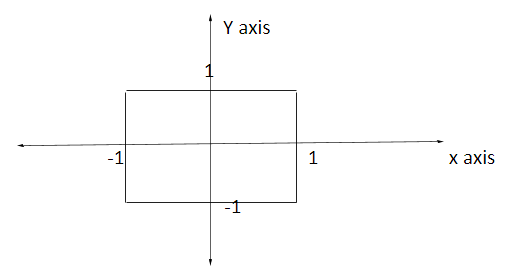
3)The rectangle formed by the lines x=$\pm $1 and y=$\pm $1
4)A unit circle with centre at the origin
Answer
 Verified
569.7k+ views
Hint: Convert the ${{\cos }^{-1}}y$ into the sine form and then use the formula ${{\sin }^{-1}}+{{\cos }^{-1}}x=\pi /2$
Simplify all the options given in the question
(1)The bisector of the first and third quadrant.
The line is bisecting and passing through first and third quadrant
$\Rightarrow $ x=y
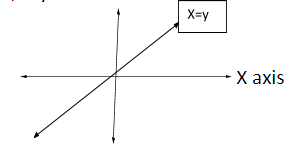
(2)The bisector of the second and fourth quadrant.
The line is bisecting and passing through second and fourth quadrant
$\Rightarrow $x=-y
(3)The rectangle formed by the lines x=$\pm $1 and y=$\pm $1
(4) A unit circle with centre at the origin
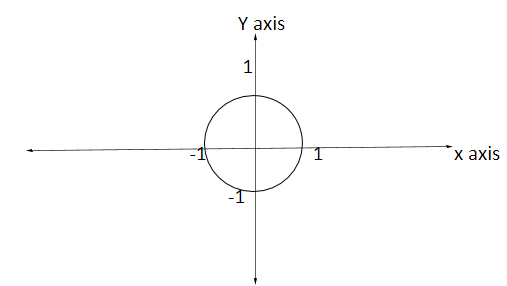
The equation for this circle is ${{x}^{2}}+{{y}^{2}}=1$
Formula Used:
$\begin{align}
& \cos \theta =Base/Hypotenuse \\
& \sin \theta =Perpendicular/Hypotenuse \\
& {{\sin }^{-1}}x+{{\sin }^{-1}}y={{\sin }^{-1}}[xy+\sqrt{1-y}\sqrt{1-{{x}^{2}}}] \\
\end{align}$
${{\sin }^{-1}}x+{{\cos }^{-1}}x=\pi /2$
Complete step-by-step answer:
${{\sin }^{-1}}x+{{\cos }^{-1}}y+{{\cos }^{-1}}(2xy)=\pi /2$ (1)
Convert the ${{\cos }^{-1}}y$ into the sine form
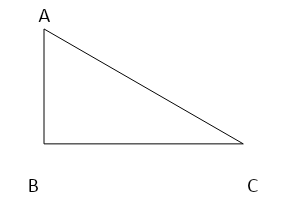
That is,
Let ${{\cos }^{-1}}y$ = $\theta $ in triangle ABC
{ $\angle ACB=\theta $}
$\Rightarrow $ cos $\theta $=y = Base/Hypotenuse
$\Rightarrow $Base=y
$\Rightarrow $Hypotenuse=1
Applying the Pythagoras theorem
Hypotenuse$^{2}$ =Base$^{2}$ + Perpendicular$^{2}$
$\Rightarrow $1$^{2}$ = y$^{2}$ + Perpendicular$^{2}$
$\Rightarrow $ Perpendicular$^{2}$ =1$^{2}$ - y$^{2}$
Taking square root on both sides
We get,
Perpendicular = $\sqrt{1-{{y}^{2}}}$
$\Rightarrow $sin$\theta $= Perpendicular/Hypotenuse
= $\sqrt{1-{{y}^{2}}}$
Now,
Put the value of ${{\cos }^{-1}}y$ in terms of sine in equation (1)
$\begin{align}
& {{\sin }^{-1}}x+{{\sin }^{-1}}\sqrt{1-{{y}^{2}}}+{{\cos }^{-1}}2xy=\pi /2 \\
& \\
\end{align}$ (2)
Use the formula ${{\sin }^{-1}}x+{{\sin }^{-1}}y={{\sin }^{-1}}[xy+\sqrt{1-y}\sqrt{1-{{x}^{2}}}]$
Here y= $\sqrt{1-{{y}^{2}}}$
$\Rightarrow $${{\sin }^{-1}}x+{{\sin }^{-1}}\sqrt{1-{{y}^{2}}}={{\sin }^{-1}}[x\sqrt{1-{{y}^{2}}}+y\sqrt{1-{{x}^{2}}}]$
Put in equation (2)
${{\sin }^{-1}}[x\sqrt{1-{{y}^{2}}}+y\sqrt{1-{{x}^{2}}}]+{{\cos }^{-1}}2xy=\pi /2$
Now,
We know that ${{\sin }^{-1}}x+{{\cos }^{-1}}x=\pi /2$
$\Rightarrow $\[x\sqrt{1-{{y}^{2}}}+y\sqrt{1-{{x}^{2}}}=2xy\]
\[\begin{align}
& \Rightarrow \sqrt{1-{{y}^{2}}}\sqrt{1-{{x}^{2}}}=2xy-xy \\
& \Rightarrow \sqrt{1-{{y}^{2}}}\sqrt{1-{{x}^{2}}}=xy \\
\end{align}\]
Squaring on both sides
We get
\[\begin{align}
& (1-{{y}^{2}})(1-{{x}^{2}})={{x}^{2}}{{y}^{2}} \\
& \Rightarrow 1-{{y}^{2}}-{{x}^{2}}+{{x}^{2}}{{y}^{2}}={{x}^{2}}{{y}^{2}} \\
& \Rightarrow 1-{{y}^{2}}-{{x}^{2}}={{x}^{2}}{{y}^{2}}-{{x}^{2}}{{y}^{2}} \\
& \Rightarrow 1-{{y}^{2}}-{{x}^{2}}=0 \\
& \Rightarrow {{y}^{2}}+{{x}^{2}}=1 \\
\end{align}\]
Hence the right option is (4) that is A unit circle with centre at the origin.
Additional information:
The inverse trigonometric functions are also known as the anti trigonometric functions or sometimes called arcus functions or cyclometric functions.
The formula list is given below for reference to solve the problems.
\[\begin{align}
& si{{n}^{-1}}x\text{ }+\text{ }co{{s}^{-1}}x\text{ }=\text{ }\pi /2\text{ },\text{ }x\in \left[ -1,\text{ }1 \right] \\
& ta{{n}^{-1}}x\text{ }+\text{ }co{{t}^{-1}}x\text{ }=\text{ }\pi /2\text{ },\text{ }x\in R \\
& se{{c}^{-1}}x\text{ }+\text{ }cose{{c}^{-1}}x\text{ }=\text{ }\pi /2\text{ },\left| x \right|\text{ }\ge \text{ }1 \\
\end{align}\]
Note: The knowledge about the trigonometric functions as well as inverse trigonometric functions and their relations is important for students to answer such questions.
Simplify all the options given in the question
(1)The bisector of the first and third quadrant.
The line is bisecting and passing through first and third quadrant
$\Rightarrow $ x=y
(2)The bisector of the second and fourth quadrant.
The line is bisecting and passing through second and fourth quadrant
$\Rightarrow $x=-y
(3)The rectangle formed by the lines x=$\pm $1 and y=$\pm $1
(4) A unit circle with centre at the origin
The equation for this circle is ${{x}^{2}}+{{y}^{2}}=1$
Formula Used:
$\begin{align}
& \cos \theta =Base/Hypotenuse \\
& \sin \theta =Perpendicular/Hypotenuse \\
& {{\sin }^{-1}}x+{{\sin }^{-1}}y={{\sin }^{-1}}[xy+\sqrt{1-y}\sqrt{1-{{x}^{2}}}] \\
\end{align}$
${{\sin }^{-1}}x+{{\cos }^{-1}}x=\pi /2$
Complete step-by-step answer:
${{\sin }^{-1}}x+{{\cos }^{-1}}y+{{\cos }^{-1}}(2xy)=\pi /2$ (1)
Convert the ${{\cos }^{-1}}y$ into the sine form
That is,
Let ${{\cos }^{-1}}y$ = $\theta $ in triangle ABC
{ $\angle ACB=\theta $}
$\Rightarrow $ cos $\theta $=y = Base/Hypotenuse
$\Rightarrow $Base=y
$\Rightarrow $Hypotenuse=1
Applying the Pythagoras theorem
Hypotenuse$^{2}$ =Base$^{2}$ + Perpendicular$^{2}$
$\Rightarrow $1$^{2}$ = y$^{2}$ + Perpendicular$^{2}$
$\Rightarrow $ Perpendicular$^{2}$ =1$^{2}$ - y$^{2}$
Taking square root on both sides
We get,
Perpendicular = $\sqrt{1-{{y}^{2}}}$
$\Rightarrow $sin$\theta $= Perpendicular/Hypotenuse
= $\sqrt{1-{{y}^{2}}}$
Now,
Put the value of ${{\cos }^{-1}}y$ in terms of sine in equation (1)
$\begin{align}
& {{\sin }^{-1}}x+{{\sin }^{-1}}\sqrt{1-{{y}^{2}}}+{{\cos }^{-1}}2xy=\pi /2 \\
& \\
\end{align}$ (2)
Use the formula ${{\sin }^{-1}}x+{{\sin }^{-1}}y={{\sin }^{-1}}[xy+\sqrt{1-y}\sqrt{1-{{x}^{2}}}]$
Here y= $\sqrt{1-{{y}^{2}}}$
$\Rightarrow $${{\sin }^{-1}}x+{{\sin }^{-1}}\sqrt{1-{{y}^{2}}}={{\sin }^{-1}}[x\sqrt{1-{{y}^{2}}}+y\sqrt{1-{{x}^{2}}}]$
Put in equation (2)
${{\sin }^{-1}}[x\sqrt{1-{{y}^{2}}}+y\sqrt{1-{{x}^{2}}}]+{{\cos }^{-1}}2xy=\pi /2$
Now,
We know that ${{\sin }^{-1}}x+{{\cos }^{-1}}x=\pi /2$
$\Rightarrow $\[x\sqrt{1-{{y}^{2}}}+y\sqrt{1-{{x}^{2}}}=2xy\]
\[\begin{align}
& \Rightarrow \sqrt{1-{{y}^{2}}}\sqrt{1-{{x}^{2}}}=2xy-xy \\
& \Rightarrow \sqrt{1-{{y}^{2}}}\sqrt{1-{{x}^{2}}}=xy \\
\end{align}\]
Squaring on both sides
We get
\[\begin{align}
& (1-{{y}^{2}})(1-{{x}^{2}})={{x}^{2}}{{y}^{2}} \\
& \Rightarrow 1-{{y}^{2}}-{{x}^{2}}+{{x}^{2}}{{y}^{2}}={{x}^{2}}{{y}^{2}} \\
& \Rightarrow 1-{{y}^{2}}-{{x}^{2}}={{x}^{2}}{{y}^{2}}-{{x}^{2}}{{y}^{2}} \\
& \Rightarrow 1-{{y}^{2}}-{{x}^{2}}=0 \\
& \Rightarrow {{y}^{2}}+{{x}^{2}}=1 \\
\end{align}\]
Hence the right option is (4) that is A unit circle with centre at the origin.
Additional information:
The inverse trigonometric functions are also known as the anti trigonometric functions or sometimes called arcus functions or cyclometric functions.
The formula list is given below for reference to solve the problems.
\[\begin{align}
& si{{n}^{-1}}x\text{ }+\text{ }co{{s}^{-1}}x\text{ }=\text{ }\pi /2\text{ },\text{ }x\in \left[ -1,\text{ }1 \right] \\
& ta{{n}^{-1}}x\text{ }+\text{ }co{{t}^{-1}}x\text{ }=\text{ }\pi /2\text{ },\text{ }x\in R \\
& se{{c}^{-1}}x\text{ }+\text{ }cose{{c}^{-1}}x\text{ }=\text{ }\pi /2\text{ },\left| x \right|\text{ }\ge \text{ }1 \\
\end{align}\]
Note: The knowledge about the trigonometric functions as well as inverse trigonometric functions and their relations is important for students to answer such questions.
Recently Updated Pages
Master Class 11 Computer Science: Engaging Questions & Answers for Success

Master Class 11 Business Studies: Engaging Questions & Answers for Success
Master Class 11 Economics: Engaging Questions & Answers for Success
Master Class 11 English: Engaging Questions & Answers for Success
Master Class 11 Maths: Engaging Questions & Answers for Success
Master Class 11 Biology: Engaging Questions & Answers for Success
Trending doubts
One Metric ton is equal to kg A 10000 B 1000 C 100 class 11 physics CBSE
There are 720 permutations of the digits 1 2 3 4 5 class 11 maths CBSE
Discuss the various forms of bacteria class 11 biology CBSE
Draw a diagram of a plant cell and label at least eight class 11 biology CBSE
State the laws of reflection of light
Explain zero factorial class 11 maths CBSE