




Point out the wrong statement about the magnetic properties of soft iron and steel.
A) Retentivity of soft iron is more than retentivity of steel.
B) Coercivity of soft iron is less than coercivity of steel.
C) Area of the B-H loop in soft iron is smaller than the area of B-H loop for steel.
D) Area of B-H loop in soft iron is greater than the area of B-H loop for steel.
Answer
 Verified
594k+ views
Hint: From the given options, we can see that B-H loop has been talked about, here B means magnetization intensity and H means magnetic field intensity. The relationship between the two is given by the loop called hysteresis loop.
So, from the observation of the hysteresis loop for both the substances, we can check which among the given options is incorrect.
Complete step by step answer:
Hysteresis loop: The hysteresis loop shows the relationship between magnetization intensity (B) and the magnetic field intensity (H).
Retentivity is the amount of magnetization that remains in a substance when the magnetic field is removed and coercivity is the amount of external magnetizing field (reverse) required so that the substance is completely demagnetized.
The hysteresis loop for both steel and iron is given as:
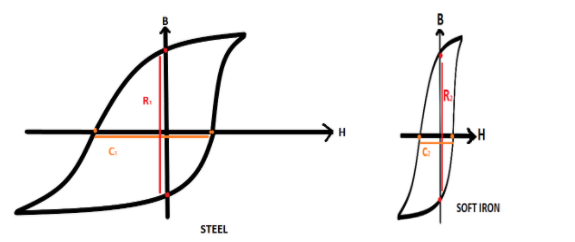
From the loop, the following observations can be made:
i) Let the area of steel be ${A_1}$ and ${A_2}$ be the area of soft iron. Then:
${A_1} > {A_2}$
🡪 Area of the B-H loop in soft iron is smaller than the area of the B-H loop for steel.
ii) If retentivity of steel is ${R_1}$ and ${R_2}$ be the retentivity of soft iron. Then:
${R_1} < {R_2}$
🡪 Retentivity of soft iron is more than the retentivity of steel.
iii) If coercivity of steel is ${C_1}$ and ${C_2}$ be the coercivity of soft iron. Then:
${C_1} > {C_2}$
🡪 Coercivity of soft iron is less than coercivity of steel.
Therefore, among the given options, option D. stating area of B-H loop in soft iron is greater than the area of B-H loop for steel is wrong.
Note:
Here, the hysteresis loop is showing the lagging of magnetization intensity behind magnetic field intensity. The property of hysteresis is exhibited by all ferromagnetic substances (gets strongly magnetized when placed in a magnetic field) and both steel and soft iron are ferromagnetic substances, this is one of the reasons we used a hysteric loop in this question for observation of respective characteristics.
So, from the observation of the hysteresis loop for both the substances, we can check which among the given options is incorrect.
Complete step by step answer:
Hysteresis loop: The hysteresis loop shows the relationship between magnetization intensity (B) and the magnetic field intensity (H).
Retentivity is the amount of magnetization that remains in a substance when the magnetic field is removed and coercivity is the amount of external magnetizing field (reverse) required so that the substance is completely demagnetized.
The hysteresis loop for both steel and iron is given as:
From the loop, the following observations can be made:
i) Let the area of steel be ${A_1}$ and ${A_2}$ be the area of soft iron. Then:
${A_1} > {A_2}$
🡪 Area of the B-H loop in soft iron is smaller than the area of the B-H loop for steel.
ii) If retentivity of steel is ${R_1}$ and ${R_2}$ be the retentivity of soft iron. Then:
${R_1} < {R_2}$
🡪 Retentivity of soft iron is more than the retentivity of steel.
iii) If coercivity of steel is ${C_1}$ and ${C_2}$ be the coercivity of soft iron. Then:
${C_1} > {C_2}$
🡪 Coercivity of soft iron is less than coercivity of steel.
Therefore, among the given options, option D. stating area of B-H loop in soft iron is greater than the area of B-H loop for steel is wrong.
Note:
Here, the hysteresis loop is showing the lagging of magnetization intensity behind magnetic field intensity. The property of hysteresis is exhibited by all ferromagnetic substances (gets strongly magnetized when placed in a magnetic field) and both steel and soft iron are ferromagnetic substances, this is one of the reasons we used a hysteric loop in this question for observation of respective characteristics.
Recently Updated Pages
Master Class 11 Social Science: Engaging Questions & Answers for Success

Master Class 11 Physics: Engaging Questions & Answers for Success
Master Class 11 Maths: Engaging Questions & Answers for Success
Master Class 11 Economics: Engaging Questions & Answers for Success
Master Class 11 Computer Science: Engaging Questions & Answers for Success
Master Class 11 Chemistry: Engaging Questions & Answers for Success
Trending doubts
One Metric ton is equal to kg A 10000 B 1000 C 100 class 11 physics CBSE
There are 720 permutations of the digits 1 2 3 4 5 class 11 maths CBSE
1 Quintal is equal to a 110 kg b 10 kg c 100kg d 1000 class 11 physics CBSE
State and prove Bernoullis theorem class 11 physics CBSE
Difference Between Prokaryotic Cells and Eukaryotic Cells
Which among the following are examples of coming together class 11 social science CBSE