




Point out the correct decreasing order of ${\text{p}}{{\text{K}}_{\text{b}}}$values of the following amines:
${{\text{C}}_{\text{2}}}{{\text{H}}_{\text{5}}}{\text{N}}{{\text{H}}_{\text{2}}}$ ,${{\text{C}}_{\text{6}}}{{\text{H}}_{\text{5}}}{\text{NHC}}{{\text{H}}_{\text{3}}}$, ${\left( {{{\text{C}}_{\text{2}}}{{\text{H}}_{\text{5}}}} \right)_2}{\text{NH}}$and ${{\text{C}}_{\text{6}}}{{\text{H}}_{\text{5}}}{\text{N}}{{\text{H}}_{\text{2}}}$
A. \[{\left( {{{\text{C}}_{\text{2}}}{{\text{H}}_{\text{5}}}} \right)_2}{\text{NH}}\, > \,{{\text{C}}_{\text{2}}}{{\text{H}}_{\text{5}}}{\text{N}}{{\text{H}}_{\text{2}}}{\text{ > }}\,{{\text{C}}_{\text{6}}}{{\text{H}}_{\text{5}}}{\text{NHC}}{{\text{H}}_{\text{3}}}{\text{ > }}\,{{\text{C}}_{\text{6}}}{{\text{H}}_{\text{5}}}{\text{N}}{{\text{H}}_{\text{2}}}\]
B. \[{\left( {{{\text{C}}_{\text{2}}}{{\text{H}}_{\text{5}}}} \right)_2}{\text{NH}}\,\,\,{\text{ > }}\,{{\text{C}}_{\text{6}}}{{\text{H}}_{\text{5}}}{\text{NHC}}{{\text{H}}_{\text{3}}}\,{\text{ > }}\,{{\text{C}}_{\text{6}}}{{\text{H}}_{\text{5}}}{\text{N}}{{\text{H}}_{\text{2}}} > \,{{\text{C}}_{\text{2}}}{{\text{H}}_{\text{5}}}{\text{N}}{{\text{H}}_{\text{2}}}\]
C. \[{{\text{C}}_{\text{6}}}{{\text{H}}_{\text{5}}}{\text{N}}{{\text{H}}_{\text{2}}}{\text{ > }}\,{{\text{C}}_{\text{6}}}{{\text{H}}_{\text{5}}}{\text{NHC}}{{\text{H}}_{\text{3}}} > {{\text{C}}_{\text{2}}}{{\text{H}}_{\text{5}}}{\text{N}}{{\text{H}}_{\text{2}}} > {\left( {{{\text{C}}_{\text{2}}}{{\text{H}}_{\text{5}}}} \right)_2}{\text{NH}}\,\]
D. \[{{\text{C}}_{\text{2}}}{{\text{H}}_{\text{5}}}{\text{N}}{{\text{H}}_{\text{2}}} > {\left( {{{\text{C}}_{\text{2}}}{{\text{H}}_{\text{5}}}} \right)_2}{\text{NH}} > {{\text{C}}_{\text{6}}}{{\text{H}}_{\text{5}}}{\text{NHC}}{{\text{H}}_{\text{3}}} > {{\text{C}}_{\text{6}}}{{\text{H}}_{\text{5}}}{\text{N}}{{\text{H}}_{\text{2}}}\]
Answer
 Verified
641.4k+ views
Hint: The basicity is defined as the tendency of a molecule to donate the electrons or hydroxide ion. AS the availability of the electrons increases, the basicity of the molecule increases. The lower the ${\text{p}}{{\text{K}}_{\text{b}}}$values higher will be the basicity.
Complete Step by step answer: In the amines, the nitrogen atom has a lone pair of electrons that can be donated so, the amines are basic.
Aliphatic amines are more basic than the aromatic amine.
Because in aromatic amine the phenyl ring works as an electron-withdrawing group which decreases the electron density on the nitrogen atom.
So, ${{\text{C}}_{\text{2}}}{{\text{H}}_{\text{5}}}{\text{N}}{{\text{H}}_{\text{2}}}$ and ${\left( {{{\text{C}}_{\text{2}}}{{\text{H}}_{\text{5}}}} \right)_2}{\text{NH}}$ are more basic than ${{\text{C}}_{\text{6}}}{{\text{H}}_{\text{5}}}{\text{NHC}}{{\text{H}}_{\text{3}}}$ and ${{\text{C}}_{\text{6}}}{{\text{H}}_{\text{5}}}{\text{N}}{{\text{H}}_{\text{2}}}$.
In the case of aliphatic amines ${{\text{C}}_{\text{2}}}{{\text{H}}_{\text{5}}}{\text{N}}{{\text{H}}_{\text{2}}}$ and ${\left( {{{\text{C}}_{\text{2}}}{{\text{H}}_{\text{5}}}} \right)_2}{\text{NH}}$, the basicity is decided on the basis of steric hindrance and $ + {\text{I}}$ effect.
In the amine, the $ - {\text{N}}{{\text{H}}_2}$ group is an electron-withdrawing group so, the $ - {\text{N}}{{\text{H}}_2}$ group has $ + {\text{I}}$ effect. Thus, it withdraws the electron density from the alkyl chain so, as the number of alkyl groups increases the basicity should be increased.
So, according to the $ + {\text{I}}$ effect, the basicity order should be,
${\left( {{{\text{C}}_{\text{2}}}{{\text{H}}_{\text{5}}}} \right)_2}{\text{NH}}\,{\text{ > }}\,{{\text{C}}_{\text{2}}}{{\text{H}}_{\text{5}}}{\text{N}}{{\text{H}}_{\text{2}}}$
The $ + {\text{I}}$ effect in ${{\text{C}}_{\text{2}}}{{\text{H}}_{\text{5}}}{\text{N}}{{\text{H}}_{\text{2}}}$ and ${\left( {{{\text{C}}_{\text{2}}}{{\text{H}}_{\text{5}}}} \right)_2}{\text{NH}}$, is as follows:
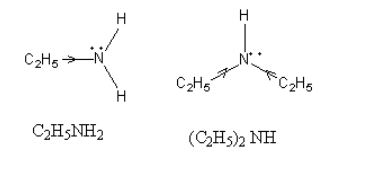
As the steric hindrance in amine increases the hydrogen ion of water which takes an electron from amine cannot approach the amine so, the basicity decreases.
So, according to the steric hindrance, the basicity order should be,
${{\text{C}}_{\text{2}}}{{\text{H}}_{\text{5}}}{\text{N}}{{\text{H}}_{\text{2}}} > {\left( {{{\text{C}}_{\text{2}}}{{\text{H}}_{\text{5}}}} \right)_2}{\text{NH}}\,$
The order of basicity which comes by the combined effect of $ + {\text{I}}$ and steric hindrance is as follows:
${\left( {{{\text{C}}_{\text{2}}}{{\text{H}}_{\text{5}}}} \right)_2}{\text{NH}}\,{\text{ > }}\,{{\text{C}}_{\text{2}}}{{\text{H}}_{\text{5}}}{\text{N}}{{\text{H}}_{\text{2}}}$
In the case of aromatic amine${{\text{C}}_{\text{6}}}{{\text{H}}_{\text{5}}}{\text{NHC}}{{\text{H}}_{\text{3}}}$ and ${{\text{C}}_{\text{6}}}{{\text{H}}_{\text{5}}}{\text{N}}{{\text{H}}_{\text{2}}}$., the basicity is decided on the basis of $ + {\text{I}}$ effect of methyl group.
The $ - {\text{I}}$ effect in ${{\text{C}}_{\text{6}}}{{\text{H}}_{\text{5}}}{\text{NHC}}{{\text{H}}_{\text{3}}}$ and ${{\text{C}}_{\text{6}}}{{\text{H}}_{\text{5}}}{\text{N}}{{\text{H}}_{\text{2}}}$, is as follows:
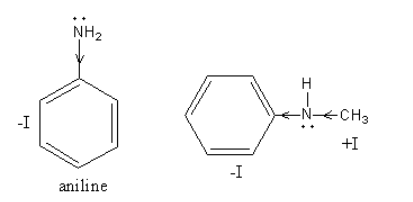
In ${{\text{C}}_{\text{6}}}{{\text{H}}_{\text{5}}}{\text{NHC}}{{\text{H}}_{\text{3}}}$, one methyl group is present instead of hydrogen and methyl group shows $ + {\text{I}}$effect which increases the electron density hence basicity.
So, the decreasing order of basicity is as follows:
\[{\left( {{{\text{C}}_{\text{2}}}{{\text{H}}_{\text{5}}}} \right)_2}{\text{NH}}\, > \,{{\text{C}}_{\text{2}}}{{\text{H}}_{\text{5}}}{\text{N}}{{\text{H}}_{\text{2}}}{\text{ > }}\,{{\text{C}}_{\text{6}}}{{\text{H}}_{\text{5}}}{\text{NHC}}{{\text{H}}_{\text{3}}}{\text{ > }}\,{{\text{C}}_{\text{6}}}{{\text{H}}_{\text{5}}}{\text{N}}{{\text{H}}_{\text{2}}}\]
${{\text{K}}_{\text{b}}}$ shows the strength of a base so, as the value of ${{\text{K}}_{\text{b}}}$ increases the basicity increases and as the${\text{p}}{{\text{K}}_{\text{b}}}$ value increases the basicity decreases.
So, a strong base will have low ${\text{p}}{{\text{K}}_{\text{b}}}$.
The decreasing order of ${\text{p}}{{\text{K}}_{\text{b}}}$values is as follows:
\[{{\text{C}}_{\text{6}}}{{\text{H}}_{\text{5}}}{\text{N}}{{\text{H}}_{\text{2}}}{\text{ > }}\,{{\text{C}}_{\text{6}}}{{\text{H}}_{\text{5}}}{\text{NHC}}{{\text{H}}_{\text{3}}} > {{\text{C}}_{\text{2}}}{{\text{H}}_{\text{5}}}{\text{N}}{{\text{H}}_{\text{2}}} > {\left( {{{\text{C}}_{\text{2}}}{{\text{H}}_{\text{5}}}} \right)_2}{\text{NH}}\,\]
Therefore, option (C) is correct.
\[{{\text{C}}_{\text{6}}}{{\text{H}}_{\text{5}}}{\text{N}}{{\text{H}}_{\text{2}}}{\text{ > }}\,{{\text{C}}_{\text{6}}}{{\text{H}}_{\text{5}}}{\text{NHC}}{{\text{H}}_{\text{3}}} > {{\text{C}}_{\text{2}}}{{\text{H}}_{\text{5}}}{\text{N}}{{\text{H}}_{\text{2}}} > {\left( {{{\text{C}}_{\text{2}}}{{\text{H}}_{\text{5}}}} \right)_2}{\text{NH}}\,\]
Note: Basicity is directly proportional to $ + {\text{I}}$ effect and inversely proportional to the $ - {\text{I}}$ and the steric hindrance. Basicity is also directly proportional to the number of electron donating groups. As the number of electron donating groups increases the basicity increases. The basicity of aniline is minimum among all four due to $ - {\text{I}}$ of the ring.
Complete Step by step answer: In the amines, the nitrogen atom has a lone pair of electrons that can be donated so, the amines are basic.
Aliphatic amines are more basic than the aromatic amine.
Because in aromatic amine the phenyl ring works as an electron-withdrawing group which decreases the electron density on the nitrogen atom.
So, ${{\text{C}}_{\text{2}}}{{\text{H}}_{\text{5}}}{\text{N}}{{\text{H}}_{\text{2}}}$ and ${\left( {{{\text{C}}_{\text{2}}}{{\text{H}}_{\text{5}}}} \right)_2}{\text{NH}}$ are more basic than ${{\text{C}}_{\text{6}}}{{\text{H}}_{\text{5}}}{\text{NHC}}{{\text{H}}_{\text{3}}}$ and ${{\text{C}}_{\text{6}}}{{\text{H}}_{\text{5}}}{\text{N}}{{\text{H}}_{\text{2}}}$.
In the case of aliphatic amines ${{\text{C}}_{\text{2}}}{{\text{H}}_{\text{5}}}{\text{N}}{{\text{H}}_{\text{2}}}$ and ${\left( {{{\text{C}}_{\text{2}}}{{\text{H}}_{\text{5}}}} \right)_2}{\text{NH}}$, the basicity is decided on the basis of steric hindrance and $ + {\text{I}}$ effect.
In the amine, the $ - {\text{N}}{{\text{H}}_2}$ group is an electron-withdrawing group so, the $ - {\text{N}}{{\text{H}}_2}$ group has $ + {\text{I}}$ effect. Thus, it withdraws the electron density from the alkyl chain so, as the number of alkyl groups increases the basicity should be increased.
So, according to the $ + {\text{I}}$ effect, the basicity order should be,
${\left( {{{\text{C}}_{\text{2}}}{{\text{H}}_{\text{5}}}} \right)_2}{\text{NH}}\,{\text{ > }}\,{{\text{C}}_{\text{2}}}{{\text{H}}_{\text{5}}}{\text{N}}{{\text{H}}_{\text{2}}}$
The $ + {\text{I}}$ effect in ${{\text{C}}_{\text{2}}}{{\text{H}}_{\text{5}}}{\text{N}}{{\text{H}}_{\text{2}}}$ and ${\left( {{{\text{C}}_{\text{2}}}{{\text{H}}_{\text{5}}}} \right)_2}{\text{NH}}$, is as follows:
As the steric hindrance in amine increases the hydrogen ion of water which takes an electron from amine cannot approach the amine so, the basicity decreases.
So, according to the steric hindrance, the basicity order should be,
${{\text{C}}_{\text{2}}}{{\text{H}}_{\text{5}}}{\text{N}}{{\text{H}}_{\text{2}}} > {\left( {{{\text{C}}_{\text{2}}}{{\text{H}}_{\text{5}}}} \right)_2}{\text{NH}}\,$
The order of basicity which comes by the combined effect of $ + {\text{I}}$ and steric hindrance is as follows:
${\left( {{{\text{C}}_{\text{2}}}{{\text{H}}_{\text{5}}}} \right)_2}{\text{NH}}\,{\text{ > }}\,{{\text{C}}_{\text{2}}}{{\text{H}}_{\text{5}}}{\text{N}}{{\text{H}}_{\text{2}}}$
In the case of aromatic amine${{\text{C}}_{\text{6}}}{{\text{H}}_{\text{5}}}{\text{NHC}}{{\text{H}}_{\text{3}}}$ and ${{\text{C}}_{\text{6}}}{{\text{H}}_{\text{5}}}{\text{N}}{{\text{H}}_{\text{2}}}$., the basicity is decided on the basis of $ + {\text{I}}$ effect of methyl group.
The $ - {\text{I}}$ effect in ${{\text{C}}_{\text{6}}}{{\text{H}}_{\text{5}}}{\text{NHC}}{{\text{H}}_{\text{3}}}$ and ${{\text{C}}_{\text{6}}}{{\text{H}}_{\text{5}}}{\text{N}}{{\text{H}}_{\text{2}}}$, is as follows:
In ${{\text{C}}_{\text{6}}}{{\text{H}}_{\text{5}}}{\text{NHC}}{{\text{H}}_{\text{3}}}$, one methyl group is present instead of hydrogen and methyl group shows $ + {\text{I}}$effect which increases the electron density hence basicity.
So, the decreasing order of basicity is as follows:
\[{\left( {{{\text{C}}_{\text{2}}}{{\text{H}}_{\text{5}}}} \right)_2}{\text{NH}}\, > \,{{\text{C}}_{\text{2}}}{{\text{H}}_{\text{5}}}{\text{N}}{{\text{H}}_{\text{2}}}{\text{ > }}\,{{\text{C}}_{\text{6}}}{{\text{H}}_{\text{5}}}{\text{NHC}}{{\text{H}}_{\text{3}}}{\text{ > }}\,{{\text{C}}_{\text{6}}}{{\text{H}}_{\text{5}}}{\text{N}}{{\text{H}}_{\text{2}}}\]
${{\text{K}}_{\text{b}}}$ shows the strength of a base so, as the value of ${{\text{K}}_{\text{b}}}$ increases the basicity increases and as the${\text{p}}{{\text{K}}_{\text{b}}}$ value increases the basicity decreases.
So, a strong base will have low ${\text{p}}{{\text{K}}_{\text{b}}}$.
The decreasing order of ${\text{p}}{{\text{K}}_{\text{b}}}$values is as follows:
\[{{\text{C}}_{\text{6}}}{{\text{H}}_{\text{5}}}{\text{N}}{{\text{H}}_{\text{2}}}{\text{ > }}\,{{\text{C}}_{\text{6}}}{{\text{H}}_{\text{5}}}{\text{NHC}}{{\text{H}}_{\text{3}}} > {{\text{C}}_{\text{2}}}{{\text{H}}_{\text{5}}}{\text{N}}{{\text{H}}_{\text{2}}} > {\left( {{{\text{C}}_{\text{2}}}{{\text{H}}_{\text{5}}}} \right)_2}{\text{NH}}\,\]
Therefore, option (C) is correct.
\[{{\text{C}}_{\text{6}}}{{\text{H}}_{\text{5}}}{\text{N}}{{\text{H}}_{\text{2}}}{\text{ > }}\,{{\text{C}}_{\text{6}}}{{\text{H}}_{\text{5}}}{\text{NHC}}{{\text{H}}_{\text{3}}} > {{\text{C}}_{\text{2}}}{{\text{H}}_{\text{5}}}{\text{N}}{{\text{H}}_{\text{2}}} > {\left( {{{\text{C}}_{\text{2}}}{{\text{H}}_{\text{5}}}} \right)_2}{\text{NH}}\,\]
Note: Basicity is directly proportional to $ + {\text{I}}$ effect and inversely proportional to the $ - {\text{I}}$ and the steric hindrance. Basicity is also directly proportional to the number of electron donating groups. As the number of electron donating groups increases the basicity increases. The basicity of aniline is minimum among all four due to $ - {\text{I}}$ of the ring.
Recently Updated Pages
If x a + bt + ct2 where x is in meters and t is in class 11 physics CBSE

A car covers the first half distance between two places class 11 physics CBSE
The resultant of two vectors overrightarrow P and overrightarrow class 11 physics CBSE
Find the value of cos 135 class 11 maths CBSE
A mass M is held in place by an applied force F and class 11 physics CBSE
A solution of glucose in water is labelled as 10 dfracwv class 11 chemistry CBSE
Trending doubts
One Metric ton is equal to kg A 10000 B 1000 C 100 class 11 physics CBSE
Find the value of the expression given below sin 30circ class 11 maths CBSE
What do you mean by retardation What is its SI uni class 11 physics CBSE
Draw a diagram of nephron and explain its structur class 11 biology CBSE
10 examples of friction in our daily life
Difference between physical and chemical change class 11 chemistry CBSE