




How do you plot the point \[\left( { - 5,60^\circ } \right)\] on a polar graph?
Answer
 Verified
595.8k+ views
Hint: In order to graph a point on the polar plane, you should find theta first and then locate r on that line. This approach allows you to narrow the location of a point to somewhere on one of the lines representing the angle. From there, you can simply count out from the pole the radial distance.
Complete step by step solution:
Change the radius from negative to positive by adding or subtracting (as appropriate) \[180^\circ \] to or from the angle.
Here, let us add \[180^\circ \] to the angle (instead of subtracting):
\[\left( { - 5,60^\circ } \right) \to \left( {5,240^\circ } \right)\]
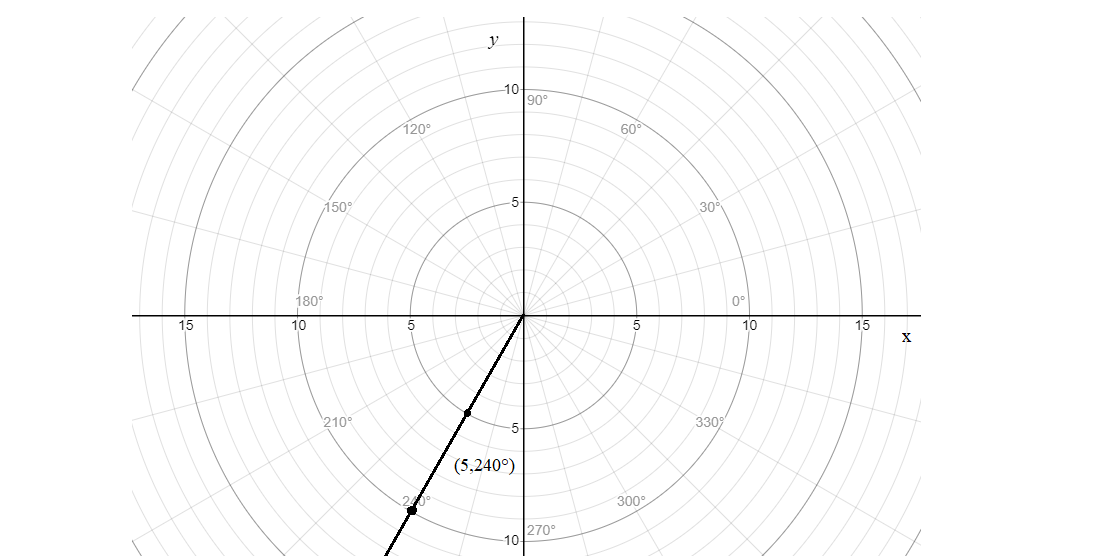
Now, you merely find the intersection on the radius of 5 and the angle of \[240^\circ \] on the graph paper and draw a point as:
\[60^\circ = \dfrac{\pi }{3}\] and \[240^\circ = \dfrac{{4\pi }}{3}\] i.e., in graph we have: \[\left( { - 5,\dfrac{\pi }{3}} \right) \to \left( {5,\dfrac{{4\pi }}{3}} \right)\].
Additional information:
Identify the type of polar equation, the polar equation is in the form, \[r = a - b\cos \theta \]. Since the equation passes the test for symmetry to the polar axis, we only need to evaluate the equation over the interval \[\left[ {0,\pi } \right]\] and then reflect the graph about the polar axis.
Note: An angle whose measure is equal to 90 degrees is called a right angle, 180 degrees angle is called a straight angle and angles such as 270 degrees which are more than 180 but less than 360 degrees are called reflex angles. A 360 degrees angle is called a complete angle, hence by doing a complete rotation of two (or more) and adding or subtracting 360 degrees or a multiple of it before settling on the angle's terminal side, you can get an infinite number of angle measures, both positive and negative, for the same basic angle.
Complete step by step solution:
Change the radius from negative to positive by adding or subtracting (as appropriate) \[180^\circ \] to or from the angle.
Here, let us add \[180^\circ \] to the angle (instead of subtracting):
\[\left( { - 5,60^\circ } \right) \to \left( {5,240^\circ } \right)\]
Now, you merely find the intersection on the radius of 5 and the angle of \[240^\circ \] on the graph paper and draw a point as:
\[60^\circ = \dfrac{\pi }{3}\] and \[240^\circ = \dfrac{{4\pi }}{3}\] i.e., in graph we have: \[\left( { - 5,\dfrac{\pi }{3}} \right) \to \left( {5,\dfrac{{4\pi }}{3}} \right)\].
Additional information:
Identify the type of polar equation, the polar equation is in the form, \[r = a - b\cos \theta \]. Since the equation passes the test for symmetry to the polar axis, we only need to evaluate the equation over the interval \[\left[ {0,\pi } \right]\] and then reflect the graph about the polar axis.
Note: An angle whose measure is equal to 90 degrees is called a right angle, 180 degrees angle is called a straight angle and angles such as 270 degrees which are more than 180 but less than 360 degrees are called reflex angles. A 360 degrees angle is called a complete angle, hence by doing a complete rotation of two (or more) and adding or subtracting 360 degrees or a multiple of it before settling on the angle's terminal side, you can get an infinite number of angle measures, both positive and negative, for the same basic angle.
Recently Updated Pages
Which will be the least stable resonating structure class 11 chemistry CBSE

How many 5 digit telephone numbers can be construc-class-11-maths-CBSE
How do you find the angle of the resultant vector class 11 physics CBSE
Draw labelled diagram of the following i Gram seed class 11 biology CBSE
1 Quintal is equal to a 110 kg b 10 kg c 100kg d 1000 class 11 physics CBSE
What is the need and importance of classification class 11 biology CBSE
Trending doubts
Find the value of the expression given below sin 30circ class 11 maths CBSE
The teeth used for biting and cutting food are called class 11 biology CBSE
Bond order ofO2 O2+ O2 and O22 is in order A O2 langle class 11 chemistry CBSE
Frogs heart when taken out of the body continues to class 11 biology CBSE
Can anyone list 10 advantages and disadvantages of friction
Draw a diagram of a plant cell and label at least eight class 11 biology CBSE