




Plot the graph for the function\[f\left( x \right) = {4^x}\].
Answer
 Verified
560.4k+ views
Hint:For plotting a graph we need different x values as well as their corresponding y values. Such that to solve this question we need to find the x intercept, y intercept and some intermediate values. Also the x-intercept and y-intercept can be found by substituting y=0 and x=0 respectively. After finding these values we just need to plot them on the XY plane.
Complete step by step solution:
Given
$f\left( x \right) = {4^x}......................\left( i \right)$
Now we know, x intercept is the point where the graph touches the X axis such that y=0.
So substitute y=0 in (i):
$
\Rightarrow y = f\left( x \right) = {4^x} \\
\Rightarrow 0 = {4^x} \\
\Rightarrow {4^x} = 0.................\left( {ii} \right) \\
$
On observing (ii) we can say that (ii) is mathematically wrong.
Therefore it implies for \[f\left( x \right) = {4^x}\]there would be no x intercept and also$f\left( x
\right) \succ 0$.
Now for finding the y intercept we have to put x=0 since y intercept is the point where the graph touches the Y axis.
So substitute x=0 in (i):
$
\Rightarrow y = f\left( x \right) = {4^x} \\
\Rightarrow y = {4^0} \\
\Rightarrow y = 1................\left( {iii} \right) \\
$
Therefore from (iii) we can write :
\[{\text{y intercept}} = \left( {0,1} \right)\]
Now let’s find some intermediate points:
For x=1:
$
\Rightarrow y = f\left( x \right) = {4^x} \\
\Rightarrow y = {4^1} = 4 \\
$
$\therefore \left( {1,4} \right)\;{\text{is}}\;{\text{a}}\;{\text{point}}{\text{.}}$
For x=2
$
\Rightarrow y = f\left( x \right) = {4^x} \\
\Rightarrow y = {4^2} = 16 \\
\\
\therefore \left( {2,16} \right)\;{\text{is}}\;{\text{a}}\;{\text{point}}{\text{.}} \\
$
Now take negative values of x:
For x=-1
$
\Rightarrow y = f\left( x \right) = {4^x} \\
\Rightarrow y = {4^{ - 1}} = \dfrac{1}{4} = 0.25 \\
\\
\therefore \left( { - 1,0.25} \right)\;{\text{is}}\;{\text{a}}\;{\text{point}}{\text{.}} \\
$
For x=-2
$
\Rightarrow y = f\left( x \right) = {4^x} \\
\Rightarrow y = {4^{ - 2}} = \dfrac{1}{{{4^2}}} = \dfrac{1}{{16}} = 0.06 \\
\\
\therefore \left( { - 2,0.06} \right)\;{\text{is}}\;{\text{a}}\;{\text{point}}{\text{.}} \\
$
Now all these values which we have got from above is to be plotted in a XY plane.
Plotting the points
\[\left( {0,1} \right)\],$\left( {1,4} \right)$,$\left( {2,16} \right)$,$\left( { - 1,0.25} \right)$,$\left( { -
2,0.06} \right)\;$
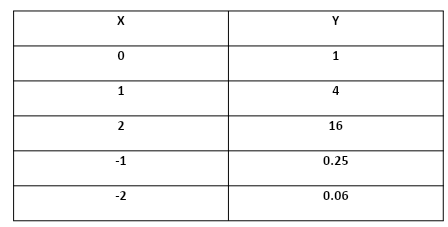
We get the following graph:
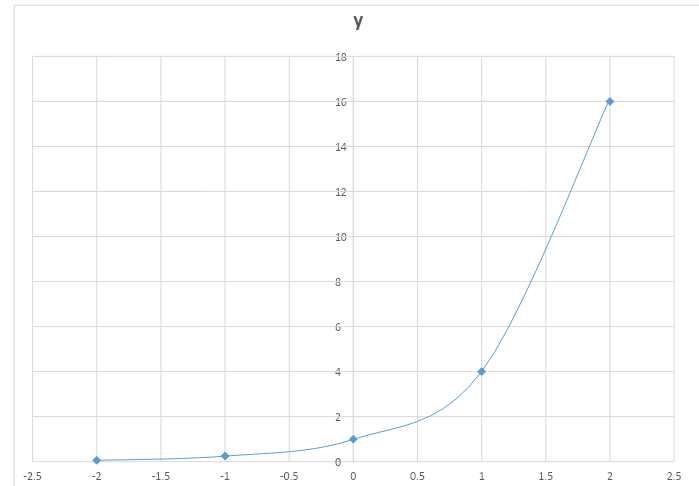
The above graph shows the plot of the function\[f\left( x \right) = {4^x}\].
Note:While approaching a similar graphical question one should find as many points as possible from the given conditions and common knowledge. Also one must be careful while doing the solution. Also while plotting the graph one must choose appropriate scale considering the values that should be plotted.
Complete step by step solution:
Given
$f\left( x \right) = {4^x}......................\left( i \right)$
Now we know, x intercept is the point where the graph touches the X axis such that y=0.
So substitute y=0 in (i):
$
\Rightarrow y = f\left( x \right) = {4^x} \\
\Rightarrow 0 = {4^x} \\
\Rightarrow {4^x} = 0.................\left( {ii} \right) \\
$
On observing (ii) we can say that (ii) is mathematically wrong.
Therefore it implies for \[f\left( x \right) = {4^x}\]there would be no x intercept and also$f\left( x
\right) \succ 0$.
Now for finding the y intercept we have to put x=0 since y intercept is the point where the graph touches the Y axis.
So substitute x=0 in (i):
$
\Rightarrow y = f\left( x \right) = {4^x} \\
\Rightarrow y = {4^0} \\
\Rightarrow y = 1................\left( {iii} \right) \\
$
Therefore from (iii) we can write :
\[{\text{y intercept}} = \left( {0,1} \right)\]
Now let’s find some intermediate points:
For x=1:
$
\Rightarrow y = f\left( x \right) = {4^x} \\
\Rightarrow y = {4^1} = 4 \\
$
$\therefore \left( {1,4} \right)\;{\text{is}}\;{\text{a}}\;{\text{point}}{\text{.}}$
For x=2
$
\Rightarrow y = f\left( x \right) = {4^x} \\
\Rightarrow y = {4^2} = 16 \\
\\
\therefore \left( {2,16} \right)\;{\text{is}}\;{\text{a}}\;{\text{point}}{\text{.}} \\
$
Now take negative values of x:
For x=-1
$
\Rightarrow y = f\left( x \right) = {4^x} \\
\Rightarrow y = {4^{ - 1}} = \dfrac{1}{4} = 0.25 \\
\\
\therefore \left( { - 1,0.25} \right)\;{\text{is}}\;{\text{a}}\;{\text{point}}{\text{.}} \\
$
For x=-2
$
\Rightarrow y = f\left( x \right) = {4^x} \\
\Rightarrow y = {4^{ - 2}} = \dfrac{1}{{{4^2}}} = \dfrac{1}{{16}} = 0.06 \\
\\
\therefore \left( { - 2,0.06} \right)\;{\text{is}}\;{\text{a}}\;{\text{point}}{\text{.}} \\
$
Now all these values which we have got from above is to be plotted in a XY plane.
Plotting the points
\[\left( {0,1} \right)\],$\left( {1,4} \right)$,$\left( {2,16} \right)$,$\left( { - 1,0.25} \right)$,$\left( { -
2,0.06} \right)\;$
We get the following graph:
The above graph shows the plot of the function\[f\left( x \right) = {4^x}\].
Note:While approaching a similar graphical question one should find as many points as possible from the given conditions and common knowledge. Also one must be careful while doing the solution. Also while plotting the graph one must choose appropriate scale considering the values that should be plotted.
Recently Updated Pages
Master Class 11 Computer Science: Engaging Questions & Answers for Success

Master Class 11 Business Studies: Engaging Questions & Answers for Success
Master Class 11 Economics: Engaging Questions & Answers for Success
Master Class 11 English: Engaging Questions & Answers for Success
Master Class 11 Maths: Engaging Questions & Answers for Success
Master Class 11 Biology: Engaging Questions & Answers for Success
Trending doubts
One Metric ton is equal to kg A 10000 B 1000 C 100 class 11 physics CBSE
There are 720 permutations of the digits 1 2 3 4 5 class 11 maths CBSE
Discuss the various forms of bacteria class 11 biology CBSE
Draw a diagram of a plant cell and label at least eight class 11 biology CBSE
State the laws of reflection of light
Explain zero factorial class 11 maths CBSE