




How do you plot $ A\left( { - 6, - \dfrac{\pi }{6}} \right),B\left( { - 5, - \dfrac{\pi }{2}} \right),\,and\,C\left( { - 8, - \dfrac{\pi }{4}} \right) $ in a polar coordinate system?
Answer
 Verified
560.1k+ views
Hint: In order to graph a polar coordinate ,draw a ray equal to the angular coordinate and mark the radius equal to radial coordinate, the point at which the ray drawn intersects the radius is our required polar coordinate on the cartesian plane.
Complete step-by-step answer:
There are two ways to determine a point on a plane, one is by the rectangular coordinates and another is by the Polar Coordinates.
Polar Coordinates $ (p,\theta ) $ is actually a 2D coordinate system in which every point on the plane is found by a distance $ p $ from a reference point and an angle i.e. $ \theta $ from a reference direction.
where $ p $ is the radial coordinate and $ \theta $ is known as the angular coordinate.
As per the question given we are given three polar coordinates as $ A\left( { - 6, - \dfrac{\pi }{6}} \right),B\left( { - 5, - \dfrac{\pi }{2}} \right),\,and\,C\left( { - 8, - \dfrac{\pi }{4}} \right) $ .
For Polar coordinate $ A $ :
Radial coordinate = $ {p_1}\,\, = {r_1} = - 6 $
Angular coordinate \[ = {\theta _1} = - \dfrac{\pi }{6}\]
First, we convert the Angular coordinate into degree
So, to convert into degree replace $ \pi $ with 180
$
{\theta _1} = - \dfrac{1}{6} \times {180^ \circ } \\
{\theta _1} = - {30^ \circ } \;
$
Now taking radius as $ {p_1}\,\, = {r_1} = - 6 $ on the y-axis and angle measure as $ - {30^ \circ } $ , plot the point on the coordinate plane .
Similarly, identify the Radial coordinate and angular coordinate for the remaining points I.e. $ B\,and\,C $ we have
For Polar coordinate $ A $ :
Radial coordinate = $ {p_2}\,\, = {r_2} = - 5 $
Angular coordinate \[ = {\theta _2} = - \dfrac{\pi }{2}\]
$
{\theta _2} = - \dfrac{1}{2} \times {180^ \circ } \\
{\theta _2} = - {90^ \circ } \;
$
For Polar coordinate $ C $ :
Radial coordinate = $ {p_2}\,\, = {r_2} = - 8 $
Angular coordinate \[ = {\theta _3} = - \dfrac{\pi }{4}\]
$
{\theta _3} = - \dfrac{1}{4} \times {180^ \circ } \\
{\theta _3} = - {45^ \circ } \;
$
Now plotting all the three points by taking the radial coordinate on the y-axis and measuring angle as per the radial coordinate. We obtain the graph of polar coordinate plane containing all the points as
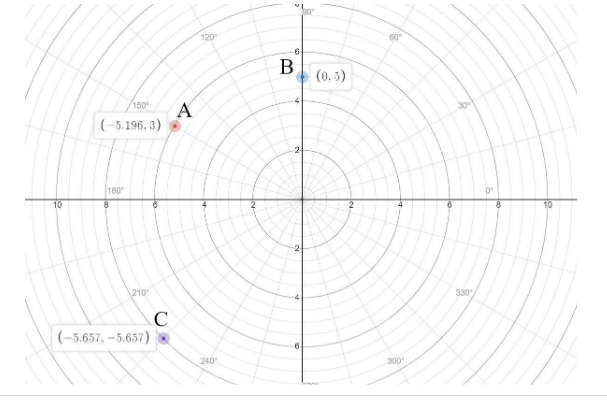
Therefore we have successfully plotted all the points on the polar coordinate plane .
Note: 1.One must be careful while determining the angular and radial coordinate.
2. To confirm you have correctly plotted our polar coordinate or not
Let Convert the polar coordinate into rectangular coordinates and if both are same then we can say that we have successfully plotted the polar coordinate correctly
Now to transformation by which we can find our rectangular coordinates $ \left( {x,y} \right) $ is
$
x = r\cos \theta \\
y = r\sin \theta \;
$
Complete step-by-step answer:
There are two ways to determine a point on a plane, one is by the rectangular coordinates and another is by the Polar Coordinates.
Polar Coordinates $ (p,\theta ) $ is actually a 2D coordinate system in which every point on the plane is found by a distance $ p $ from a reference point and an angle i.e. $ \theta $ from a reference direction.
where $ p $ is the radial coordinate and $ \theta $ is known as the angular coordinate.
As per the question given we are given three polar coordinates as $ A\left( { - 6, - \dfrac{\pi }{6}} \right),B\left( { - 5, - \dfrac{\pi }{2}} \right),\,and\,C\left( { - 8, - \dfrac{\pi }{4}} \right) $ .
For Polar coordinate $ A $ :
Radial coordinate = $ {p_1}\,\, = {r_1} = - 6 $
Angular coordinate \[ = {\theta _1} = - \dfrac{\pi }{6}\]
First, we convert the Angular coordinate into degree
So, to convert into degree replace $ \pi $ with 180
$
{\theta _1} = - \dfrac{1}{6} \times {180^ \circ } \\
{\theta _1} = - {30^ \circ } \;
$
Now taking radius as $ {p_1}\,\, = {r_1} = - 6 $ on the y-axis and angle measure as $ - {30^ \circ } $ , plot the point on the coordinate plane .
Similarly, identify the Radial coordinate and angular coordinate for the remaining points I.e. $ B\,and\,C $ we have
For Polar coordinate $ A $ :
Radial coordinate = $ {p_2}\,\, = {r_2} = - 5 $
Angular coordinate \[ = {\theta _2} = - \dfrac{\pi }{2}\]
$
{\theta _2} = - \dfrac{1}{2} \times {180^ \circ } \\
{\theta _2} = - {90^ \circ } \;
$
For Polar coordinate $ C $ :
Radial coordinate = $ {p_2}\,\, = {r_2} = - 8 $
Angular coordinate \[ = {\theta _3} = - \dfrac{\pi }{4}\]
$
{\theta _3} = - \dfrac{1}{4} \times {180^ \circ } \\
{\theta _3} = - {45^ \circ } \;
$
Now plotting all the three points by taking the radial coordinate on the y-axis and measuring angle as per the radial coordinate. We obtain the graph of polar coordinate plane containing all the points as
Therefore we have successfully plotted all the points on the polar coordinate plane .
Note: 1.One must be careful while determining the angular and radial coordinate.
2. To confirm you have correctly plotted our polar coordinate or not
Let Convert the polar coordinate into rectangular coordinates and if both are same then we can say that we have successfully plotted the polar coordinate correctly
Now to transformation by which we can find our rectangular coordinates $ \left( {x,y} \right) $ is
$
x = r\cos \theta \\
y = r\sin \theta \;
$
Recently Updated Pages
Master Class 11 Social Science: Engaging Questions & Answers for Success

Master Class 11 English: Engaging Questions & Answers for Success
Master Class 11 Maths: Engaging Questions & Answers for Success
Master Class 11 Chemistry: Engaging Questions & Answers for Success
Master Class 11 Biology: Engaging Questions & Answers for Success
Master Class 11 Physics: Engaging Questions & Answers for Success
Trending doubts
Differentiate between an exothermic and an endothermic class 11 chemistry CBSE
One Metric ton is equal to kg A 10000 B 1000 C 100 class 11 physics CBSE
Difference Between Prokaryotic Cells and Eukaryotic Cells
There are 720 permutations of the digits 1 2 3 4 5 class 11 maths CBSE
Draw a diagram of a plant cell and label at least eight class 11 biology CBSE
1 Quintal is equal to a 110 kg b 10 kg c 100kg d 1000 class 11 physics CBSE