




Plot a graph depicting the first four multiples of 5.
Answer
 Verified
570k+ views
Hint: First let us understand the meaning of a multiple. A multiple is an end product that is obtained by multiplying a number by an integer. Hence the multiples of 5 would be 5 multiplied by the integers such as 1,2,3,4…. To plot any graph, we need coordinates first. Here we take four consecutive integers as the x-coordinates and the four consecutive multiples of 5 as the y-coordinates and then plot them on a graph.
Complete step by step solution:
Firstly, we write down the multiples of 5.
The multiples of any number are nothing, but the outcomes resulted when we multiply that with the integers.
The integers are 1,2,3,4,5…... and so on.
Now the multiples of 5 will be,
$\Rightarrow \left( 5\times 1 \right),\left( 5\times 2 \right),\left( 5\times 3 \right),\left( 5\times 4 \right).......$
On evaluating them we get the resulted multiples as,
$\Rightarrow 5,10,15,20,25....$
Now let us depict these multiples on a graph.
Here we are taking integers 1,2,3,4,5,6…... on the x-axis and the multiples of 5 which we found 5,10,15,20,25…. On the y-axis.
Since we are asked to plot only four coordinates,
The coordinates which we are going to plot will be,
$\Rightarrow \left( 1,5 \right),\left( 2,10 \right),\left( 3,15 \right),\left( 4,20 \right)$
To plot any coordinate on the graph,
We first take the quantity in the x-coordinate and measure it in the graph and then mark a point. We do the same for the y-coordinate.
After we get a set of points, join them to depict a line or a closed figure.
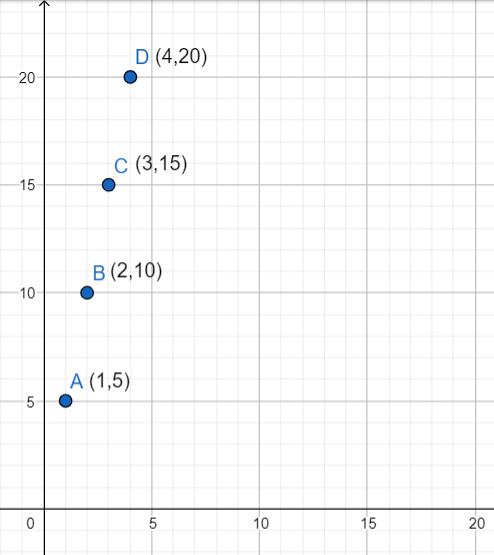
The figure given above is a graph which depicts all the points which are multiples of 5.
Note: One might make a mistake in considering factors in place of multiples. Factors are a couple of numbers which when we multiply together, results in a whole number. Those numbers are said to be the factors of that whole number. Multiples are what we get after multiplying those factors.
Complete step by step solution:
Firstly, we write down the multiples of 5.
The multiples of any number are nothing, but the outcomes resulted when we multiply that with the integers.
The integers are 1,2,3,4,5…... and so on.
Now the multiples of 5 will be,
$\Rightarrow \left( 5\times 1 \right),\left( 5\times 2 \right),\left( 5\times 3 \right),\left( 5\times 4 \right).......$
On evaluating them we get the resulted multiples as,
$\Rightarrow 5,10,15,20,25....$
Now let us depict these multiples on a graph.
Here we are taking integers 1,2,3,4,5,6…... on the x-axis and the multiples of 5 which we found 5,10,15,20,25…. On the y-axis.
Since we are asked to plot only four coordinates,
The coordinates which we are going to plot will be,
$\Rightarrow \left( 1,5 \right),\left( 2,10 \right),\left( 3,15 \right),\left( 4,20 \right)$
To plot any coordinate on the graph,
We first take the quantity in the x-coordinate and measure it in the graph and then mark a point. We do the same for the y-coordinate.
After we get a set of points, join them to depict a line or a closed figure.
The figure given above is a graph which depicts all the points which are multiples of 5.
Note: One might make a mistake in considering factors in place of multiples. Factors are a couple of numbers which when we multiply together, results in a whole number. Those numbers are said to be the factors of that whole number. Multiples are what we get after multiplying those factors.
Recently Updated Pages
Master Class 12 Business Studies: Engaging Questions & Answers for Success

Master Class 12 Biology: Engaging Questions & Answers for Success
Master Class 12 Chemistry: Engaging Questions & Answers for Success
Class 12 Question and Answer - Your Ultimate Solutions Guide
Master Class 11 Social Science: Engaging Questions & Answers for Success
Master Class 11 English: Engaging Questions & Answers for Success
Trending doubts
Find the sum of series 1 + 2 + 3 + 4 + 5 + + 100 class 9 maths CBSE
Fill the blanks with the suitable prepositions 1 The class 9 english CBSE
Difference Between Plant Cell and Animal Cell
How many hours before the closure of election must class 9 social science CBSE
What is pollution? How many types of pollution? Define it
Name 10 Living and Non living things class 9 biology CBSE