




Please explain the $ + E$ and $ - E$ electromeric effect with examples.
Answer
 Verified
564k+ views
Hint: The instantaneous formation of a dipole in an organic compound because of complete transfer of shared pi electron pairs to one of the atoms having double bond under the influence of an attacking reagent is referred to as an electromeric effect. It is a temporary effect that means the molecule will return back to its original state when the attacking reagent is removed from the system.
Complete answer:
Electromeric effect can be classified into two categories i.e., $ + E$ and $ - E$ electromeric effect. The classification is based on the criteria in which direction in which the electron pair is transferred which is explained as follows:
$ + E$ electromeric effect:
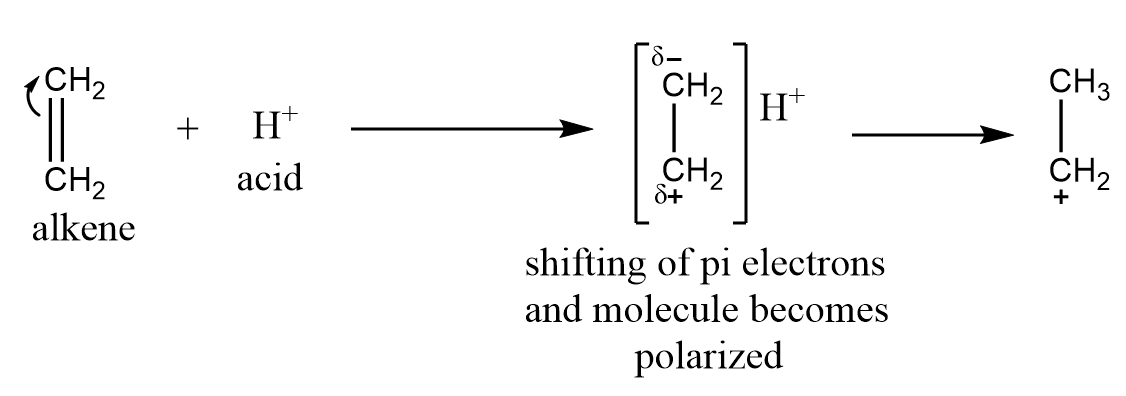
This effect is observed when the electron pair of the pi bond is transferred towards the attacking reagent. It is generally observed when an attacking reagent is an electrophile i.e., electron deficient species and will attract the pi electrons towards it. A common example for the $ + E$ effect is the addition of an acid to alkenes.
$ - E$ electromeric effect:
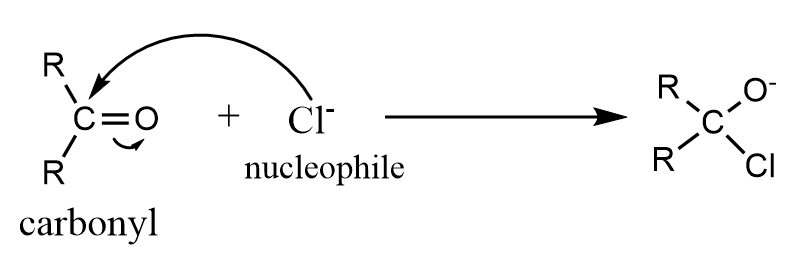
This effect occurs when the electron pair of the pi bond is shifted away from the attacking reagent. In this case, the attacking reagent is a nucleophile i.e., electron rich species and thus, forms a bond with the positively charged atom in the molecule instead of the atom to which the pi electrons are transferred. A common example of the $ - E$ effect is addition of a nucleophile to a carbonyl compound.
Note:
It is important to note that unlike the inductive effect, the electromeric effect is not a permanent effect which only arises when the compound is subjected to an attacking reagent and this effect is observed only in those organic compounds in which multiple bonds are present.
Complete answer:
Electromeric effect can be classified into two categories i.e., $ + E$ and $ - E$ electromeric effect. The classification is based on the criteria in which direction in which the electron pair is transferred which is explained as follows:
$ + E$ electromeric effect:
This effect is observed when the electron pair of the pi bond is transferred towards the attacking reagent. It is generally observed when an attacking reagent is an electrophile i.e., electron deficient species and will attract the pi electrons towards it. A common example for the $ + E$ effect is the addition of an acid to alkenes.
$ - E$ electromeric effect:
This effect occurs when the electron pair of the pi bond is shifted away from the attacking reagent. In this case, the attacking reagent is a nucleophile i.e., electron rich species and thus, forms a bond with the positively charged atom in the molecule instead of the atom to which the pi electrons are transferred. A common example of the $ - E$ effect is addition of a nucleophile to a carbonyl compound.
Note:
It is important to note that unlike the inductive effect, the electromeric effect is not a permanent effect which only arises when the compound is subjected to an attacking reagent and this effect is observed only in those organic compounds in which multiple bonds are present.
Recently Updated Pages
If x a + bt + ct2 where x is in meters and t is in class 11 physics CBSE

A car covers the first half distance between two places class 11 physics CBSE
The resultant of two vectors overrightarrow P and overrightarrow class 11 physics CBSE
Find the value of cos 135 class 11 maths CBSE
A mass M is held in place by an applied force F and class 11 physics CBSE
A solution of glucose in water is labelled as 10 dfracwv class 11 chemistry CBSE
Trending doubts
Find the value of the expression given below sin 30circ class 11 maths CBSE
One Metric ton is equal to kg A 10000 B 1000 C 100 class 11 physics CBSE
Draw a diagram of nephron and explain its structur class 11 biology CBSE
10 examples of friction in our daily life
Proton was discovered by A Thomson B Rutherford C Chadwick class 11 chemistry CBSE
Bond order ofO2 O2+ O2 and O22 is in order A O2 langle class 11 chemistry CBSE