




Plates A and B constitute an isolated, charge parallel plate capacitor. The inner surface of A and B have charges \[ + Q\] and \[-Q\] respectively. A third plate C with charge \[ + Q\] is now introduced midway between A and B. Which of the following statements is not correct?
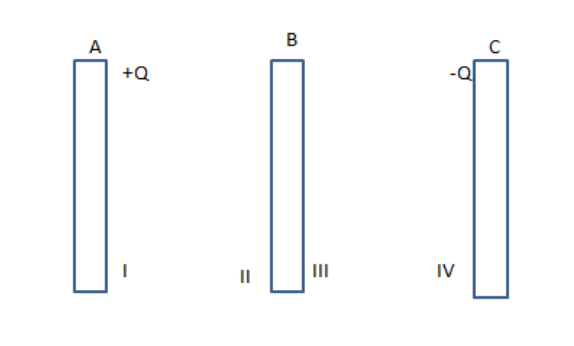
A.The surfaces $I$ and $II$will have equal and opposite charges.
B.The surfaces $III$and $IV$will have equal and opposite charges.
C.The charge on surface $III$will be greater than $Q$.
D.The potential difference between A and C will be equal to the potential difference between C and B.
Answer
 Verified
513k+ views
Hint: the comparison of the number of protons and electrons gives a charge.
If there is more proton then it is net positive charge.
If there is more electrons then it is a new negative charge.
Complete answer:
The electric potential is known as the work done on moving charges. It measures the change in the potential energy of a particular charge. We can measure the electric potential units of joules per coulomb and it measures the amount of work per charge.
The capacitance describes the ability to store the charges. The work required to move the positive charge is also known as the electric potential. The capacitance has medical applications like defibrillators. The capacitance is also called a temporary battery.
When there is an excess charge on the insulator or a conductor then the potential field is created around the it. Which is known as the scalar field. The static electric field is a negative
Finally, the field distribution is,
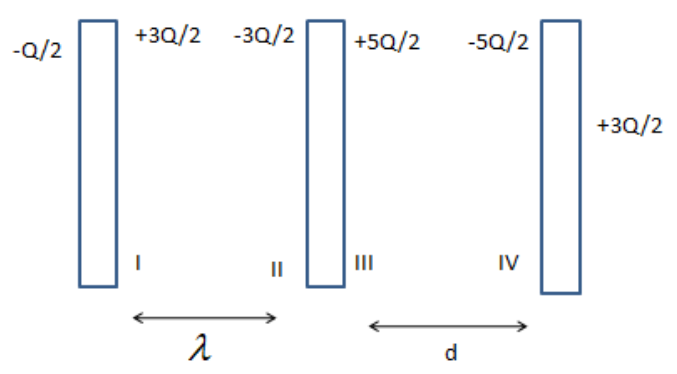
Hence the correct answer is an option (D) The potential difference between A and C will be equal to the potential difference between C and B.
Note:
The electric potential and capacitance have more applications in power generation.
It has a wide range of applications in energy storage also.
We found this electric potential is from the human brain also it is about $70mV$ average.
If there is more proton then it is net positive charge.
If there is more electrons then it is a new negative charge.
Complete answer:
The electric potential is known as the work done on moving charges. It measures the change in the potential energy of a particular charge. We can measure the electric potential units of joules per coulomb and it measures the amount of work per charge.
The capacitance describes the ability to store the charges. The work required to move the positive charge is also known as the electric potential. The capacitance has medical applications like defibrillators. The capacitance is also called a temporary battery.
When there is an excess charge on the insulator or a conductor then the potential field is created around the it. Which is known as the scalar field. The static electric field is a negative
Finally, the field distribution is,
Hence the correct answer is an option (D) The potential difference between A and C will be equal to the potential difference between C and B.
Note:
The electric potential and capacitance have more applications in power generation.
It has a wide range of applications in energy storage also.
We found this electric potential is from the human brain also it is about $70mV$ average.
Recently Updated Pages
Master Class 11 Social Science: Engaging Questions & Answers for Success

Master Class 11 English: Engaging Questions & Answers for Success
Master Class 11 Maths: Engaging Questions & Answers for Success
Master Class 11 Chemistry: Engaging Questions & Answers for Success
Master Class 11 Biology: Engaging Questions & Answers for Success
Class 11 Question and Answer - Your Ultimate Solutions Guide
Trending doubts
One Metric ton is equal to kg A 10000 B 1000 C 100 class 11 physics CBSE
Difference Between Prokaryotic Cells and Eukaryotic Cells
Find the value of the expression given below sin 30circ class 11 maths CBSE
1 ton equals to A 100 kg B 1000 kg C 10 kg D 10000 class 11 physics CBSE
Two of the body parts which do not appear in MRI are class 11 biology CBSE
Draw a diagram of nephron and explain its structur class 11 biology CBSE