




Plastids are found in
(a)All animal cells
(b)Some animals
(c)All plant cells
(d)All plant cells and euglenoids
Answer
 Verified
587.4k+ views
Hint: Plastid is a double membrane-bound organelle and is involved in the synthesis and storage of food. It is commonly found within the cells of photosynthetic organisms.
Complete answer:
Plastids were first discovered and named by Ernst Haeckel. Plastids are necessary for essential life processes in various organisms, like photosynthesis and food storage.
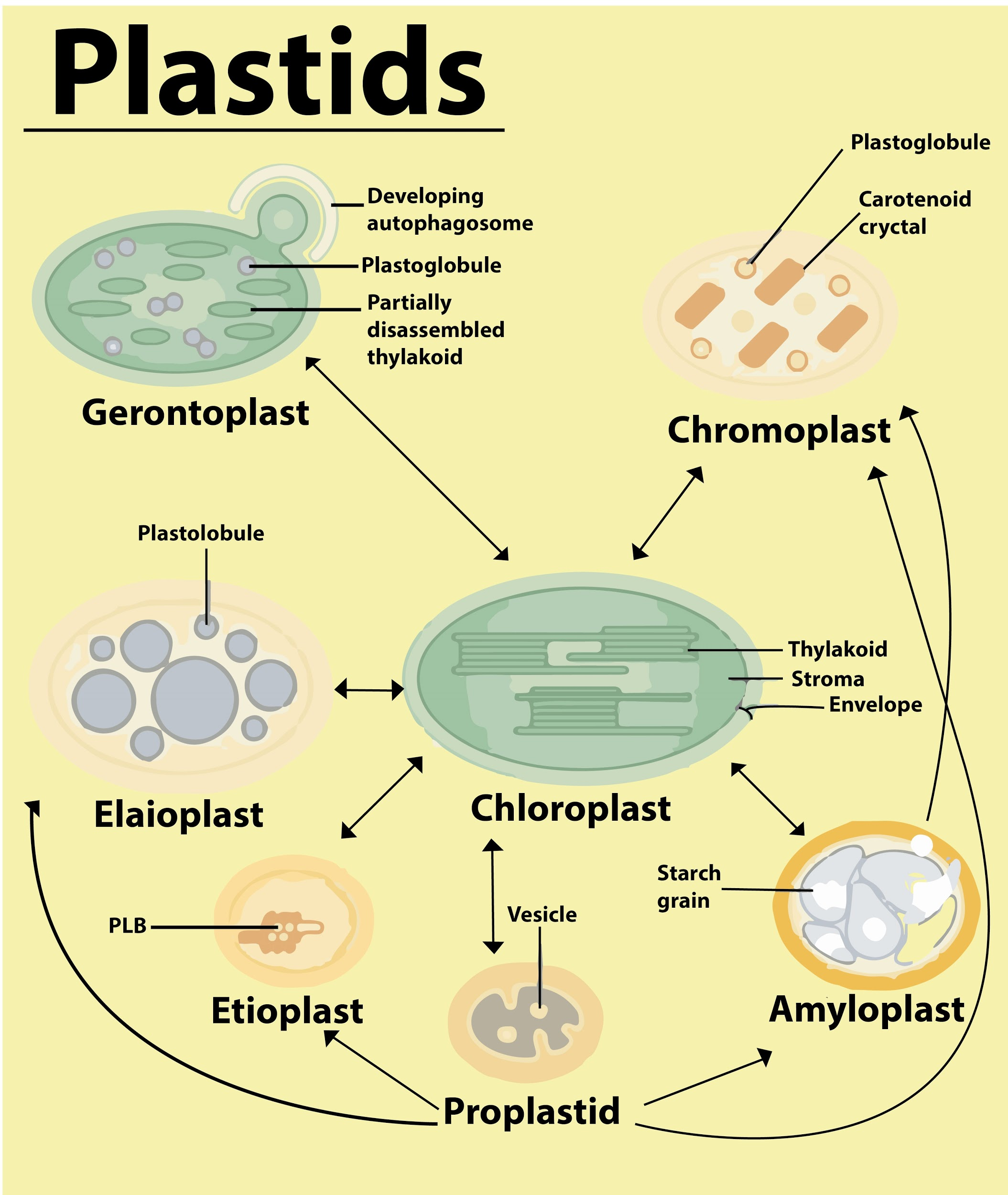
A plastid can contain different pigments. A plastid that contains green pigment chlorophyll is called chloroplast whereas a plastid that contains any pigments apart from green is called a chromoplast. A plastid that lacks pigments and is involved mainly in food storage is called leucoplast. An undifferentiated plastid is known as a proplastid and may develop later into any of the other plastids.
Additional Information: Different types of Plastids are as follows:
-Chloroplasts: The chloroplasts are probably the most common of all the plastids. These are mainly responsible for photosynthesis. This plastid contains a large number of thylakoids, which is the main site for photosynthesis.
-Chromoplasts: Pigments are stored and synthesized in a plant in the units of chromoplast. These are mainly found in flowering plants, fruits, and aging leaves. Old chloroplasts convert over to chromoplasts. The carotenoid pigments allow for the different colors that are seen in various fruits and the fall leaves. These colors mainly help in attracting pollinators.
-Leucoplasts: Leucoplasts do not contain any pigment and therefore are found mainly in the non-photosynthetic parts of the plant, such as the roots. They mainly synthesize amino acids and fatty acids. A leucoplast can also transform into: An amyloplast that stores starch
An elaioplast that stores fat
A proteinoplast that stores proteins.
-Gerontoplast: Gerontoplasts are basically chloroplasts that are undergoing the aging process. These are chloroplasts of the leaves that are starting to convert into different organelles or are being repurposed during the fall season when the leaf is no longer utilizing photosynthesis.
So, the correct answer is 'All plant cells and euglenoids'
Note: Plastids are the main sites of manufacturing and storing important chemical compounds that are used by the cells of plants to carry out different functions. Additionally, like mitochondria, plastids have their own DNA and ribosomes. Hence, they are also used in phylogenetic studies.
Complete answer:
Plastids were first discovered and named by Ernst Haeckel. Plastids are necessary for essential life processes in various organisms, like photosynthesis and food storage.
A plastid can contain different pigments. A plastid that contains green pigment chlorophyll is called chloroplast whereas a plastid that contains any pigments apart from green is called a chromoplast. A plastid that lacks pigments and is involved mainly in food storage is called leucoplast. An undifferentiated plastid is known as a proplastid and may develop later into any of the other plastids.
Additional Information: Different types of Plastids are as follows:
-Chloroplasts: The chloroplasts are probably the most common of all the plastids. These are mainly responsible for photosynthesis. This plastid contains a large number of thylakoids, which is the main site for photosynthesis.
-Chromoplasts: Pigments are stored and synthesized in a plant in the units of chromoplast. These are mainly found in flowering plants, fruits, and aging leaves. Old chloroplasts convert over to chromoplasts. The carotenoid pigments allow for the different colors that are seen in various fruits and the fall leaves. These colors mainly help in attracting pollinators.
-Leucoplasts: Leucoplasts do not contain any pigment and therefore are found mainly in the non-photosynthetic parts of the plant, such as the roots. They mainly synthesize amino acids and fatty acids. A leucoplast can also transform into: An amyloplast that stores starch
An elaioplast that stores fat
A proteinoplast that stores proteins.
-Gerontoplast: Gerontoplasts are basically chloroplasts that are undergoing the aging process. These are chloroplasts of the leaves that are starting to convert into different organelles or are being repurposed during the fall season when the leaf is no longer utilizing photosynthesis.
So, the correct answer is 'All plant cells and euglenoids'
Note: Plastids are the main sites of manufacturing and storing important chemical compounds that are used by the cells of plants to carry out different functions. Additionally, like mitochondria, plastids have their own DNA and ribosomes. Hence, they are also used in phylogenetic studies.
Recently Updated Pages
Which will be the least stable resonating structure class 11 chemistry CBSE

How many 5 digit telephone numbers can be construc-class-11-maths-CBSE
How do you find the angle of the resultant vector class 11 physics CBSE
Draw labelled diagram of the following i Gram seed class 11 biology CBSE
What is the need and importance of classification class 11 biology CBSE
The way in which the sparrows expressed their sorrow class 11 english CBSE
Trending doubts
One Metric ton is equal to kg A 10000 B 1000 C 100 class 11 physics CBSE
Find the value of the expression given below sin 30circ class 11 maths CBSE
1 Quintal is equal to a 110 kg b 10 kg c 100kg d 1000 class 11 physics CBSE
Draw a diagram of nephron and explain its structur class 11 biology CBSE
10 examples of friction in our daily life
Proton was discovered by A Thomson B Rutherford C Chadwick class 11 chemistry CBSE