




Plasmolysis in a plant cell is defined as
(a) Breakdown(lysis) of the plasma membrane in hypotonic medium
(b) Shrinkage of protoplasm in hypertonic medium
(c) Shrinkage of nucleoplasm
(d) None of the above
Answer
 Verified
614.4k+ views
Hint: When a cell is placed in a solution of low concentration when compared to the surrounding concentration, the water from the cell moves out and causes plasmolysis
Complete answer:
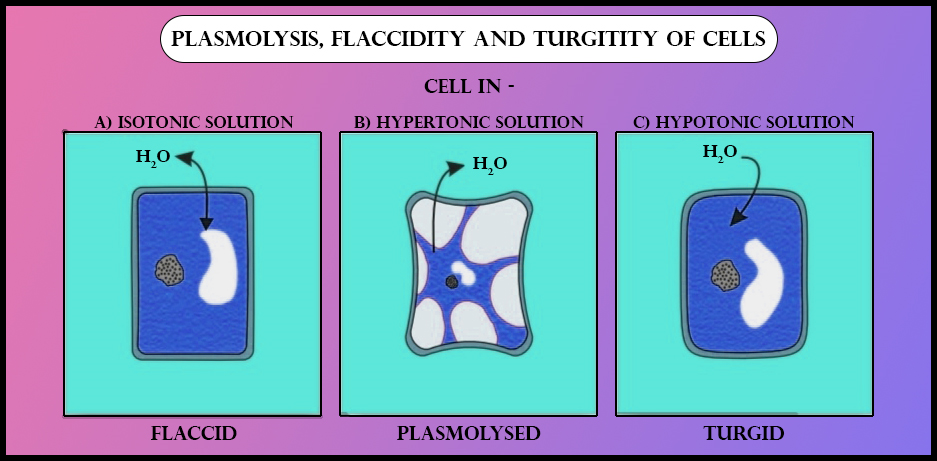
Cells swell when it is placed in a hypotonic solution and when it is placed in a hypertonic solution or medium it shrinks from the cell wall. This phenomenon is called plasmolysis.
If the external pressure balances the cytoplasmic pressure it is called an isotonic solution and if the external solution is more concentrated then it is called a hypertonic solution and if the external solution is very less concentrated then it is a hypotonic solution.
Additional Information: - Depending upon the surrounding water, the behavior of a plant cell or tissue varies.
- plasmolysis is the separation of protoplasm from the cell wall
- Plasmolysis occurs when water comes out and the cell membrane of the plant cell shrinks away from the cell wall.
- In a plant cell or tissue is placed in a hypotonic solution, water inside the cell moves out by the process of osmosis and the cell membrane shrinks away from the cell wall.
- If a plant cell is placed in a hypotonic solution, water from the surrounding enters inside the cell and it swells.
- If a plant cell is placed in an isotonic solution there will be neither shrinkage or swelling of the cell.
so, the correct answer is ‘shrinkage of protoplasm in hypertonic medium’
Note: Initially when a cell is placed in a hypertonic, shrinkage is seen only at the corners of the cell wall. This stage is called incipient plasmolysis and if the cell is placed for more time then it shows complete plasmolysis.
For a cell placed in a hypotonic solution, water potential becomes equal to the solute potential.
Complete answer:
Cells swell when it is placed in a hypotonic solution and when it is placed in a hypertonic solution or medium it shrinks from the cell wall. This phenomenon is called plasmolysis.
If the external pressure balances the cytoplasmic pressure it is called an isotonic solution and if the external solution is more concentrated then it is called a hypertonic solution and if the external solution is very less concentrated then it is a hypotonic solution.
Additional Information: - Depending upon the surrounding water, the behavior of a plant cell or tissue varies.
- plasmolysis is the separation of protoplasm from the cell wall
- Plasmolysis occurs when water comes out and the cell membrane of the plant cell shrinks away from the cell wall.
- In a plant cell or tissue is placed in a hypotonic solution, water inside the cell moves out by the process of osmosis and the cell membrane shrinks away from the cell wall.
- If a plant cell is placed in a hypotonic solution, water from the surrounding enters inside the cell and it swells.
- If a plant cell is placed in an isotonic solution there will be neither shrinkage or swelling of the cell.
so, the correct answer is ‘shrinkage of protoplasm in hypertonic medium’
Note: Initially when a cell is placed in a hypertonic, shrinkage is seen only at the corners of the cell wall. This stage is called incipient plasmolysis and if the cell is placed for more time then it shows complete plasmolysis.
For a cell placed in a hypotonic solution, water potential becomes equal to the solute potential.
Recently Updated Pages
Master Class 11 English: Engaging Questions & Answers for Success

Master Class 11 Social Science: Engaging Questions & Answers for Success
Master Class 11 Maths: Engaging Questions & Answers for Success
Master Class 11 Biology: Engaging Questions & Answers for Success
Master Class 11 Physics: Engaging Questions & Answers for Success
Master Class 11 Chemistry: Engaging Questions & Answers for Success
Trending doubts
One Metric ton is equal to kg A 10000 B 1000 C 100 class 11 physics CBSE
Difference Between Prokaryotic Cells and Eukaryotic Cells
Find the value of the expression given below sin 30circ class 11 maths CBSE
Two of the body parts which do not appear in MRI are class 11 biology CBSE
Draw a diagram of a plant cell and label at least eight class 11 biology CBSE
10 examples of friction in our daily life