




Plants with ovaries having only one or a few ovules are generally pollinated by
A. Butterflies
B. Birds
C. Wind
D. Bees
Answer
 Verified
617.4k+ views
Hint: The pollination is the process of transfer of pollen grains to the ovule of flowers. This can happen through various means. Moreover, plants having ovaries with one or a few ovules have light non-sticky pollen.
Complete step by step answer: The process of pollination is the first step toward the completion of sexual reproduction in plants. It is followed by fertilization and then the formation of zygote. The pollination involves bringing near the pollen or the male gametes to the eggs or female gametes.
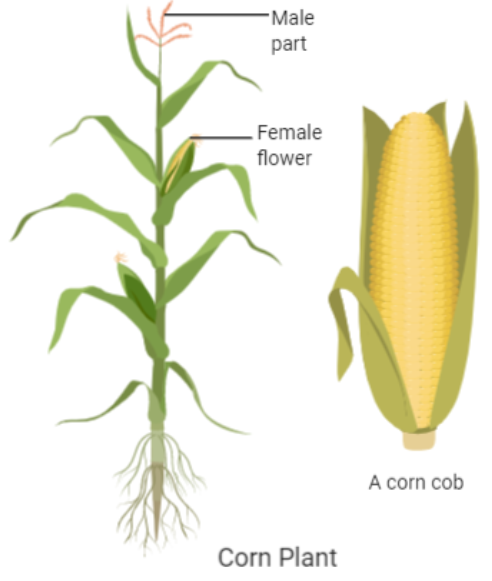
This process of transfer of pollen grains from one flower to the other having egg is carried out by various means. The plants that have ovaries with one or few ovules generally have pollen that is non-sticky and light in weight. The flowers often contain well-exposed female organs called stamens. The heightened or exposed stamens are easy to be pollinated by pollens dispersed in wind. The surface of stamens is sticky that entraps the wind-driven pollen grains. In addition, the stigmas can be feathery to act as a trap for airborne pollen. Also, the plants having a single ovule in each ovary have numerous flowers arranged in cluster inflorescence. So, the wind that acts as a medium for pollen grains to travel towards the stigmas of flowers for pollination to take place. This type of pollination is called Anemophily. An example of this is pollination in a corn cob.
Butterflies and bees are modes of Entomophily. This is a type of pollination including insects as a medium to carry pollen towards the stigma. On the other hand, the pollination derived by birds is called Ornithophily.
Hence, the correct option is option C, i.e., wind.
Note: Some flowers bear colorful, sticky, and fragrant pollen. These are made attractive to attract various insects, bees, etc to serve as pollinators. Also, the birds get attracted to nectar-filled fragrant pollen and carry them towards the stigmas. The water pollinates plants with pollen covered with protective layers.
Complete step by step answer: The process of pollination is the first step toward the completion of sexual reproduction in plants. It is followed by fertilization and then the formation of zygote. The pollination involves bringing near the pollen or the male gametes to the eggs or female gametes.
This process of transfer of pollen grains from one flower to the other having egg is carried out by various means. The plants that have ovaries with one or few ovules generally have pollen that is non-sticky and light in weight. The flowers often contain well-exposed female organs called stamens. The heightened or exposed stamens are easy to be pollinated by pollens dispersed in wind. The surface of stamens is sticky that entraps the wind-driven pollen grains. In addition, the stigmas can be feathery to act as a trap for airborne pollen. Also, the plants having a single ovule in each ovary have numerous flowers arranged in cluster inflorescence. So, the wind that acts as a medium for pollen grains to travel towards the stigmas of flowers for pollination to take place. This type of pollination is called Anemophily. An example of this is pollination in a corn cob.
Butterflies and bees are modes of Entomophily. This is a type of pollination including insects as a medium to carry pollen towards the stigma. On the other hand, the pollination derived by birds is called Ornithophily.
Hence, the correct option is option C, i.e., wind.
Note: Some flowers bear colorful, sticky, and fragrant pollen. These are made attractive to attract various insects, bees, etc to serve as pollinators. Also, the birds get attracted to nectar-filled fragrant pollen and carry them towards the stigmas. The water pollinates plants with pollen covered with protective layers.
Recently Updated Pages
Master Class 12 Business Studies: Engaging Questions & Answers for Success

Master Class 12 Chemistry: Engaging Questions & Answers for Success
Master Class 12 Biology: Engaging Questions & Answers for Success
Class 12 Question and Answer - Your Ultimate Solutions Guide
Master Class 11 English: Engaging Questions & Answers for Success
Master Class 11 Social Science: Engaging Questions & Answers for Success
Trending doubts
Which are the Top 10 Largest Countries of the World?
Draw a labelled sketch of the human eye class 12 physics CBSE
Differentiate between homogeneous and heterogeneous class 12 chemistry CBSE
Differentiate between Pyramid of energy and pyramid class 12 biology CBSE
Why is the cell called the structural and functional class 12 biology CBSE
Draw the diagram of the pyramid of energy Explain In class 12 biology CBSE