




Plants whose seeds have more than one seed leaf (cotyledon) are
A. Ferns
B. Dicots
C. Monocots
D. Moss
Answer
 Verified
620.1k+ views
Hint: Seed plants have a unique process where male and female cells come together with a process known as fertilization. After implantation, a small plant named an embryo is created inside the seed. Seed preserves the embryo and supplies food for the embryo.
Complete answer:
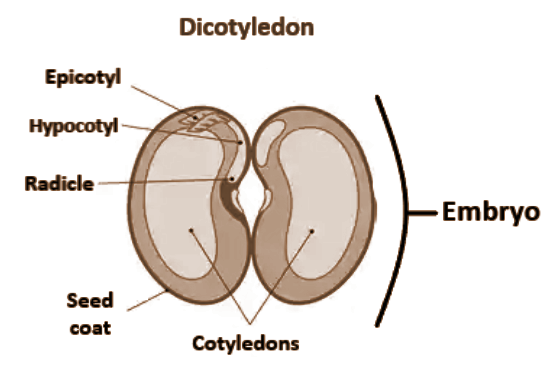
Dicotyledon, by term dicot, every member of the flowering plant that has a set of leaves or cotyledon within the embryo of the seed. The term refers to being one of the group's usual features, which is that the seed has two embryonic leaves or cotyledons. In dicotyledonous plants, the embryo consists of an embryo center and two cotyledons. Cotyledons always have a swelling look as they serve as a nutrient source for budding seeds. The path of the embryo has two ends. The first one that constitutes the tip of the shoot is named the plumule, and the part at the low end forms the edge of the root is called the radicle. The entire material is contained in a protective coating termed a seed coat. Dicots do have a tap root mechanism with a long deep root that progresses into fine secondary roots. In the lack of endosperm, the two cotyledons do provide the seed with nutritional requirements.
So, the correct answer is (B).
Additional information:
Monocotyledons are plants that flower or angiosperms holding single cotyledon or embryonic leaf seed. Monocotyledon is a tiny number of plant species with 60,000 species of plants. The monocot leaves have stomata both on the top and bottom surfaces and are therefore referred to as amphistomatous. Ferns are species that do not have flowers. In particular, the ferns multiply by developing spores. Comparable to flowering plants, the ferns have roots, stems, and leaves. Almost all of the ferns occupy the humid, damp areas of the world. Mosses were a category of plants with no tissue to transfer water. Mosses have developed from liverworts. Moss tissue seems to have no water-moving cells. This implies they're non-vascular plants. Water needs to be immersed in mosses like a sponge.
Note: In dicotyledons, the food may have been preserved within the endosperm or cotyledon. Embryo dominates the entire interior or only the core region of the seed. Seed coat offers security for seeds from cellular damage and adverse weather conditions. Dicots are worthy of secondary growth owing to the presence of lateral meristem. The meristem continues to grow new cells in concentric rings, growing the size of the plant.
Complete answer:
Dicotyledon, by term dicot, every member of the flowering plant that has a set of leaves or cotyledon within the embryo of the seed. The term refers to being one of the group's usual features, which is that the seed has two embryonic leaves or cotyledons. In dicotyledonous plants, the embryo consists of an embryo center and two cotyledons. Cotyledons always have a swelling look as they serve as a nutrient source for budding seeds. The path of the embryo has two ends. The first one that constitutes the tip of the shoot is named the plumule, and the part at the low end forms the edge of the root is called the radicle. The entire material is contained in a protective coating termed a seed coat. Dicots do have a tap root mechanism with a long deep root that progresses into fine secondary roots. In the lack of endosperm, the two cotyledons do provide the seed with nutritional requirements.
So, the correct answer is (B).
Additional information:
Monocotyledons are plants that flower or angiosperms holding single cotyledon or embryonic leaf seed. Monocotyledon is a tiny number of plant species with 60,000 species of plants. The monocot leaves have stomata both on the top and bottom surfaces and are therefore referred to as amphistomatous. Ferns are species that do not have flowers. In particular, the ferns multiply by developing spores. Comparable to flowering plants, the ferns have roots, stems, and leaves. Almost all of the ferns occupy the humid, damp areas of the world. Mosses were a category of plants with no tissue to transfer water. Mosses have developed from liverworts. Moss tissue seems to have no water-moving cells. This implies they're non-vascular plants. Water needs to be immersed in mosses like a sponge.
Note: In dicotyledons, the food may have been preserved within the endosperm or cotyledon. Embryo dominates the entire interior or only the core region of the seed. Seed coat offers security for seeds from cellular damage and adverse weather conditions. Dicots are worthy of secondary growth owing to the presence of lateral meristem. The meristem continues to grow new cells in concentric rings, growing the size of the plant.
Recently Updated Pages
Basicity of sulphurous acid and sulphuric acid are

Master Class 11 English: Engaging Questions & Answers for Success
Master Class 11 Physics: Engaging Questions & Answers for Success
Master Class 11 Computer Science: Engaging Questions & Answers for Success
Master Class 11 Chemistry: Engaging Questions & Answers for Success
Master Class 11 Social Science: Engaging Questions & Answers for Success
Trending doubts
Difference Between Prokaryotic Cells and Eukaryotic Cells
Two of the body parts which do not appear in MRI are class 11 biology CBSE
One Metric ton is equal to kg A 10000 B 1000 C 100 class 11 physics CBSE
10 examples of friction in our daily life
Draw a diagram of nephron and explain its structur class 11 biology CBSE
What will happen if the mucus is not secreted by the class 11 biology CBSE