




Plant roots grow downwards and show
A. Positive geotropic
B. Negative geotropic
C. Positive phototropic
D. Negative hydrotropic
Answer
 Verified
626.4k+ views
Hint: Gravitropism (otherwise called geotropism) is a planned cycle of differential development by a plant or parasite in light of gravity pulling on it. Gravity can be either "fake gravity" or normal gravity. It is an overall component of all higher and many lower plants just as different living beings.
Complete answer:
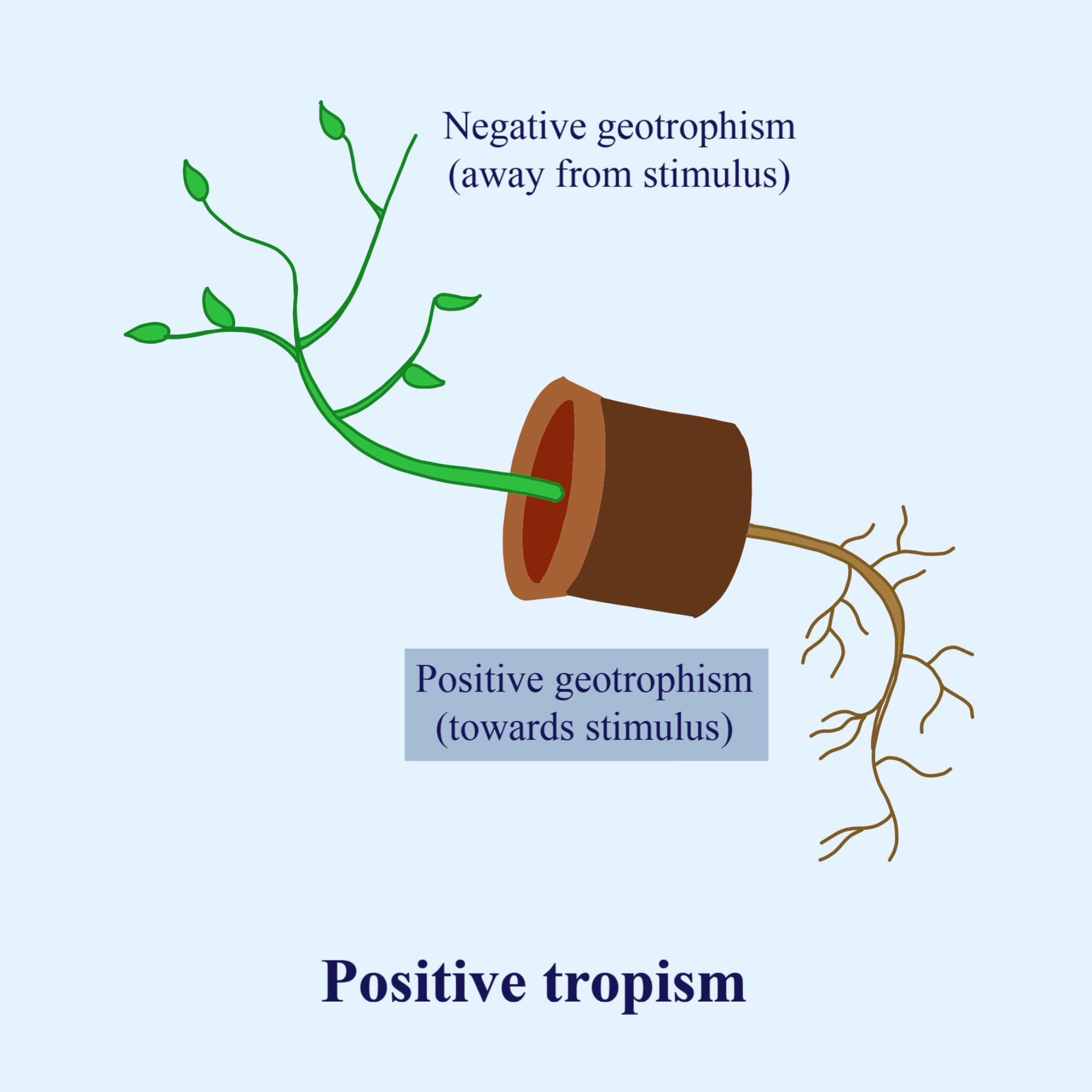
Geotropism is the development reaction of a plant because of gravity. Negative phototropism and positive geotropism of roots. The roots become away from light and down in the gravity of heading. The roots are bound to discover soil toward this path. Soil is significant for plants for mooring, water, and mineral supplements.
Additional Information: Charles Darwin was one of the first to experimentally record that roots show positive gravitropism and stems show negative gravitropism. That is, establishes fill toward gravitational force (i.e., descending), and stems fill the other way (i.e., upwards). This conduct can be effortlessly exhibited with any pruned plant. At the point when laid onto its side, the developing pieces of the stem start to show negative gravitropism, developing (scholars state, turning; see tropism) upwards. Herbaceous (non-woody) stems are equipped for a little level of genuine twisting, however, the greater part of the diverted development happens as a result of root or stem development outside. The instrument depends on the Cholodny–Went model which was proposed in 1927, and has since been modified. Although the model has been reprimanded and keeps on being refined, it has generally stood the trial of time.
So the correct answer is Positive geotropism.
Note: Root development happens by the division of undifferentiated organisms in the root meristem situated in the tip of the root, and the ensuing lopsided extension of cells in a shoot-ward area to the tip known as the lengthening zone. Differential development during tropisms predominantly includes changes in cell extension versus changes in cell division, albeit a function for cell division in jungle development has not been officially precluded. Gravity is detected in the root tip and this data should then be handed-off to the extension zone in order to keep up development bearing and mount compelling development reactions to changes in direction to and keep on developing its underlying foundations in a similar way as gravity.
Complete answer:
Geotropism is the development reaction of a plant because of gravity. Negative phototropism and positive geotropism of roots. The roots become away from light and down in the gravity of heading. The roots are bound to discover soil toward this path. Soil is significant for plants for mooring, water, and mineral supplements.
Additional Information: Charles Darwin was one of the first to experimentally record that roots show positive gravitropism and stems show negative gravitropism. That is, establishes fill toward gravitational force (i.e., descending), and stems fill the other way (i.e., upwards). This conduct can be effortlessly exhibited with any pruned plant. At the point when laid onto its side, the developing pieces of the stem start to show negative gravitropism, developing (scholars state, turning; see tropism) upwards. Herbaceous (non-woody) stems are equipped for a little level of genuine twisting, however, the greater part of the diverted development happens as a result of root or stem development outside. The instrument depends on the Cholodny–Went model which was proposed in 1927, and has since been modified. Although the model has been reprimanded and keeps on being refined, it has generally stood the trial of time.
So the correct answer is Positive geotropism.
Note: Root development happens by the division of undifferentiated organisms in the root meristem situated in the tip of the root, and the ensuing lopsided extension of cells in a shoot-ward area to the tip known as the lengthening zone. Differential development during tropisms predominantly includes changes in cell extension versus changes in cell division, albeit a function for cell division in jungle development has not been officially precluded. Gravity is detected in the root tip and this data should then be handed-off to the extension zone in order to keep up development bearing and mount compelling development reactions to changes in direction to and keep on developing its underlying foundations in a similar way as gravity.
Recently Updated Pages
Which will be the least stable resonating structure class 11 chemistry CBSE

How many 5 digit telephone numbers can be construc-class-11-maths-CBSE
How do you find the angle of the resultant vector class 11 physics CBSE
Draw labelled diagram of the following i Gram seed class 11 biology CBSE
1 Quintal is equal to a 110 kg b 10 kg c 100kg d 1000 class 11 physics CBSE
What is the need and importance of classification class 11 biology CBSE
Trending doubts
One Metric ton is equal to kg A 10000 B 1000 C 100 class 11 physics CBSE
Find the value of the expression given below sin 30circ class 11 maths CBSE
Draw a diagram of nephron and explain its structur class 11 biology CBSE
10 examples of friction in our daily life
Proton was discovered by A Thomson B Rutherford C Chadwick class 11 chemistry CBSE
The teeth used for biting and cutting food are called class 11 biology CBSE