




Why do plant cells need both chloroplast and mitochondria?
Answer
 Verified
540k+ views
Hint: Plant cells are the Eukaryotic cells that contain all the membrane-bound organelles. The mitochondria are known as the powerhouse of the cell and the chloroplast are the organelles which produce food in the form of glucose. These two organelles work together.
Complete answer:
Plant cells are autotrophs that can prepare their own food by the process of photosynthesis. During photosynthesis, carbon dioxide is utilised to produce glucose and water in the presence of sunlight and chlorophyll.
To answer this question, we must know about the functions of each organelle.
i) Chloroplast- The chloroplasts are the organelles that contain chlorophyll. The chlorophyll is the important molecule that is necessary for photosynthesis. The sunlight is trapped by the chlorophyll and further carbon dioxide and water are utilised to produce energy in the form of glucose. The oxygen is generated as a by-product of photosynthesis along glucose is further processed in the mitochondria.
ii) Mitochondria- It is known as the powerhouse of the cell and the site of cellular respiration. The oxygen released by the chloroplast during the process of photosynthesis is utilised in the mitochondria to release energy by the oxidation of glucose. The energy produced by the mitochondria is in the form of ATP.
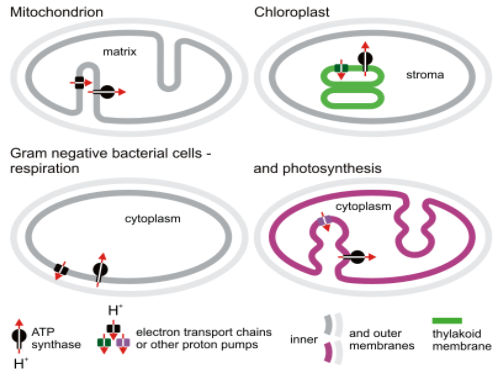
Thus, we can say that the plants require both chloroplast and mitochondria for producing chemical energy and energy in the form of ATP.
Note: The chloroplast and the mitochondria are the semi-autonomous bodies. They contain their own genetic material which is similar to the prokaryotic circular DNA. Chloroplast is absent in the animal cell. Chloroplast and mitochondria together work for the growth of the plants.
Complete answer:
Plant cells are autotrophs that can prepare their own food by the process of photosynthesis. During photosynthesis, carbon dioxide is utilised to produce glucose and water in the presence of sunlight and chlorophyll.
To answer this question, we must know about the functions of each organelle.
i) Chloroplast- The chloroplasts are the organelles that contain chlorophyll. The chlorophyll is the important molecule that is necessary for photosynthesis. The sunlight is trapped by the chlorophyll and further carbon dioxide and water are utilised to produce energy in the form of glucose. The oxygen is generated as a by-product of photosynthesis along glucose is further processed in the mitochondria.
ii) Mitochondria- It is known as the powerhouse of the cell and the site of cellular respiration. The oxygen released by the chloroplast during the process of photosynthesis is utilised in the mitochondria to release energy by the oxidation of glucose. The energy produced by the mitochondria is in the form of ATP.
Thus, we can say that the plants require both chloroplast and mitochondria for producing chemical energy and energy in the form of ATP.
Note: The chloroplast and the mitochondria are the semi-autonomous bodies. They contain their own genetic material which is similar to the prokaryotic circular DNA. Chloroplast is absent in the animal cell. Chloroplast and mitochondria together work for the growth of the plants.
Recently Updated Pages
Master Class 11 Social Science: Engaging Questions & Answers for Success

Master Class 11 English: Engaging Questions & Answers for Success
Master Class 11 Accountancy: Engaging Questions & Answers for Success
Master Class 11 Physics: Engaging Questions & Answers for Success
Master Class 11 Computer Science: Engaging Questions & Answers for Success
Master Class 11 Business Studies: Engaging Questions & Answers for Success
Trending doubts
One Metric ton is equal to kg A 10000 B 1000 C 100 class 11 physics CBSE
Find the value of the expression given below sin 30circ class 11 maths CBSE
Draw a diagram of nephron and explain its structur class 11 biology CBSE
10 examples of friction in our daily life
Proton was discovered by A Thomson B Rutherford C Chadwick class 11 chemistry CBSE
The teeth used for biting and cutting food are called class 11 biology CBSE