




How many planes can be made to pass through three distinct non-collinear points?
(a) 3
(b) 2
(c) 1
(d) 0
Answer
 Verified
617.7k+ views
Hint: First, before proceeding for this, we must know the following condition to make a plane that at least one point should pass from the plane to get that plane in existence. Then, we have three distinct non-collinear points: let A, B and C be those points that are non-collinear in nature means that are not in a straight line and have different places of marking. Then, by considering different cases for the planes to exist, we will get the condition for the maximum number of planes from three non collinear points as an answer.
Complete step-by-step answer:
In this question, we are supposed to find the number of planes that can be made to pass through three distinct non-collinear points.
So, before proceeding for this, we must know the following condition to make a plane that at least one point should pass from the plane to get that plane in existence.
Now, we have three distinct non-collinear points. Let A, B and C be those points that are non-collinear in nature means that are not in a straight line and have different places of marking.
So, we can draw the non-collinear points A, B and C as:
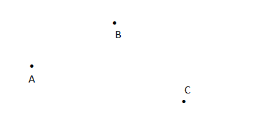
Now, it is clear from the figure that the three points are not in the straight line which makes them non-collinear.
Then, we need to get the maximum number of planes that can pass through these points.
So, we can pass a place through AB and C alone which makes the count as 2 planes.
Similarly, taking two points at a time for a plane and a single point for another plane makes the count of planes at maximum is 2.
Now, if we take all three points in one plane which makes the count of planes as 1.
Then, we can take three planes from all three points A,B and c which are different which makes the count of planes 3 as:
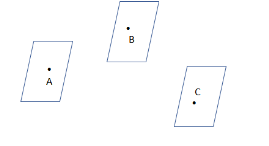
So, the maximum number of planes that can be made to pass through three distinct non-collinear points is 3.
So, the correct answer is “Option A”.
Note: Now, the only mistake in this type of question we occur is that we give the answer as 1 and mark option (c) as correct which is a wrong choice because most of the time the conditions mentioned in the question are collinear to confuse the candidate. But, in this question the points are non-collinear, so three planes can exist at maximum.
Complete step-by-step answer:
In this question, we are supposed to find the number of planes that can be made to pass through three distinct non-collinear points.
So, before proceeding for this, we must know the following condition to make a plane that at least one point should pass from the plane to get that plane in existence.
Now, we have three distinct non-collinear points. Let A, B and C be those points that are non-collinear in nature means that are not in a straight line and have different places of marking.
So, we can draw the non-collinear points A, B and C as:
Now, it is clear from the figure that the three points are not in the straight line which makes them non-collinear.
Then, we need to get the maximum number of planes that can pass through these points.
So, we can pass a place through AB and C alone which makes the count as 2 planes.
Similarly, taking two points at a time for a plane and a single point for another plane makes the count of planes at maximum is 2.
Now, if we take all three points in one plane which makes the count of planes as 1.
Then, we can take three planes from all three points A,B and c which are different which makes the count of planes 3 as:
So, the maximum number of planes that can be made to pass through three distinct non-collinear points is 3.
So, the correct answer is “Option A”.
Note: Now, the only mistake in this type of question we occur is that we give the answer as 1 and mark option (c) as correct which is a wrong choice because most of the time the conditions mentioned in the question are collinear to confuse the candidate. But, in this question the points are non-collinear, so three planes can exist at maximum.
Recently Updated Pages
Master Class 12 Business Studies: Engaging Questions & Answers for Success

Master Class 12 Biology: Engaging Questions & Answers for Success
Master Class 12 Chemistry: Engaging Questions & Answers for Success
Class 12 Question and Answer - Your Ultimate Solutions Guide
Master Class 11 Social Science: Engaging Questions & Answers for Success
Master Class 11 English: Engaging Questions & Answers for Success
Trending doubts
What is BLO What is the full form of BLO class 8 social science CBSE
Citizens of India can vote at the age of A 18 years class 8 social science CBSE
Right to vote is a AFundamental Right BFundamental class 8 social science CBSE
10 slogans on organ donation class 8 english CBSE
Name the states through which the Tropic of Cancer class 8 social science CBSE
What are the methods of reducing friction. Explain