




Phylum Nemathelminths includes these very common organisms, some of which are parasitic and most of which are often found in soil. Which of the following is it?
A) Segmented worms
B) Flatworms
C) Earthworms
D) Roundworms
Answer
 Verified
656.1k+ views
Hint: These organisms are of varied length having long round bodies. The presence of pseudocoelom is their characteristic feature.
Complete answer:
The organisms belonging to Phylum Nemathelminthes, that are very common organisms, and are parasitic and most of which are often found in soil are called roundworms.
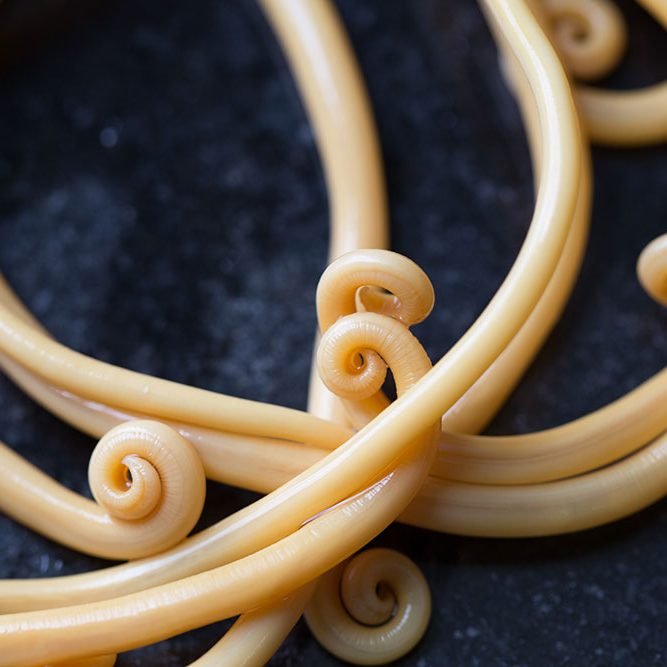
Fig: Roundworms
Additional information:
The common name for Aschelminthes is roundworms because the body appears circular in the transverse cross-section. This circular appearance in a transverse plane gives the common name roundworm.
General characteristic features of Aschelminthes:
- Habit and Habitat: They may be free or parasitic Free-living roundworms do not live within other animals and are independent. They may be aquatic or terrestrial.
- These are triploblastic, pseudocoelomate, bilaterally symmetrical having an organ system level of organization.
- They have an elongated, cylindrical body that tapers towards both ends.
- The digestive system is complete, having two separate openings. Tube within tube body plan. The stomach is absent in parasitic forms. Extracellular digestion. The roundworms have well developed muscular pharynx.
- H shaped Renette cells are present for excretion.
- They lack a circulatory system.
- They have a poorly developed nervous system.
- Sexes are separate. Females are often larger than males.
- Both direct and indirect development is present.
So, the correct answer is ‘Roundworms’.
Note: Aschelminthes is a superphylum where all pseudocoelomates are placed. This phylum is represented by about 15,000 species of roundworms. Parasitic roundworms live in plants and animals called endoparasites.
Complete answer:
The organisms belonging to Phylum Nemathelminthes, that are very common organisms, and are parasitic and most of which are often found in soil are called roundworms.
Fig: Roundworms
Additional information:
The common name for Aschelminthes is roundworms because the body appears circular in the transverse cross-section. This circular appearance in a transverse plane gives the common name roundworm.
General characteristic features of Aschelminthes:
- Habit and Habitat: They may be free or parasitic Free-living roundworms do not live within other animals and are independent. They may be aquatic or terrestrial.
- These are triploblastic, pseudocoelomate, bilaterally symmetrical having an organ system level of organization.
- They have an elongated, cylindrical body that tapers towards both ends.
- The digestive system is complete, having two separate openings. Tube within tube body plan. The stomach is absent in parasitic forms. Extracellular digestion. The roundworms have well developed muscular pharynx.
- H shaped Renette cells are present for excretion.
- They lack a circulatory system.
- They have a poorly developed nervous system.
- Sexes are separate. Females are often larger than males.
- Both direct and indirect development is present.
So, the correct answer is ‘Roundworms’.
Note: Aschelminthes is a superphylum where all pseudocoelomates are placed. This phylum is represented by about 15,000 species of roundworms. Parasitic roundworms live in plants and animals called endoparasites.
Recently Updated Pages
Class 10 Question and Answer - Your Ultimate Solutions Guide

Master Class 10 Computer Science: Engaging Questions & Answers for Success
Master Class 10 General Knowledge: Engaging Questions & Answers for Success
Master Class 12 Economics: Engaging Questions & Answers for Success
Master Class 12 Social Science: Engaging Questions & Answers for Success
Master Class 12 English: Engaging Questions & Answers for Success
Trending doubts
Explain the Treaty of Vienna of 1815 class 10 social science CBSE
The slogan Jai Hind was given by A Lal Bahadur Shastri class 10 social science CBSE
10 examples of evaporation in daily life with explanations
What is the full form of POSCO class 10 social science CBSE
Identify the feminine form of noun nephew a shenephew class 10 english CBSE
CSIR full form?