




What is phylloclade?
a. Modification of stem for support
b. Modification of root for storage
c. Modification of leaves to reduce transpiration
d. None of the above
Answer
 Verified
634.8k+ views
Hint: Phylloclade is the modification of stem in plants for carrying out photosynthesis, as well as for structural support and survival.
Complete answer:
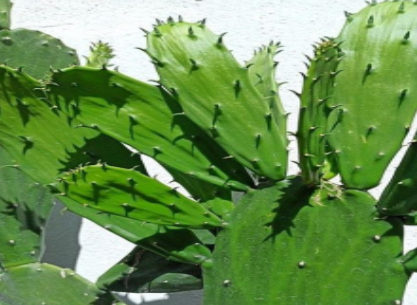
Phylloclade is a special modified stem which is photosynthetic and is present mostly in xerophytes (i.e. land plants). The plants in dry and arid regions modify their stems to achieve adaptability in that environment for their better survival. For example: Opuntia
Additional information:
As you know that the stem helps in providing structure and support to the plant. Further, it is modified into three important types:
1. Underground Modifications: in this the underground stems are modified for food storage and to survive under unfavorable conditions. Some of the underground stem modifications are: Rhizomes, bulb, corm, and tuber.
2. Sub-aerial Modifications: In these kinds of plants, the stem is partly above the ground and partly below the ground. These consist of Runner, sucker, stolon and offset.
3. Aerial Modifications: These stems are modified into aerial forms to perform important functions such as climbing, food storage, vegetative propagation, and protection. The modifications of this group are Stem tendrils, thorns, phylloclade, cladodes, bulbils, and thalamus.
Note: Various plants are known to have modified plant parts like roots for storage and functions; stems for storage, support, structure and environment; leaves into leaf hook, leaf spine, leaf tendril, leaf bladder etc. to adapt better to the environment.
Complete answer:
Phylloclade is a special modified stem which is photosynthetic and is present mostly in xerophytes (i.e. land plants). The plants in dry and arid regions modify their stems to achieve adaptability in that environment for their better survival. For example: Opuntia
Additional information:
As you know that the stem helps in providing structure and support to the plant. Further, it is modified into three important types:
1. Underground Modifications: in this the underground stems are modified for food storage and to survive under unfavorable conditions. Some of the underground stem modifications are: Rhizomes, bulb, corm, and tuber.
2. Sub-aerial Modifications: In these kinds of plants, the stem is partly above the ground and partly below the ground. These consist of Runner, sucker, stolon and offset.
3. Aerial Modifications: These stems are modified into aerial forms to perform important functions such as climbing, food storage, vegetative propagation, and protection. The modifications of this group are Stem tendrils, thorns, phylloclade, cladodes, bulbils, and thalamus.
Note: Various plants are known to have modified plant parts like roots for storage and functions; stems for storage, support, structure and environment; leaves into leaf hook, leaf spine, leaf tendril, leaf bladder etc. to adapt better to the environment.
Recently Updated Pages
Master Class 11 English: Engaging Questions & Answers for Success

Master Class 11 Social Science: Engaging Questions & Answers for Success
Master Class 11 Maths: Engaging Questions & Answers for Success
Master Class 11 Biology: Engaging Questions & Answers for Success
Master Class 11 Physics: Engaging Questions & Answers for Success
Master Class 11 Chemistry: Engaging Questions & Answers for Success
Trending doubts
One Metric ton is equal to kg A 10000 B 1000 C 100 class 11 physics CBSE
Difference Between Prokaryotic Cells and Eukaryotic Cells
Two of the body parts which do not appear in MRI are class 11 biology CBSE
Find the value of the expression given below sin 30circ class 11 maths CBSE
Draw a diagram of a plant cell and label at least eight class 11 biology CBSE
10 examples of friction in our daily life