



p-Hydroxy benzophenone upon reaction with bromine in carbon tetrachloride gives:
(A)
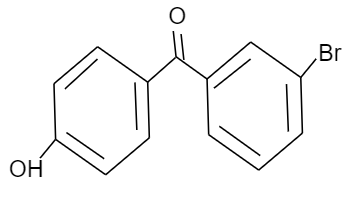
(B)
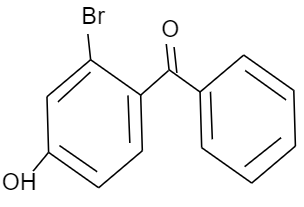
(C)
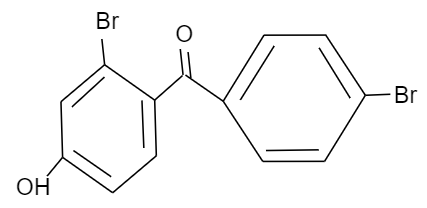
(D)
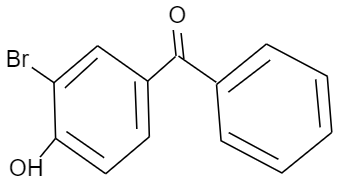
Answer
 Verified
642.6k+ views
Hint: You should know that the oxygen atom of the hydroxyl group present in the compound given has lone pairs of electrons. So, consider the hydroxyl group will undergo a positive mesomeric effect, where the ortho and para positions get activated for the electrophilic substitution reaction.
Complete step by step solution:
Given that, p-hydroxy benzophenone which has chemical formula ${{C}_{13}}{{H}_{10}}{{O}_{2}}$ is being reacted with bromine in presence of carbon tetrachloride (having chemical formula $CC{{l}_{4}}$). We have to find out the major product formed by this reaction. We should know that, the hydroxyl group present in the p-hydroxy benzophenone will show mesomeric effect and it will specifically show positive mesomeric effect because of the presence of lone pairs of electrons on the oxygen atom of hydroxyl group in the structure. Due to this positive mesomeric effect, the ortho and para sites in the structure of the compound given will get activated towards the electrophilic substitution reaction. As we know, bromine is an electrophile component. So, it will get directed to attack on the ortho and para position of the structure of the compound given. But as the ortho position is already occupied by the hydroxyl group in the structure, it will get directed towards the para position of the structure forming a major product known by the name $3-\text{bromo}-4-\text{hydroxyphenyl phenyl methanone}$.
The reaction is shown as follows:
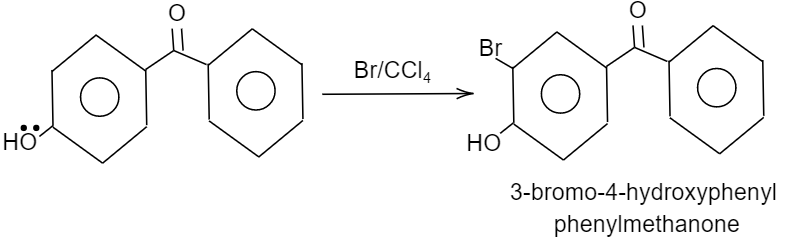
Hence, the correct option is D.
Note: You can get confused with option A where the bromine attacks the para position of another benzene ring, but it should be noted that the electrophile will attack that group having the lone pairs of electrons. Remember when the pi electrons are moved from the conjugate system to a group, negative mesomeric effect takes place while when the pi electrons moved from a particular group to a conjugate system, positive mesomeric effect takes place and for positive mesomeric effect, the group should have either a lone pair of electrons or a negative charge upon it.
Complete step by step solution:
Given that, p-hydroxy benzophenone which has chemical formula ${{C}_{13}}{{H}_{10}}{{O}_{2}}$ is being reacted with bromine in presence of carbon tetrachloride (having chemical formula $CC{{l}_{4}}$). We have to find out the major product formed by this reaction. We should know that, the hydroxyl group present in the p-hydroxy benzophenone will show mesomeric effect and it will specifically show positive mesomeric effect because of the presence of lone pairs of electrons on the oxygen atom of hydroxyl group in the structure. Due to this positive mesomeric effect, the ortho and para sites in the structure of the compound given will get activated towards the electrophilic substitution reaction. As we know, bromine is an electrophile component. So, it will get directed to attack on the ortho and para position of the structure of the compound given. But as the ortho position is already occupied by the hydroxyl group in the structure, it will get directed towards the para position of the structure forming a major product known by the name $3-\text{bromo}-4-\text{hydroxyphenyl phenyl methanone}$.
The reaction is shown as follows:
Hence, the correct option is D.
Note: You can get confused with option A where the bromine attacks the para position of another benzene ring, but it should be noted that the electrophile will attack that group having the lone pairs of electrons. Remember when the pi electrons are moved from the conjugate system to a group, negative mesomeric effect takes place while when the pi electrons moved from a particular group to a conjugate system, positive mesomeric effect takes place and for positive mesomeric effect, the group should have either a lone pair of electrons or a negative charge upon it.
Recently Updated Pages
Which of the following graphs shows the variation of class 12 physics CBSE

Draw a labelled diagram of the human male reproductive class 12 biology CBSE
Describe the experiment to compare the emf of two cells class 12 physics CBSE
What is standard hydrogen electrode
What is conventional current and electric current class 12 physics CBSE
2Bromopentane is treated with an alcoholic KOH solution class 12 chemistry CBSE
Trending doubts
Draw a labelled sketch of the human eye class 12 physics CBSE
Which are the Top 10 Largest Countries of the World?
A member of Simon commission later became Prime Minister class 12 social science CBSE
Draw ray diagrams each showing i myopic eye and ii class 12 physics CBSE
Give one example of a reptile that is viviparous class 12 biology CBSE
Which is the correct genotypic ratio of mendel dihybrid class 12 biology CBSE