




How do phospholipids arrange themselves into bilayer?
Answer
 Verified
554.4k+ views
Hint: Plasma membrane is also termed as the cell membrane. It is the membrane that is present in all the cells. It distinguishes the interior of the cell from the external environment of the cell. The plasma membrane is made up of lipid bilayer with proteins and carbohydrates embedded in between.
Complete answer:
- The plasma membrane is composed of the components like phospholipids, cholesterol, proteins, and carbohydrates.
- These all components of the plasma membrane provide the membrane a fluid character.
- Plasma membrane shows its size range from 5 to 10 nm in thickness.
Phospholipids:
- Phospholipids are the class of lipids that are existing in the plasma membrane.
- A phospholipid is a molecule which is usually composed of glycerol, two fatty acids and one phosphate linked head group.
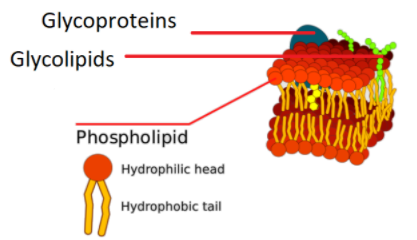
- They are amphipathic in nature in which they have a polar or hydrophilic head and a nonpolar or hydrophobic tail.
- Phospholipids organize themselves in a manner that their hydrophobic tails facing each other and hydrophobic heads dealing with out.
- There is a barrier created by using this arrangement and gives a bilayer shape to the cell membrane.
Proteins and Carbohydrate:
The proteins are present embedded in the bilayer. This helps in transport of polar molecules like water and other polar ions. The carbohydrate helps in maintaining structural integrity of the membrane.
Note: The lipid bilayer provides flexibility and fluidity to the plasma membrane. Plasma membrane is usually shown as semi-permeable membrane which means that it allows the movement of selective molecules or ions across itself. Plasma membranes show performance of various functions like osmosis, endocytosis, exocytosis, diffusion, etc. The amount of the components of plasma membrane that are proteins, carbohydrates, lipids differ with the cell type.
Complete answer:
- The plasma membrane is composed of the components like phospholipids, cholesterol, proteins, and carbohydrates.
- These all components of the plasma membrane provide the membrane a fluid character.
- Plasma membrane shows its size range from 5 to 10 nm in thickness.
Phospholipids:
- Phospholipids are the class of lipids that are existing in the plasma membrane.
- A phospholipid is a molecule which is usually composed of glycerol, two fatty acids and one phosphate linked head group.
- They are amphipathic in nature in which they have a polar or hydrophilic head and a nonpolar or hydrophobic tail.
- Phospholipids organize themselves in a manner that their hydrophobic tails facing each other and hydrophobic heads dealing with out.
- There is a barrier created by using this arrangement and gives a bilayer shape to the cell membrane.
Proteins and Carbohydrate:
The proteins are present embedded in the bilayer. This helps in transport of polar molecules like water and other polar ions. The carbohydrate helps in maintaining structural integrity of the membrane.
Note: The lipid bilayer provides flexibility and fluidity to the plasma membrane. Plasma membrane is usually shown as semi-permeable membrane which means that it allows the movement of selective molecules or ions across itself. Plasma membranes show performance of various functions like osmosis, endocytosis, exocytosis, diffusion, etc. The amount of the components of plasma membrane that are proteins, carbohydrates, lipids differ with the cell type.
Recently Updated Pages
Master Class 11 Economics: Engaging Questions & Answers for Success

Master Class 11 English: Engaging Questions & Answers for Success
Master Class 11 Maths: Engaging Questions & Answers for Success
Class 11 Question and Answer - Your Ultimate Solutions Guide
Master Class 11 Social Science: Engaging Questions & Answers for Success
Master Class 11 Business Studies: Engaging Questions & Answers for Success
Trending doubts
One Metric ton is equal to kg A 10000 B 1000 C 100 class 11 physics CBSE
There are 720 permutations of the digits 1 2 3 4 5 class 11 maths CBSE
Differentiate between an exothermic and an endothermic class 11 chemistry CBSE
In what year Guru Nanak Dev ji was born A15 April 1469 class 11 social science CBSE
Difference Between Prokaryotic Cells and Eukaryotic Cells
State and prove Bernoullis theorem class 11 physics CBSE