




Phloem in gymnosperms lacks.
(a) Albuminous cells and sieve cells
(b) Sieve tubes only
(c) Companion cells only
(d) Both sieve tubes and companion cells
Answer
 Verified
658.5k+ views
Hint: Phloem consists of many types of cells including sclerenchyma, parenchyma, sieve elements, and corresponding cells. The so-called "sieve part" can be more precisely referred to in angiosperms as a sieve tube member, and in gymnosperms and ferns as a sieve cell. Companion cells are the cells found in angiosperms with abundant plasma and nucleus.
Complete answer:
In Gymnosperms, the phloem lacks both the sieve tube and the corresponding cells. Instead they contain sieve cells for food material conduction.
The Sieve element is the phloem conductive element. Companion Cells for the sieve function are "life support" cells. Fibers developed from sclerenchyma cells and provide the plant with structural support. Parenchyma serves as material for packaging between other types of cells and helps to move materials to the SE / CC complex.
Gymnosperm sieve cells lack a sieve layer, and instead have sieve pores across the cell wall that allow flow between adjacent cells. The members of the sieve tube found in flowering plants are typically larger than sieve cells and have sieve plates that link the ends of adjacent cells. These sieve plates are areas with several pores, from which a continuous cytoplasm connects adjacent cells.
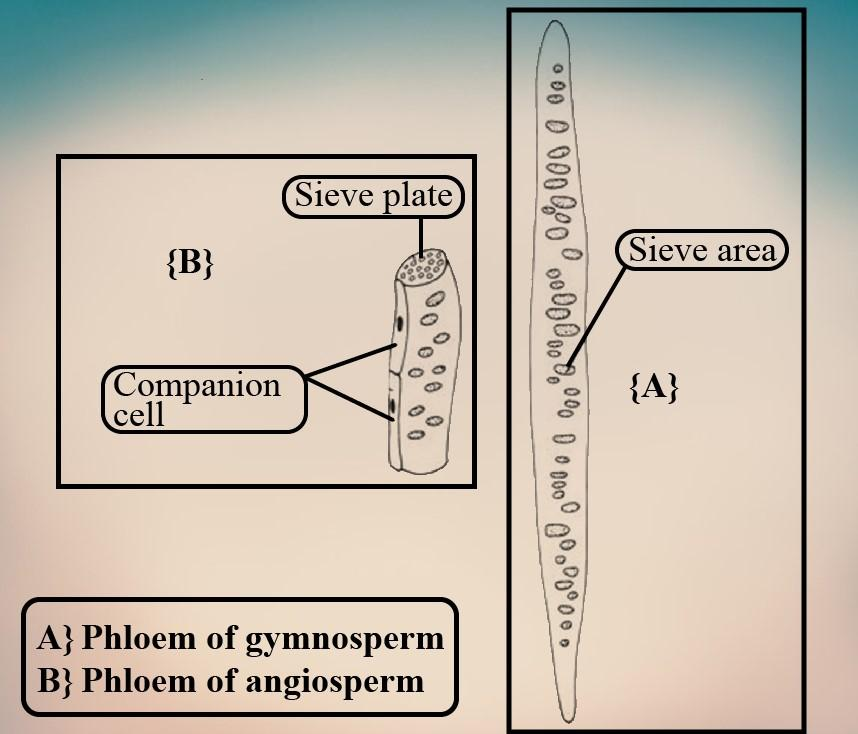
So, the correct answer is, 'Both sieve tubes and companion cells'.
Note: Phloem is the vascular tissue responsible for transmitting sugar from the source tissue (e.g. photosynthetic leaf cells) to the sink tissues (e.g. non-photosynthetic root cells or flowers). Even other molecules such as proteins and mRNAs are transported through phloem in the plant. Gymnosperms need no root pressure to get water from the soil, because most of them grow in cold and dry climates.
Complete answer:
In Gymnosperms, the phloem lacks both the sieve tube and the corresponding cells. Instead they contain sieve cells for food material conduction.
The Sieve element is the phloem conductive element. Companion Cells for the sieve function are "life support" cells. Fibers developed from sclerenchyma cells and provide the plant with structural support. Parenchyma serves as material for packaging between other types of cells and helps to move materials to the SE / CC complex.
Gymnosperm sieve cells lack a sieve layer, and instead have sieve pores across the cell wall that allow flow between adjacent cells. The members of the sieve tube found in flowering plants are typically larger than sieve cells and have sieve plates that link the ends of adjacent cells. These sieve plates are areas with several pores, from which a continuous cytoplasm connects adjacent cells.
So, the correct answer is, 'Both sieve tubes and companion cells'.
Note: Phloem is the vascular tissue responsible for transmitting sugar from the source tissue (e.g. photosynthetic leaf cells) to the sink tissues (e.g. non-photosynthetic root cells or flowers). Even other molecules such as proteins and mRNAs are transported through phloem in the plant. Gymnosperms need no root pressure to get water from the soil, because most of them grow in cold and dry climates.
Recently Updated Pages
If x a + bt + ct2 where x is in meters and t is in class 11 physics CBSE

A car covers the first half distance between two places class 11 physics CBSE
The resultant of two vectors overrightarrow P and overrightarrow class 11 physics CBSE
Find the value of cos 135 class 11 maths CBSE
A mass M is held in place by an applied force F and class 11 physics CBSE
A solution of glucose in water is labelled as 10 dfracwv class 11 chemistry CBSE
Trending doubts
One Metric ton is equal to kg A 10000 B 1000 C 100 class 11 physics CBSE
Find the value of the expression given below sin 30circ class 11 maths CBSE
What do you mean by retardation What is its SI uni class 11 physics CBSE
Draw a diagram of nephron and explain its structur class 11 biology CBSE
10 examples of friction in our daily life
Difference between physical and chemical change class 11 chemistry CBSE