




$ Phenol $ , $ {C_6}{H_5}OH $ , is allowed to react with $ diazomethane $ , $ C{H_2}{N_2} $ . The product formed is
(A) $ {C_6}{H_5}C{H_2}OH $
(B) $ {C_6}{H_5}OC{H_3} $
(C)
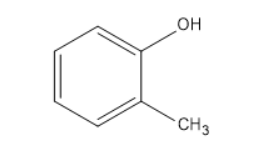
(D)
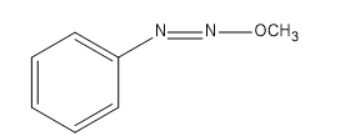
Answer
 Verified
560.7k+ views
Hint: $ Diazomethane $ is a very reactive compound. It acts as a methylating agent. $ Diazomethane $ converts alcohol into ethers in the presence of ether. To solve this question remember the fact that $ Diazomethane $ is an alkylating agent therefore alkylates the phenol.
Complete answer:
$ Phenol $ is an aromatic organic compound which is a volatile compound. $ Phenol $ has a widespread use involving as a disinfectant, mouthwash, medicinal use like that in surgical antiseptics. $ Phenol $ are similar to alcohols but they form stronger hydrogen bonds that is why they are more soluble in water than are alcohols. $ Phenol $ was first mined from coal tar, but today it is manufactured on a large scale from petroleum. It is an important industrial product as a pioneer to various materials and useful compounds. $ Phenol $ and its chemical products are very important for the production of Bakelite, polycarbonates, detergents, nylon, epoxies, herbicides such as phenoxy herbicides.
$ Diazomethane $ is the simplest diazo compound. As mentioned in the hint $ Diazomethane $ converts alcohol into ethers. This is due to the fact that $ - C{H_2} $ group attaches to the alcohol group releasing molecular nitrogen.
$ Diazomethane $ when reacting with a $ Phenol $ acts as a base and abstracts a proton from phenol. This results in the formation of $ phenoxide $ ions. After this $ phenoxide $ ion acts as a nucleophile and under this nucleophilic attack $ Anisole $ ether is formed.
The reaction is shown below:
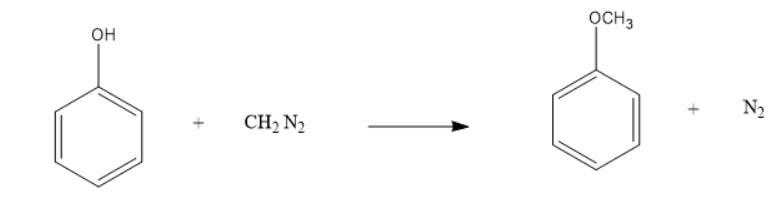
$ Anisole $ is formed in the reaction and nitrogen gas is liberated when $ Diazomethane $ reacts with . $ Phenol $ . This reaction takes place in the presence of $ Fluoroboric $ $ acid $ .
$ Anisole $ or $ methoxybenzene $ is an organic compound which is a colourless liquid. Its smell is reminiscent of anise seed. Due to this smell it is used in making perfumes, flavouring agents as well as solvent.
Note:
We not only use $ Fluoroboric $ $ acid $ to enhance the rate of reaction but also chemicals like $ Sodium{\text{ }}hydroxide $ which increases the rate of reaction. During such reactions, liberation of nitrogen always takes place.
Complete answer:
$ Phenol $ is an aromatic organic compound which is a volatile compound. $ Phenol $ has a widespread use involving as a disinfectant, mouthwash, medicinal use like that in surgical antiseptics. $ Phenol $ are similar to alcohols but they form stronger hydrogen bonds that is why they are more soluble in water than are alcohols. $ Phenol $ was first mined from coal tar, but today it is manufactured on a large scale from petroleum. It is an important industrial product as a pioneer to various materials and useful compounds. $ Phenol $ and its chemical products are very important for the production of Bakelite, polycarbonates, detergents, nylon, epoxies, herbicides such as phenoxy herbicides.
$ Diazomethane $ is the simplest diazo compound. As mentioned in the hint $ Diazomethane $ converts alcohol into ethers. This is due to the fact that $ - C{H_2} $ group attaches to the alcohol group releasing molecular nitrogen.
$ Diazomethane $ when reacting with a $ Phenol $ acts as a base and abstracts a proton from phenol. This results in the formation of $ phenoxide $ ions. After this $ phenoxide $ ion acts as a nucleophile and under this nucleophilic attack $ Anisole $ ether is formed.
The reaction is shown below:
$ Anisole $ is formed in the reaction and nitrogen gas is liberated when $ Diazomethane $ reacts with . $ Phenol $ . This reaction takes place in the presence of $ Fluoroboric $ $ acid $ .
$ Anisole $ or $ methoxybenzene $ is an organic compound which is a colourless liquid. Its smell is reminiscent of anise seed. Due to this smell it is used in making perfumes, flavouring agents as well as solvent.
Note:
We not only use $ Fluoroboric $ $ acid $ to enhance the rate of reaction but also chemicals like $ Sodium{\text{ }}hydroxide $ which increases the rate of reaction. During such reactions, liberation of nitrogen always takes place.
Recently Updated Pages
Master Class 11 English: Engaging Questions & Answers for Success

Master Class 11 Physics: Engaging Questions & Answers for Success
Master Class 11 Computer Science: Engaging Questions & Answers for Success
Master Class 11 Chemistry: Engaging Questions & Answers for Success
Master Class 11 Social Science: Engaging Questions & Answers for Success
Master Class 11 Accountancy: Engaging Questions & Answers for Success
Trending doubts
Difference Between Prokaryotic Cells and Eukaryotic Cells
Two of the body parts which do not appear in MRI are class 11 biology CBSE
One Metric ton is equal to kg A 10000 B 1000 C 100 class 11 physics CBSE
10 examples of friction in our daily life
Draw a diagram of nephron and explain its structur class 11 biology CBSE
Draw a diagram of a plant cell and label at least eight class 11 biology CBSE