




Phagocytosis
(a) Is carried by cells of the adaptive immune system.
(b) Is restricted to macrophages.
(c) Is important in bacterial infections.
(d) Is a process that does not involve energy.
Answer
 Verified
591.9k+ views
Hint: Other than feeding in unicellular organisms the processes of phagocytosis is also used by the immune system of higher organisms mainly against a particular microorganism.
Complete answer:
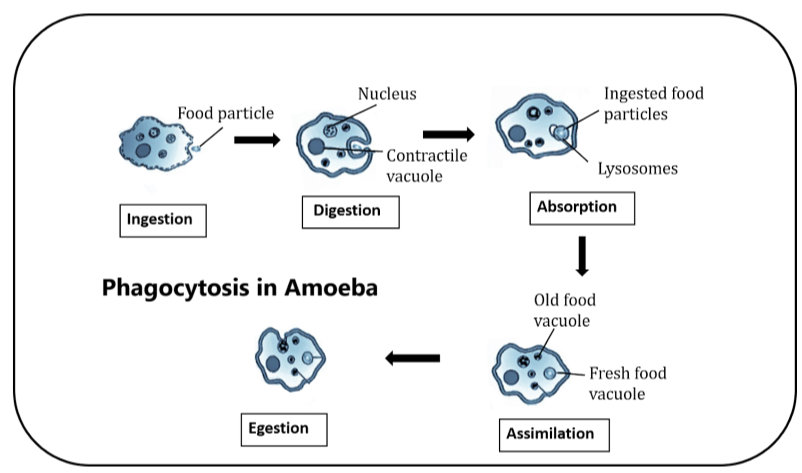
Phagocytosis is important in bacterial infections. Phagocytosis is the process by which certain living cells known as phagocytes ingest or engulf other cells or particles. A free-living unicellular organism, such as an amoeba, or one of the body cells, such as a white blood cell is the phagocyte. In multicellular or higher organisms or animals, it is mainly a defensive reaction against infection and invasion of bacteria or foreign substances or antigens.
Additional Information:
- In unicellular organisms, phagocytosis is a means of nutrition or feeding such as in amoebas and sponges.
- In humans, the most-effective phagocytic cells are two kinds of white blood cells: the macrophages and the neutrophils.
- The macrophages and therefore the neutrophils are carried along by the circulating blood until they reach a neighborhood of infected tissue, where they undergo the vessel wall into that tissue.
- Both macrophages and neutrophils are drawn toward a neighborhood of infection or inflammation by means of drugs given off by the bacteria, they engulf particles after colliding with them.
- Before phagocytosis is accomplished, the phagocyte and the bacteria or particle must adhere to each other.
- The cell flows around the object until it has been engulfed completely.
- The engulfed object is then enclosed within a membrane-bound vacuole known as a phagosome.
- The phagocyte digests the ingested particle with the assistance of hydrolytic enzymes, which are present within membrane-enclosed sacs called lysosomes that are found within the cell.
- Phagocytic enzymes are secreted into the vacuole during which digestion takes place.
So, the correct answer is, ’(c) Is important in bacterial infections’.
Note:
- The particles that generally undergo phagocytosis by white blood cells include bacteria, dead tissue cells, protozoa, various dust particles, pigments, and other minute foreign bodies.
- The phagocyte digests the ingested particle with the assistance of hydrolytic enzymes, which are present within membrane- enclosed sacs called lysosomes that are found within the cell.
- Phagocytic enzymes are secreted into the vacuole during which digestion takes place.
Complete answer:
Phagocytosis is important in bacterial infections. Phagocytosis is the process by which certain living cells known as phagocytes ingest or engulf other cells or particles. A free-living unicellular organism, such as an amoeba, or one of the body cells, such as a white blood cell is the phagocyte. In multicellular or higher organisms or animals, it is mainly a defensive reaction against infection and invasion of bacteria or foreign substances or antigens.
Additional Information:
- In unicellular organisms, phagocytosis is a means of nutrition or feeding such as in amoebas and sponges.
- In humans, the most-effective phagocytic cells are two kinds of white blood cells: the macrophages and the neutrophils.
- The macrophages and therefore the neutrophils are carried along by the circulating blood until they reach a neighborhood of infected tissue, where they undergo the vessel wall into that tissue.
- Both macrophages and neutrophils are drawn toward a neighborhood of infection or inflammation by means of drugs given off by the bacteria, they engulf particles after colliding with them.
- Before phagocytosis is accomplished, the phagocyte and the bacteria or particle must adhere to each other.
- The cell flows around the object until it has been engulfed completely.
- The engulfed object is then enclosed within a membrane-bound vacuole known as a phagosome.
- The phagocyte digests the ingested particle with the assistance of hydrolytic enzymes, which are present within membrane-enclosed sacs called lysosomes that are found within the cell.
- Phagocytic enzymes are secreted into the vacuole during which digestion takes place.
So, the correct answer is, ’(c) Is important in bacterial infections’.
Note:
- The particles that generally undergo phagocytosis by white blood cells include bacteria, dead tissue cells, protozoa, various dust particles, pigments, and other minute foreign bodies.
- The phagocyte digests the ingested particle with the assistance of hydrolytic enzymes, which are present within membrane- enclosed sacs called lysosomes that are found within the cell.
- Phagocytic enzymes are secreted into the vacuole during which digestion takes place.
Recently Updated Pages
Master Class 11 English: Engaging Questions & Answers for Success

Master Class 11 Maths: Engaging Questions & Answers for Success
Class 11 Question and Answer - Your Ultimate Solutions Guide
Master Class 11 Biology: Engaging Questions & Answers for Success
Master Class 11 Physics: Engaging Questions & Answers for Success
Master Class 11 Accountancy: Engaging Questions & Answers for Success
Trending doubts
Differentiate between an exothermic and an endothermic class 11 chemistry CBSE
One Metric ton is equal to kg A 10000 B 1000 C 100 class 11 physics CBSE
In what year Guru Nanak Dev ji was born A15 April 1469 class 11 social science CBSE
Difference Between Prokaryotic Cells and Eukaryotic Cells
There are 720 permutations of the digits 1 2 3 4 5 class 11 maths CBSE
Draw a diagram of a plant cell and label at least eight class 11 biology CBSE