




What is the period of $\cos\left(\dfrac{x}{3}\right)$?
Answer
 Verified
543.6k+ views
Hint: Fundamental period or period of a function is defined as the interval at which the function repeats its value. Here, we are provided with a function whose period we have to find out. Mathematically, the period is valued $K \in \mathbb{R}-\{0\} s.t. f\left(x+k\right)=f\left(x\right)$.
$cos\left(x\right)$ has period $2 \pi$.
Complete step-by-step solution:
We are given the function $\cos\left(\dfrac{x}{3}\right)$. And as we know that the $\cos\left(x\right)$ is a periodic function with the period $2\pi$. So, our function is also periodic with some fundamental period. Since when there is $x$ in $\cos$ function it repeats its value after $2\pi$ . That is here the function will repeat its value after $6\pi$.
Other periods can be given as:
$F=\{ 6n \pi : n \in \textbf{Z} \}$
But the fundamental period is basically the minimum of the set from the positive side.
Mathematically, if the period of $f\left(x\right)$ is 'p' then the period of $f\left(ax\right)$ will be $\dfrac{p}{a}$.
Using this fact, we know the period of $cos\left(x\right)$ is $2\pi$ then, period of $\cos\left(\dfrac{x}{3}\right)$ will be $3\times\left(2\pi\right)$ $\implies$ $6\pi$. What we have done is, we have to divide the coefficient of 'x' by the fundamental period of the function.
The graph for $\cos\left(\dfrac{x}{3}\right)$ is as below:
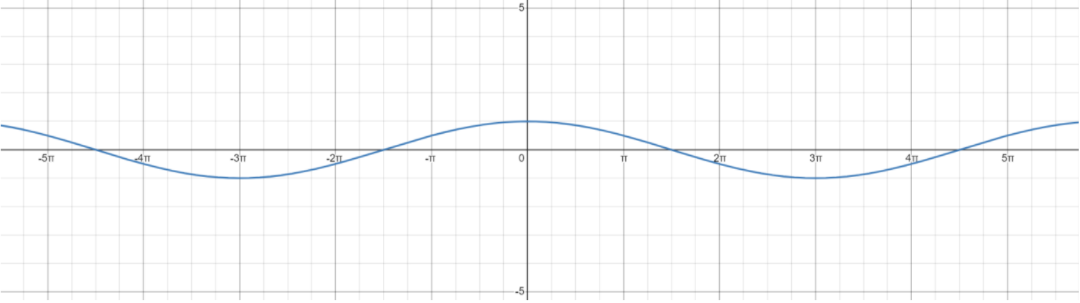
So, the fundamental period has been found.
Note: Since, there is a coefficient of $\dfrac{1}{3}$ with the variable 'x' inside cos, it is a general mistake to divide the standard period by 3 and write the result i.e. you can NOT write the period to be $\dfrac{2\times\pi}{3}$. This would be an incorrect solution. Moreover, do not write any multiple above the least one, because then that would not be the principle period.
$cos\left(x\right)$ has period $2 \pi$.
Complete step-by-step solution:
We are given the function $\cos\left(\dfrac{x}{3}\right)$. And as we know that the $\cos\left(x\right)$ is a periodic function with the period $2\pi$. So, our function is also periodic with some fundamental period. Since when there is $x$ in $\cos$ function it repeats its value after $2\pi$ . That is here the function will repeat its value after $6\pi$.
Other periods can be given as:
$F=\{ 6n \pi : n \in \textbf{Z} \}$
But the fundamental period is basically the minimum of the set from the positive side.
Mathematically, if the period of $f\left(x\right)$ is 'p' then the period of $f\left(ax\right)$ will be $\dfrac{p}{a}$.
Using this fact, we know the period of $cos\left(x\right)$ is $2\pi$ then, period of $\cos\left(\dfrac{x}{3}\right)$ will be $3\times\left(2\pi\right)$ $\implies$ $6\pi$. What we have done is, we have to divide the coefficient of 'x' by the fundamental period of the function.
The graph for $\cos\left(\dfrac{x}{3}\right)$ is as below:
So, the fundamental period has been found.
Note: Since, there is a coefficient of $\dfrac{1}{3}$ with the variable 'x' inside cos, it is a general mistake to divide the standard period by 3 and write the result i.e. you can NOT write the period to be $\dfrac{2\times\pi}{3}$. This would be an incorrect solution. Moreover, do not write any multiple above the least one, because then that would not be the principle period.
Recently Updated Pages
Master Class 11 Social Science: Engaging Questions & Answers for Success

Master Class 11 Physics: Engaging Questions & Answers for Success
Master Class 11 Maths: Engaging Questions & Answers for Success
Master Class 11 Economics: Engaging Questions & Answers for Success
Master Class 11 Computer Science: Engaging Questions & Answers for Success
Master Class 11 Chemistry: Engaging Questions & Answers for Success
Trending doubts
One Metric ton is equal to kg A 10000 B 1000 C 100 class 11 physics CBSE
There are 720 permutations of the digits 1 2 3 4 5 class 11 maths CBSE
1 Quintal is equal to a 110 kg b 10 kg c 100kg d 1000 class 11 physics CBSE
State and prove Bernoullis theorem class 11 physics CBSE
Difference Between Prokaryotic Cells and Eukaryotic Cells
Which among the following are examples of coming together class 11 social science CBSE