




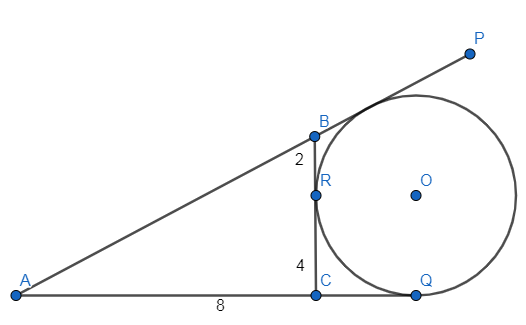
What is the perimeter of the triangle ACB?
Answer
 Verified
630.6k+ views
Hint: Perimeter of a triangle is given by summation of all three sides. So, first try to calculate all the sides of the triangle ACB given in the diagram.Here,length of AC and BC given.So,to find length of AB use the Pythagoras theorem defined for a right- angled triangle which can be given as
${{\left( \text{Hypotenuse} \right)}^{2}}={{\left( \text{base} \right)}^{2}}+{{\left( \text{Perpendicular} \right)}^{2}}$.Finally add all the sides of triangle ACB to get required perimeter of triangle
“Complete step-by-step answer:”
Here, we have diagram given as
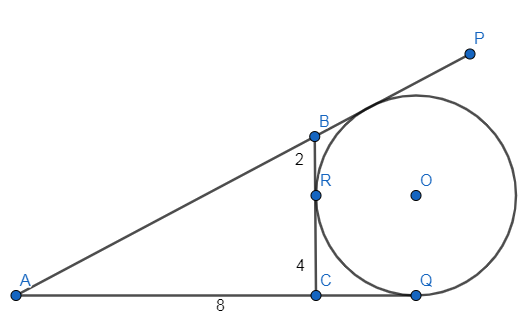
As, we know that the perimeter is the length of the continuous line forming the boundary of a closed geometric figure. Here, the closed geometric figure is given as a triangle ACB of which we need to determine the perimeter.
Hence, the perimeter of the triangle is given by summation of lengths of three sides.
So, the perimeter of the triangle ACB can be given in the form of sides as AC + CB + BA.
Now, we know
AC = 8, CR = 4, RB = 2
We can calculate the length of side BC by adding the lengths of the sides RB and CR from the diagram. Hence, length of side BC of triangle ABC can be given as
BC = CR + RB
Substituting the given values, we get
BC = 4 + 2 = 6cm
Now, we need to calculate side AB only to get the perimeter of $\Delta ACB$
As we can observe that $\Delta ACB$ is a right angled triangle at angle C. So, we can apply the Pythagoras theorem in triangle ACB to get the value of length AB.
Now, we know Pythagoras theorem can be given by relation
${{\left( \text{Hypotenuse} \right)}^{2}}={{\left( \text{base} \right)}^{2}}+{{\left( \text{Perpendicular} \right)}^{2}}$
Here hypotenuse is the side opposite to ${{90}^{\circ }}$ in a right angled triangle.
So, we can apply Pythagoras theorem in $\Delta ACB$ to get AB as
${{\left( AB \right)}^{2}}={{\left( AC \right)}^{2}}+{{\left( CB \right)}^{2}}$
Substituting the values of AC and BC, we get
$\begin{align}
& {{\left( AB \right)}^{2}}={{8}^{2}}+{{6}^{2}}=64+36 \\
& {{\left( AB \right)}^{2}}=100={{\left( 10 \right)}^{2}} \\
\end{align}$
Now, taking square root to both sides we get,
AB = 10cm
Now, we can calculate the perimeter of $\Delta ACB$ by adding the sides of it. Hence, perimeter of \[\Delta ACB\] is
$=AC+CB+BA$
= 8 + 6 + 10
= 14 + 10 = 24cm
So, the required perimeter is 24cm.
Note: One can get two values of AB by equation $A{{B}^{2}}=100$ as 10 and -10 both. We can ignore AB = -10 as the length of any side can never be negative value. Hence, AB = 10 will be taken. Here, we don’t need the given circle in the problem. So, don’t confuse it with the given circle. We can calculate the perimeter by the triangle itself. Don’t place any term of Pythagoras theorem in an incorrect position. Hence, be clear with the fundamentals or terminology of the Pythagoras theorem.
${{\left( \text{Hypotenuse} \right)}^{2}}={{\left( \text{base} \right)}^{2}}+{{\left( \text{Perpendicular} \right)}^{2}}$.Finally add all the sides of triangle ACB to get required perimeter of triangle
“Complete step-by-step answer:”
Here, we have diagram given as
As, we know that the perimeter is the length of the continuous line forming the boundary of a closed geometric figure. Here, the closed geometric figure is given as a triangle ACB of which we need to determine the perimeter.
Hence, the perimeter of the triangle is given by summation of lengths of three sides.
So, the perimeter of the triangle ACB can be given in the form of sides as AC + CB + BA.
Now, we know
AC = 8, CR = 4, RB = 2
We can calculate the length of side BC by adding the lengths of the sides RB and CR from the diagram. Hence, length of side BC of triangle ABC can be given as
BC = CR + RB
Substituting the given values, we get
BC = 4 + 2 = 6cm
Now, we need to calculate side AB only to get the perimeter of $\Delta ACB$
As we can observe that $\Delta ACB$ is a right angled triangle at angle C. So, we can apply the Pythagoras theorem in triangle ACB to get the value of length AB.
Now, we know Pythagoras theorem can be given by relation
${{\left( \text{Hypotenuse} \right)}^{2}}={{\left( \text{base} \right)}^{2}}+{{\left( \text{Perpendicular} \right)}^{2}}$
Here hypotenuse is the side opposite to ${{90}^{\circ }}$ in a right angled triangle.
So, we can apply Pythagoras theorem in $\Delta ACB$ to get AB as
${{\left( AB \right)}^{2}}={{\left( AC \right)}^{2}}+{{\left( CB \right)}^{2}}$
Substituting the values of AC and BC, we get
$\begin{align}
& {{\left( AB \right)}^{2}}={{8}^{2}}+{{6}^{2}}=64+36 \\
& {{\left( AB \right)}^{2}}=100={{\left( 10 \right)}^{2}} \\
\end{align}$
Now, taking square root to both sides we get,
AB = 10cm
Now, we can calculate the perimeter of $\Delta ACB$ by adding the sides of it. Hence, perimeter of \[\Delta ACB\] is
$=AC+CB+BA$
= 8 + 6 + 10
= 14 + 10 = 24cm
So, the required perimeter is 24cm.
Note: One can get two values of AB by equation $A{{B}^{2}}=100$ as 10 and -10 both. We can ignore AB = -10 as the length of any side can never be negative value. Hence, AB = 10 will be taken. Here, we don’t need the given circle in the problem. So, don’t confuse it with the given circle. We can calculate the perimeter by the triangle itself. Don’t place any term of Pythagoras theorem in an incorrect position. Hence, be clear with the fundamentals or terminology of the Pythagoras theorem.
Recently Updated Pages
In a plane electromagnetic wave the electric field class 12 physics CBSE

A plane electromagnetic wave travels in vacuum along class 12 physics CBSE
The magnetic field in a plane electromagnetic wave class 11 physics CBSE
Basicity of sulphurous acid and sulphuric acid are
Master Class 10 English: Engaging Questions & Answers for Success
Master Class 10 Social Science: Engaging Questions & Answers for Success
Trending doubts
Which country won the ICC Men's ODI World Cup in 2023?
What is the full form of PNG A Petrol Natural Gas B class 10 chemistry CBSE
In cricket, how many legal balls are there in a standard over?
Explain the Treaty of Vienna of 1815 class 10 social science CBSE
What does "powerplay" mean in limited-overs cricket?
What is the "Powerplay" in T20 cricket?