




What is the perimeter of a regular octagon with a radius of length 20?
Answer
 Verified
566.4k+ views
Hint: Here in this question, we have to find the perimeter of a regular octagon of given radius of length \[r = 20\] . First, we have to find the length \[l\] of each side of octagon using a distance formula \[l = \sqrt {{{\left( {{y_2} - {y_1}} \right)}^2} + {{\left( {{x_2} - {x_1}} \right)}^2}} \] and later find a perimeter using a formula \[P = 8 \times l\,\] . If we are finding the perimeter of a regular octagon, then we know that all eight sides are equal lengths, so we can simplify the formula using multiplication operation to get the required solution.
Complete step-by-step answer:
In geometry, perimeter can be defined as the path or the boundary that surrounds a shape. It can also be defined as the length of the outline of a shape.
If a octagon is regular, then all the sides are equal in length, and eight angles are of equal measures
Consider a regular octagon having radius of length \[r = 20\] , which is same for vertices of pentagons.
In figure, the red circle circumscribes the outer radius and the green circle the inner one.
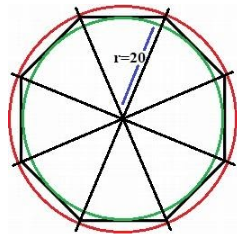
Let consider \[r = 20\] be the outer radius - that is the radius of the red circle.
Then, the vertices of the octagon centred at origin i.e., \[\left( {0,0} \right)\] are at \[\left( { \pm \,r,0} \right)\] , \[\left( {0, \pm \,r} \right)\] and \[\left( { \pm \,\dfrac{r}{{\sqrt 2 }}, \pm \,\dfrac{r}{{\sqrt 2 }}} \right)\] .
So the length of one side of regular octagon is distance between \[\left( {r,\,0} \right)\] and \[\left( {\dfrac{r}{{\sqrt 2 }},\,\dfrac{r}{{\sqrt 2 }}} \right)\]
Let consider a distance formula \[l = \sqrt {{{\left( {{y_2} - {y_1}} \right)}^2} + {{\left( {{x_2} - {x_1}} \right)}^2}} \] , on substituting we have
\[ \Rightarrow \,\,l = \sqrt {{{\left( {\dfrac{r}{{\sqrt 2 }} - 0} \right)}^2} + {{\left( {\dfrac{r}{{\sqrt 2 }} - r} \right)}^2}} \]
\[ \Rightarrow \,\,l = \sqrt {{{\left( {\dfrac{r}{{\sqrt 2 }}} \right)}^2} + {{\left( {\dfrac{r}{{\sqrt 2 }} - r} \right)}^2}} \]
\[ \Rightarrow \,\,l = \sqrt {{r^2}{{\left( {\dfrac{1}{{\sqrt 2 }}} \right)}^2} + {r^2}{{\left( {\dfrac{1}{{\sqrt 2 }} - 1} \right)}^2}} \]
Take \[{r^2}\] to outside, then
\[ \Rightarrow \,\,l = r\sqrt {{{\left( {\dfrac{1}{{\sqrt 2 }}} \right)}^2} + {{\left( {\dfrac{1}{{\sqrt 2 }} - 1} \right)}^2}} \]
Simplify using a algebraic identity \[{\left( {a - b} \right)^2} = {a^2} + {b^2} - 2ab\] , we have
\[ \Rightarrow \,\,l = r\sqrt {\dfrac{1}{{{{\left( {\sqrt 2 } \right)}^2}}} + \dfrac{1}{{{{\left( {\sqrt 2 } \right)}^2}}} + 1 - \dfrac{2}{{\sqrt 2 }}} \]
On simplification, we get
\[ \Rightarrow \,\,l = r\sqrt {\dfrac{1}{2} + \dfrac{1}{2} + 1 - \dfrac{2}{{\sqrt 2 }}} \]
\[ \Rightarrow \,\,l = r\sqrt {1 + 1 - \dfrac{2}{{\sqrt 2 }}} \]
\[ \Rightarrow \,\,l = r\sqrt {2 - \sqrt 2 } \] ------(1)
Which is the length of the each side of the regular octagon when \[r\] be the outer radius.
Then perimeter of regular octagon is
\[ \Rightarrow \,\,P = 8 \times l\,\]
On substituting equation (1), we have
\[ \Rightarrow \,\,P = 8 \times r\sqrt {2 - \sqrt 2 } \]
given \[r = 20\] , then
\[ \Rightarrow \,\,P = 8 \times 20\sqrt {2 - \sqrt 2 } \]
\[ \Rightarrow \,\,P = 160\sqrt {2 - \sqrt 2 } \]
On using calculator, we get the exact value
\[ \Rightarrow \,\,P = 160\sqrt {2 - \sqrt 2 } \simeq 122.46\]
Now, consider \[{r_1} = 20\] be the inner radius - that is the radius of the green circle
The inner radius will be \[{r_1} = r\cos \theta \]
From the figure we have \[\theta = \dfrac{\pi }{8}\] , then
\[ \Rightarrow \,\,{r_1} = r\cos \left( {\dfrac{\pi }{8}} \right)\]
By using a calculator, the value of \[\cos \left( {\dfrac{\pi }{8}} \right) = \dfrac{{\sqrt {2 + \sqrt 2 } }}{2}\] , then
\[ \Rightarrow \,\,{r_1} = r\left( {\dfrac{{\sqrt {2 + \sqrt 2 } }}{2}} \right)\]
On cross multiplication, we have
\[ \Rightarrow \,r = \,\dfrac{{2{r_1}}}{{\sqrt {2 + \sqrt 2 } }}\] ------(2)
On substituting equation (2) in (1), we get the length of each side i.e.,
\[ \Rightarrow \,\,l = \dfrac{{2{r_1}}}{{\sqrt {2 + \sqrt 2 } }}\sqrt {2 - \sqrt 2 } \]
\[ \Rightarrow \,\,l = 2{r_1}\dfrac{{\sqrt {2 - \sqrt 2 } }}{{\sqrt {2 + \sqrt 2 } }}\]
To rationalize the denominator, we have to multiply and divide the RHS by \[\sqrt {2 + \sqrt 2 } \] , then
\[ \Rightarrow \,\,l = 2{r_1}\dfrac{{\sqrt {2 - \sqrt 2 } }}{{\sqrt {2 + \sqrt 2 } }} \times \dfrac{{\sqrt {2 + \sqrt 2 } }}{{\sqrt {2 + \sqrt 2 } }}\]
\[ \Rightarrow \,\,l = 2{r_1}\dfrac{{\left( {\sqrt {2 - \sqrt 2 } } \right)\left( {\sqrt {2 + \sqrt 2 } } \right)}}{{\left( {\sqrt {2 + \sqrt 2 } } \right)\left( {\sqrt {2 + \sqrt 2 } } \right)}}\]
\[ \Rightarrow \,\,l = 2{r_1}\dfrac{{\sqrt {\left( {2 - \sqrt 2 } \right)\left( {2 + \sqrt 2 } \right)} }}{{{{\left( {\sqrt {2 + \sqrt 2 } } \right)}^2}}}\]
On simplification, we get
\[ \Rightarrow \,\,l = 2{r_1}\dfrac{{\sqrt {4 + 2\sqrt 2 - 2\sqrt 2 - 2} }}{{2 + \sqrt 2 }}\]
\[ \Rightarrow \,\,l = 2{r_1}\dfrac{{\sqrt 2 }}{{2 + \sqrt 2 }}\] -----------(3)
Which is the length of each side of the regular octagon when \[r\] be the inner radius.
Then perimeter of regular octagon is
\[ \Rightarrow \,\,P = 8 \times l\,\]
On substituting equation (1), we have
\[ \Rightarrow \,\,P = 8 \times 2{r_1}\dfrac{{\sqrt 2 }}{{2 + \sqrt 2 }}\]
\[ \Rightarrow \,\,P = 16{r_1}\dfrac{{\sqrt 2 }}{{2 + \sqrt 2 }}\]
given \[{r_1} = 20\] , then
\[ \Rightarrow \,\,P = 16\left( {20} \right)\dfrac{{\sqrt 2 }}{{2 + \sqrt 2 }}\]
\[ \Rightarrow \,\,P = 320\dfrac{{\sqrt 2 }}{{2 + \sqrt 2 }}\]
On using calculator, we get the exact value
\[ \Rightarrow \,\,P = 320\dfrac{{\sqrt 2 }}{{2 + \sqrt 2 }} \simeq 132.55\]
Hence, the perimeter of regular octagon of radius 20 is
If the outer radius is 20, then the perimeter is: \[P = 160\sqrt {2 - \sqrt 2 } \simeq 122.46\]
If the inner radius is 20, then the perimeter is: \[\,P = 320\dfrac{{\sqrt 2 }}{{2 + \sqrt 2 }} \simeq 132.55\]
So, the correct answer is “$\simeq 132.55$”.
Note: While determining the perimeter we use the formula. The unit for the perimeter will be the same as the unit of the length of a side or polygon. Whereas the unit for the area will be the square of the unit of the length of a polygon. We should not forget to write the unit with a final answer and we should also know about regular and irregular polygons.
Complete step-by-step answer:
In geometry, perimeter can be defined as the path or the boundary that surrounds a shape. It can also be defined as the length of the outline of a shape.
If a octagon is regular, then all the sides are equal in length, and eight angles are of equal measures
Consider a regular octagon having radius of length \[r = 20\] , which is same for vertices of pentagons.
In figure, the red circle circumscribes the outer radius and the green circle the inner one.
Let consider \[r = 20\] be the outer radius - that is the radius of the red circle.
Then, the vertices of the octagon centred at origin i.e., \[\left( {0,0} \right)\] are at \[\left( { \pm \,r,0} \right)\] , \[\left( {0, \pm \,r} \right)\] and \[\left( { \pm \,\dfrac{r}{{\sqrt 2 }}, \pm \,\dfrac{r}{{\sqrt 2 }}} \right)\] .
So the length of one side of regular octagon is distance between \[\left( {r,\,0} \right)\] and \[\left( {\dfrac{r}{{\sqrt 2 }},\,\dfrac{r}{{\sqrt 2 }}} \right)\]
Let consider a distance formula \[l = \sqrt {{{\left( {{y_2} - {y_1}} \right)}^2} + {{\left( {{x_2} - {x_1}} \right)}^2}} \] , on substituting we have
\[ \Rightarrow \,\,l = \sqrt {{{\left( {\dfrac{r}{{\sqrt 2 }} - 0} \right)}^2} + {{\left( {\dfrac{r}{{\sqrt 2 }} - r} \right)}^2}} \]
\[ \Rightarrow \,\,l = \sqrt {{{\left( {\dfrac{r}{{\sqrt 2 }}} \right)}^2} + {{\left( {\dfrac{r}{{\sqrt 2 }} - r} \right)}^2}} \]
\[ \Rightarrow \,\,l = \sqrt {{r^2}{{\left( {\dfrac{1}{{\sqrt 2 }}} \right)}^2} + {r^2}{{\left( {\dfrac{1}{{\sqrt 2 }} - 1} \right)}^2}} \]
Take \[{r^2}\] to outside, then
\[ \Rightarrow \,\,l = r\sqrt {{{\left( {\dfrac{1}{{\sqrt 2 }}} \right)}^2} + {{\left( {\dfrac{1}{{\sqrt 2 }} - 1} \right)}^2}} \]
Simplify using a algebraic identity \[{\left( {a - b} \right)^2} = {a^2} + {b^2} - 2ab\] , we have
\[ \Rightarrow \,\,l = r\sqrt {\dfrac{1}{{{{\left( {\sqrt 2 } \right)}^2}}} + \dfrac{1}{{{{\left( {\sqrt 2 } \right)}^2}}} + 1 - \dfrac{2}{{\sqrt 2 }}} \]
On simplification, we get
\[ \Rightarrow \,\,l = r\sqrt {\dfrac{1}{2} + \dfrac{1}{2} + 1 - \dfrac{2}{{\sqrt 2 }}} \]
\[ \Rightarrow \,\,l = r\sqrt {1 + 1 - \dfrac{2}{{\sqrt 2 }}} \]
\[ \Rightarrow \,\,l = r\sqrt {2 - \sqrt 2 } \] ------(1)
Which is the length of the each side of the regular octagon when \[r\] be the outer radius.
Then perimeter of regular octagon is
\[ \Rightarrow \,\,P = 8 \times l\,\]
On substituting equation (1), we have
\[ \Rightarrow \,\,P = 8 \times r\sqrt {2 - \sqrt 2 } \]
given \[r = 20\] , then
\[ \Rightarrow \,\,P = 8 \times 20\sqrt {2 - \sqrt 2 } \]
\[ \Rightarrow \,\,P = 160\sqrt {2 - \sqrt 2 } \]
On using calculator, we get the exact value
\[ \Rightarrow \,\,P = 160\sqrt {2 - \sqrt 2 } \simeq 122.46\]
Now, consider \[{r_1} = 20\] be the inner radius - that is the radius of the green circle
The inner radius will be \[{r_1} = r\cos \theta \]
From the figure we have \[\theta = \dfrac{\pi }{8}\] , then
\[ \Rightarrow \,\,{r_1} = r\cos \left( {\dfrac{\pi }{8}} \right)\]
By using a calculator, the value of \[\cos \left( {\dfrac{\pi }{8}} \right) = \dfrac{{\sqrt {2 + \sqrt 2 } }}{2}\] , then
\[ \Rightarrow \,\,{r_1} = r\left( {\dfrac{{\sqrt {2 + \sqrt 2 } }}{2}} \right)\]
On cross multiplication, we have
\[ \Rightarrow \,r = \,\dfrac{{2{r_1}}}{{\sqrt {2 + \sqrt 2 } }}\] ------(2)
On substituting equation (2) in (1), we get the length of each side i.e.,
\[ \Rightarrow \,\,l = \dfrac{{2{r_1}}}{{\sqrt {2 + \sqrt 2 } }}\sqrt {2 - \sqrt 2 } \]
\[ \Rightarrow \,\,l = 2{r_1}\dfrac{{\sqrt {2 - \sqrt 2 } }}{{\sqrt {2 + \sqrt 2 } }}\]
To rationalize the denominator, we have to multiply and divide the RHS by \[\sqrt {2 + \sqrt 2 } \] , then
\[ \Rightarrow \,\,l = 2{r_1}\dfrac{{\sqrt {2 - \sqrt 2 } }}{{\sqrt {2 + \sqrt 2 } }} \times \dfrac{{\sqrt {2 + \sqrt 2 } }}{{\sqrt {2 + \sqrt 2 } }}\]
\[ \Rightarrow \,\,l = 2{r_1}\dfrac{{\left( {\sqrt {2 - \sqrt 2 } } \right)\left( {\sqrt {2 + \sqrt 2 } } \right)}}{{\left( {\sqrt {2 + \sqrt 2 } } \right)\left( {\sqrt {2 + \sqrt 2 } } \right)}}\]
\[ \Rightarrow \,\,l = 2{r_1}\dfrac{{\sqrt {\left( {2 - \sqrt 2 } \right)\left( {2 + \sqrt 2 } \right)} }}{{{{\left( {\sqrt {2 + \sqrt 2 } } \right)}^2}}}\]
On simplification, we get
\[ \Rightarrow \,\,l = 2{r_1}\dfrac{{\sqrt {4 + 2\sqrt 2 - 2\sqrt 2 - 2} }}{{2 + \sqrt 2 }}\]
\[ \Rightarrow \,\,l = 2{r_1}\dfrac{{\sqrt 2 }}{{2 + \sqrt 2 }}\] -----------(3)
Which is the length of each side of the regular octagon when \[r\] be the inner radius.
Then perimeter of regular octagon is
\[ \Rightarrow \,\,P = 8 \times l\,\]
On substituting equation (1), we have
\[ \Rightarrow \,\,P = 8 \times 2{r_1}\dfrac{{\sqrt 2 }}{{2 + \sqrt 2 }}\]
\[ \Rightarrow \,\,P = 16{r_1}\dfrac{{\sqrt 2 }}{{2 + \sqrt 2 }}\]
given \[{r_1} = 20\] , then
\[ \Rightarrow \,\,P = 16\left( {20} \right)\dfrac{{\sqrt 2 }}{{2 + \sqrt 2 }}\]
\[ \Rightarrow \,\,P = 320\dfrac{{\sqrt 2 }}{{2 + \sqrt 2 }}\]
On using calculator, we get the exact value
\[ \Rightarrow \,\,P = 320\dfrac{{\sqrt 2 }}{{2 + \sqrt 2 }} \simeq 132.55\]
Hence, the perimeter of regular octagon of radius 20 is
If the outer radius is 20, then the perimeter is: \[P = 160\sqrt {2 - \sqrt 2 } \simeq 122.46\]
If the inner radius is 20, then the perimeter is: \[\,P = 320\dfrac{{\sqrt 2 }}{{2 + \sqrt 2 }} \simeq 132.55\]
So, the correct answer is “$\simeq 132.55$”.
Note: While determining the perimeter we use the formula. The unit for the perimeter will be the same as the unit of the length of a side or polygon. Whereas the unit for the area will be the square of the unit of the length of a polygon. We should not forget to write the unit with a final answer and we should also know about regular and irregular polygons.
Recently Updated Pages
Master Class 11 English: Engaging Questions & Answers for Success

Master Class 11 Social Science: Engaging Questions & Answers for Success
Master Class 11 Maths: Engaging Questions & Answers for Success
Master Class 11 Biology: Engaging Questions & Answers for Success
Master Class 11 Physics: Engaging Questions & Answers for Success
Master Class 11 Chemistry: Engaging Questions & Answers for Success
Trending doubts
One Metric ton is equal to kg A 10000 B 1000 C 100 class 11 physics CBSE
Difference Between Prokaryotic Cells and Eukaryotic Cells
Find the value of the expression given below sin 30circ class 11 maths CBSE
Difference between physical and chemical change class 11 chemistry CBSE
Two of the body parts which do not appear in MRI are class 11 biology CBSE
Draw a diagram of a plant cell and label at least eight class 11 biology CBSE