



What percentage of Gulmohar sapling were planted? In %.
Answer
 Verified
534.9k+ views
Hint: Find the overall trees planted by taking the sum of the given types of trees planted. Take the ratio of the number of Gulmohar trees planted to the total number of trees planted and multiply this ratio with $100$ to find the percentage and get the answer. Use the formula: $\% $ of Gulmohar tree planted $ = \dfrac{{{\text{Number of Gulmohar tree}}}}{{{\text{Total number of trees planted}}}} \times 100$ .
Complete step-by-step answer:
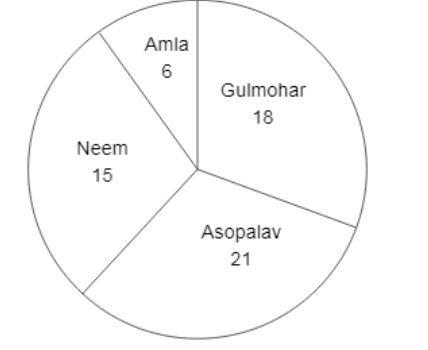
From the above pie chart, we can conclude that
Number of Gulmohar trees planted $ = 18$
Number of Asopalav trees planted $ = 21$
Number of Neem trees planted $ = 15$
Number of Amla trees planted $ = 6$
To find the percentage, we need to find the total number of trees planted. Therefore, the total number of trees planted will be the sum of the number of trees planted in each category.
Number of trees planted in total $ = 18 + 21 + 15 + 6$
$ = 60$
Now, we need to find the percentage of Gulmohar sapling. Therefore, using the formula
% of Gulmohar sapling $ = \dfrac{{{\text{Number of Gulmohar tree planted}}}}{{{\text{Total number of trees planted}}}} \times 100$ , we get
% of Gulmohar sapling $ = \dfrac{{18}}{{60}} \times 100$
Cancelling the common factors and simplify, we get
% of Gulmohar sapling $ = 6 \times 5$
$ = 30\% $
So, $30\%$ of Gulmohar trees were planted.
So, the correct answer is “ $30\% $”.
Note: One may note that, in the similar manner we can find the percentage of other trees planted. There can be another way to find the answer. We can calculate the percentage of trees planted in the other three categories and then take their sum which is then subtracted from $100$ . In this way also we will get the same answer for the Gulmohar tree but the process will be lengther as we would have to calculate the percentage three times.
Complete step-by-step answer:
From the above pie chart, we can conclude that
Number of Gulmohar trees planted $ = 18$
Number of Asopalav trees planted $ = 21$
Number of Neem trees planted $ = 15$
Number of Amla trees planted $ = 6$
To find the percentage, we need to find the total number of trees planted. Therefore, the total number of trees planted will be the sum of the number of trees planted in each category.
Number of trees planted in total $ = 18 + 21 + 15 + 6$
$ = 60$
Now, we need to find the percentage of Gulmohar sapling. Therefore, using the formula
% of Gulmohar sapling $ = \dfrac{{{\text{Number of Gulmohar tree planted}}}}{{{\text{Total number of trees planted}}}} \times 100$ , we get
% of Gulmohar sapling $ = \dfrac{{18}}{{60}} \times 100$
Cancelling the common factors and simplify, we get
% of Gulmohar sapling $ = 6 \times 5$
$ = 30\% $
So, $30\%$ of Gulmohar trees were planted.
So, the correct answer is “ $30\% $”.
Note: One may note that, in the similar manner we can find the percentage of other trees planted. There can be another way to find the answer. We can calculate the percentage of trees planted in the other three categories and then take their sum which is then subtracted from $100$ . In this way also we will get the same answer for the Gulmohar tree but the process will be lengther as we would have to calculate the percentage three times.

Recently Updated Pages
Master Class 12 Economics: Engaging Questions & Answers for Success

Master Class 12 English: Engaging Questions & Answers for Success
Master Class 12 Social Science: Engaging Questions & Answers for Success
Master Class 12 Maths: Engaging Questions & Answers for Success
Master Class 12 Physics: Engaging Questions & Answers for Success
Master Class 9 General Knowledge: Engaging Questions & Answers for Success
Trending doubts
Find the sum of series 1 + 2 + 3 + 4 + 5 + + 100 class 9 maths CBSE
Difference Between Plant Cell and Animal Cell
Fill the blanks with the suitable prepositions 1 The class 9 english CBSE
What is pollution? How many types of pollution? Define it
Name 10 Living and Non living things class 9 biology CBSE
What is the full form of pH?