




What is the percentage of carbon, by wt. in vitamin C ?
Options-
(A) 66.67%
(B) 40.9%
(C) 20%
(D) 60%
Answer
 Verified
576k+ views
Hint: Draw the expanded structure of vitamin C. Calculate the total mass of the compound. Now identify the number of carbon atoms in vitamin C. Calculate their total mass. Now take the ratio of mass of carbon atoms and total mass of compound. Now multiply this with 100 to obtain the correct answer.
Complete answer:
Vitamin C also called as ascorbic acid has the following structure.
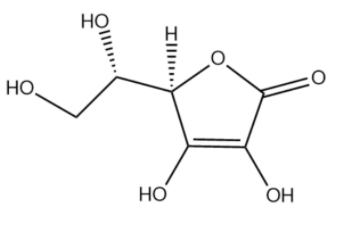
We will now determine the total mass of the above compound.
Total number of carbon atoms = 6
Total number of oxygen atoms = 6
Total number of hydrogen atoms = 8
Mass of 1 carbon atom = 12 g
Mass of 1 oxygen atom = 16 g
Mass of 1 hydrogen atom = 1 g
Total mass of the compound = (6 x 12) + ( 6 x 16) + ( 8 x 1) = 176 g
Mass of carbon atoms = 72 g
The ratio of mass of carbon atoms and total mass of compound gives the value, 0.4099
Hence the percentage of carbon, by wt. in vitamin C is 0.4099 x 100 = 40.9%
Therefore, the correct answer is option (B).
Note:
It is important to know that the structure of ascorbic acid does not have any carboxylic acid group. It is called an acid due to its pH value mainly. One more organic compound like this is picric acid which too is called an acid due to its pH value.
Complete answer:
Vitamin C also called as ascorbic acid has the following structure.
We will now determine the total mass of the above compound.
Total number of carbon atoms = 6
Total number of oxygen atoms = 6
Total number of hydrogen atoms = 8
Mass of 1 carbon atom = 12 g
Mass of 1 oxygen atom = 16 g
Mass of 1 hydrogen atom = 1 g
Total mass of the compound = (6 x 12) + ( 6 x 16) + ( 8 x 1) = 176 g
Mass of carbon atoms = 72 g
The ratio of mass of carbon atoms and total mass of compound gives the value, 0.4099
Hence the percentage of carbon, by wt. in vitamin C is 0.4099 x 100 = 40.9%
Therefore, the correct answer is option (B).
Note:
It is important to know that the structure of ascorbic acid does not have any carboxylic acid group. It is called an acid due to its pH value mainly. One more organic compound like this is picric acid which too is called an acid due to its pH value.
Recently Updated Pages
Master Class 11 Computer Science: Engaging Questions & Answers for Success

Master Class 11 Business Studies: Engaging Questions & Answers for Success
Master Class 11 Economics: Engaging Questions & Answers for Success
Master Class 11 English: Engaging Questions & Answers for Success
Master Class 11 Maths: Engaging Questions & Answers for Success
Master Class 11 Biology: Engaging Questions & Answers for Success
Trending doubts
One Metric ton is equal to kg A 10000 B 1000 C 100 class 11 physics CBSE
There are 720 permutations of the digits 1 2 3 4 5 class 11 maths CBSE
Discuss the various forms of bacteria class 11 biology CBSE
Draw a diagram of a plant cell and label at least eight class 11 biology CBSE
State the laws of reflection of light
Explain zero factorial class 11 maths CBSE