




What percent of water is lost through the respiratory system?
Answer
 Verified
526.8k+ views
Hint: The parts and organs of the body that are responsible for the breathing and the exchange of gases that include oxygen and carbon dioxide together constitute the respiratory system. Here the alimentary canal and the lungs are the important part of the respiratory system and help in the transport of gases.
Complete answer
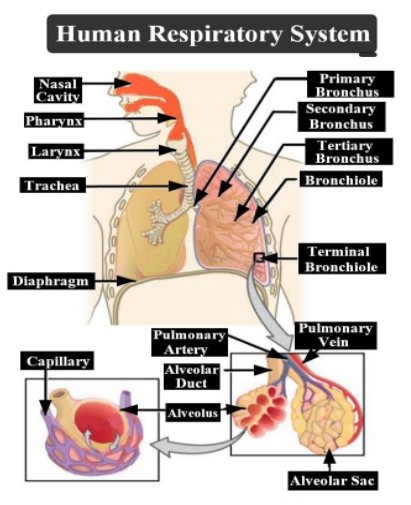
Respiration is a Physico-chemical, and catabolic process. It involves the inhalation of oxygen and exhalation of carbon dioxide and results in the formation of energy. The respiratory system involves the intake of oxygen and the removal of carbon dioxide and water. Air or oxygen is indeed through the nostrils and then the air is carried to the nasal cavity from where it is transferred to the pharynx and the larynx (voice box). The bronchi in the lungs terminate into respiratory alveoli which provides a much larger surface area for respiration than the total skin surface area. The gaseous exchange takes place across the alveolar wall where the oxygen we inhale diffuses to blood and carbon dioxide produced by the cell and carried by the blood is diffused into the alveolar air.
When during the process of respiration we inhale the oxygen it then goes from our nasal cavity to the respiratory tract and then reaches the lungs. While going through these passageways the air gets humidified and when we exhale the air becomes moist. Through the process of respiration via the respiratory tract about 10 to $20\%$ of water is lost. The loss of water depends upon the external temperature and the humidity. It is observed that when the person does exercise then at that time the water lost will be four times more than the water lost in the normal situation through the respiratory system.
Note:
Bronchitis, pneumonia, bronchial asthma, emphysema, etc are the common respiratory disorders while silicosis, common cold, asphyxia, asbestosis, and allergic rhinitis (Hay fever) are the occupational disorders. The major causes of these disorders are smoking tobacco, some allergic substances, and breathing in air pollutants.
Complete answer
Respiration is a Physico-chemical, and catabolic process. It involves the inhalation of oxygen and exhalation of carbon dioxide and results in the formation of energy. The respiratory system involves the intake of oxygen and the removal of carbon dioxide and water. Air or oxygen is indeed through the nostrils and then the air is carried to the nasal cavity from where it is transferred to the pharynx and the larynx (voice box). The bronchi in the lungs terminate into respiratory alveoli which provides a much larger surface area for respiration than the total skin surface area. The gaseous exchange takes place across the alveolar wall where the oxygen we inhale diffuses to blood and carbon dioxide produced by the cell and carried by the blood is diffused into the alveolar air.
When during the process of respiration we inhale the oxygen it then goes from our nasal cavity to the respiratory tract and then reaches the lungs. While going through these passageways the air gets humidified and when we exhale the air becomes moist. Through the process of respiration via the respiratory tract about 10 to $20\%$ of water is lost. The loss of water depends upon the external temperature and the humidity. It is observed that when the person does exercise then at that time the water lost will be four times more than the water lost in the normal situation through the respiratory system.
Note:
Bronchitis, pneumonia, bronchial asthma, emphysema, etc are the common respiratory disorders while silicosis, common cold, asphyxia, asbestosis, and allergic rhinitis (Hay fever) are the occupational disorders. The major causes of these disorders are smoking tobacco, some allergic substances, and breathing in air pollutants.
Recently Updated Pages
Master Class 11 Computer Science: Engaging Questions & Answers for Success

Master Class 11 Business Studies: Engaging Questions & Answers for Success
Master Class 11 Economics: Engaging Questions & Answers for Success
Master Class 11 English: Engaging Questions & Answers for Success
Master Class 11 Maths: Engaging Questions & Answers for Success
Master Class 11 Biology: Engaging Questions & Answers for Success
Trending doubts
One Metric ton is equal to kg A 10000 B 1000 C 100 class 11 physics CBSE
There are 720 permutations of the digits 1 2 3 4 5 class 11 maths CBSE
Discuss the various forms of bacteria class 11 biology CBSE
Draw a diagram of a plant cell and label at least eight class 11 biology CBSE
State the laws of reflection of light
Explain zero factorial class 11 maths CBSE