




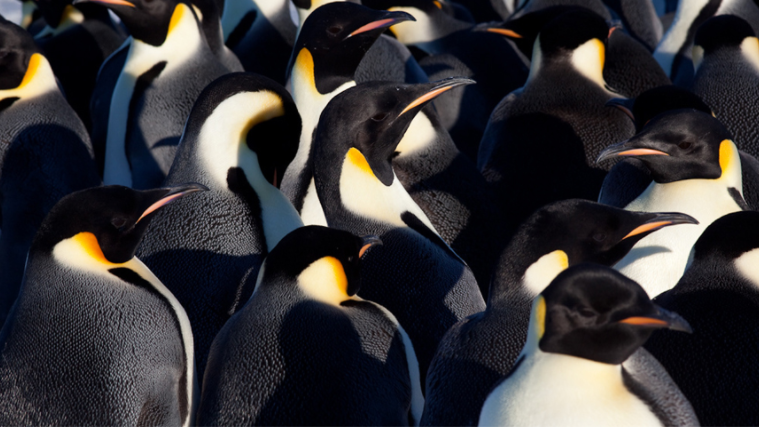
Penguin huddling is the process to withstand the harsh weather of the Antarctic, emperor penguins huddle in groups. Suppose that a penguin is a circular cylinder with a top surface area $a=0.34{{m}^{2}}$ and height $h=1.1m$. Let ${{P}_{r}}$ be the rate at which each penguin will radiate energy to the environment through the top and the sides. Thus $NP$ is the rate at which $N$ similar well separated penguins will radiate. When the penguins huddle coming near to produce a huddled cylinder having a top surface area $Na$ and a height $h$, then the cylinder will be radiating at the rate ${{P}_{h}}$ . When $N=1000$ at what percentage does huddling decrease the total radiation loss?
Answer
 Verified
595.5k+ views
Hint: For each individual penguin the surface area that radiates is the sum of the top surface area and the sides. Find the area of the two cases. The power radiated from the surface will be directly proportional to the surface area. Using this equation, find the total radiation loss up to which can reduce. This will help you in answering this question.
Complete step by step solution:
For each individual penguin the surface area that radiates is the sum of the top surface area and the sides. That is we can write that,
${{A}_{r}}=a+2\pi rh$
As the area of the surface can be written as,
$\begin{align}
& a=\pi {{r}^{2}} \\
& \Rightarrow r=\sqrt{\dfrac{a}{\pi }} \\
\end{align}$
Substituting this in the equation will give,
\[\begin{align}
& {{A}_{r}}=a+2\pi \sqrt{\dfrac{a}{\pi }}h \\
& \Rightarrow {{A}_{r}}=a+2h\sqrt{a\pi } \\
\end{align}\]
For the huddled cylinder the radius can be represented as \[{r}'\].
This can be indicated as,
\[\begin{align}
& Na=\pi {{{{r}'}}^{2}} \\
& \Rightarrow {r}'=\sqrt{\dfrac{Na}{\pi }} \\
\end{align}\]
Therefore the area of the huddled cylinder will be,
\[\begin{align}
& {{A}_{h}}=Na+2\pi {r}'h \\
& \Rightarrow {{A}_{h}}=Na+2\pi \sqrt{\dfrac{Na}{\pi }}h \\
& \therefore {{A}_{h}}=Na+2h\sqrt{Na\pi } \\
\end{align}\]
As we all know, the power radiated from the surface will be directly proportional to the surface area. Therefore we can write that,
\[\dfrac{{{P}_{h}}}{N{{P}_{r}}}=\dfrac{{{A}_{h}}}{N{{A}_{r}}}\]
Substituting the values in the equation can be written as,
\[\begin{align}
& \dfrac{{{P}_{h}}}{N{{P}_{r}}}=\dfrac{Na+2h\sqrt{Na\pi }}{N\left( a+2h\sqrt{a\pi } \right)} \\
& \Rightarrow \dfrac{{{P}_{h}}}{N{{P}_{r}}}=\dfrac{1+2h\sqrt{\dfrac{\pi }{Na}}}{1+2h\sqrt{\dfrac{\pi }{a}}} \\
\end{align}\]
As already mentioned in the question, we can write that,
\[\begin{align}
& N=1000 \\
& a=0.34{{m}^{2}} \\
& h=1.1m \\
\end{align}\]
Substituting this in the equation will be,
\[\dfrac{{{P}_{h}}}{N{{P}_{r}}}=\dfrac{1+2\left( 1.1 \right)\sqrt{\dfrac{\pi }{1000\left( 0.34 \right)}}}{1+2\left( 1.1 \right)\sqrt{\dfrac{\pi }{0.34}}}=0.16\]
That is,
\[\dfrac{{{P}_{h}}}{N{{P}_{r}}}=0.16\]
Therefore the total radiation loss can be reduced by the value found to be as,
\[1-0.16=0.84\]
That is by \[84\]percentage.
Hence the answer for the question has been calculated.
Note:
The power can be defined as the amount of the energy lost or achieved in a particular period of time. The power can represent the ability of a body or a surface in order to perform a work or to transfer the heat. The unit of power is watt.
Complete step by step solution:
For each individual penguin the surface area that radiates is the sum of the top surface area and the sides. That is we can write that,
${{A}_{r}}=a+2\pi rh$
As the area of the surface can be written as,
$\begin{align}
& a=\pi {{r}^{2}} \\
& \Rightarrow r=\sqrt{\dfrac{a}{\pi }} \\
\end{align}$
Substituting this in the equation will give,
\[\begin{align}
& {{A}_{r}}=a+2\pi \sqrt{\dfrac{a}{\pi }}h \\
& \Rightarrow {{A}_{r}}=a+2h\sqrt{a\pi } \\
\end{align}\]
For the huddled cylinder the radius can be represented as \[{r}'\].
This can be indicated as,
\[\begin{align}
& Na=\pi {{{{r}'}}^{2}} \\
& \Rightarrow {r}'=\sqrt{\dfrac{Na}{\pi }} \\
\end{align}\]
Therefore the area of the huddled cylinder will be,
\[\begin{align}
& {{A}_{h}}=Na+2\pi {r}'h \\
& \Rightarrow {{A}_{h}}=Na+2\pi \sqrt{\dfrac{Na}{\pi }}h \\
& \therefore {{A}_{h}}=Na+2h\sqrt{Na\pi } \\
\end{align}\]
As we all know, the power radiated from the surface will be directly proportional to the surface area. Therefore we can write that,
\[\dfrac{{{P}_{h}}}{N{{P}_{r}}}=\dfrac{{{A}_{h}}}{N{{A}_{r}}}\]
Substituting the values in the equation can be written as,
\[\begin{align}
& \dfrac{{{P}_{h}}}{N{{P}_{r}}}=\dfrac{Na+2h\sqrt{Na\pi }}{N\left( a+2h\sqrt{a\pi } \right)} \\
& \Rightarrow \dfrac{{{P}_{h}}}{N{{P}_{r}}}=\dfrac{1+2h\sqrt{\dfrac{\pi }{Na}}}{1+2h\sqrt{\dfrac{\pi }{a}}} \\
\end{align}\]
As already mentioned in the question, we can write that,
\[\begin{align}
& N=1000 \\
& a=0.34{{m}^{2}} \\
& h=1.1m \\
\end{align}\]
Substituting this in the equation will be,
\[\dfrac{{{P}_{h}}}{N{{P}_{r}}}=\dfrac{1+2\left( 1.1 \right)\sqrt{\dfrac{\pi }{1000\left( 0.34 \right)}}}{1+2\left( 1.1 \right)\sqrt{\dfrac{\pi }{0.34}}}=0.16\]
That is,
\[\dfrac{{{P}_{h}}}{N{{P}_{r}}}=0.16\]
Therefore the total radiation loss can be reduced by the value found to be as,
\[1-0.16=0.84\]
That is by \[84\]percentage.
Hence the answer for the question has been calculated.
Note:
The power can be defined as the amount of the energy lost or achieved in a particular period of time. The power can represent the ability of a body or a surface in order to perform a work or to transfer the heat. The unit of power is watt.
Recently Updated Pages
Master Class 11 Economics: Engaging Questions & Answers for Success

Master Class 11 English: Engaging Questions & Answers for Success
Master Class 11 Maths: Engaging Questions & Answers for Success
Class 11 Question and Answer - Your Ultimate Solutions Guide
Master Class 11 Social Science: Engaging Questions & Answers for Success
Master Class 11 Business Studies: Engaging Questions & Answers for Success
Trending doubts
Differentiate between an exothermic and an endothermic class 11 chemistry CBSE
One Metric ton is equal to kg A 10000 B 1000 C 100 class 11 physics CBSE
There are 720 permutations of the digits 1 2 3 4 5 class 11 maths CBSE
In what year Guru Nanak Dev ji was born A15 April 1469 class 11 social science CBSE
Difference Between Prokaryotic Cells and Eukaryotic Cells
Draw a diagram of a plant cell and label at least eight class 11 biology CBSE